
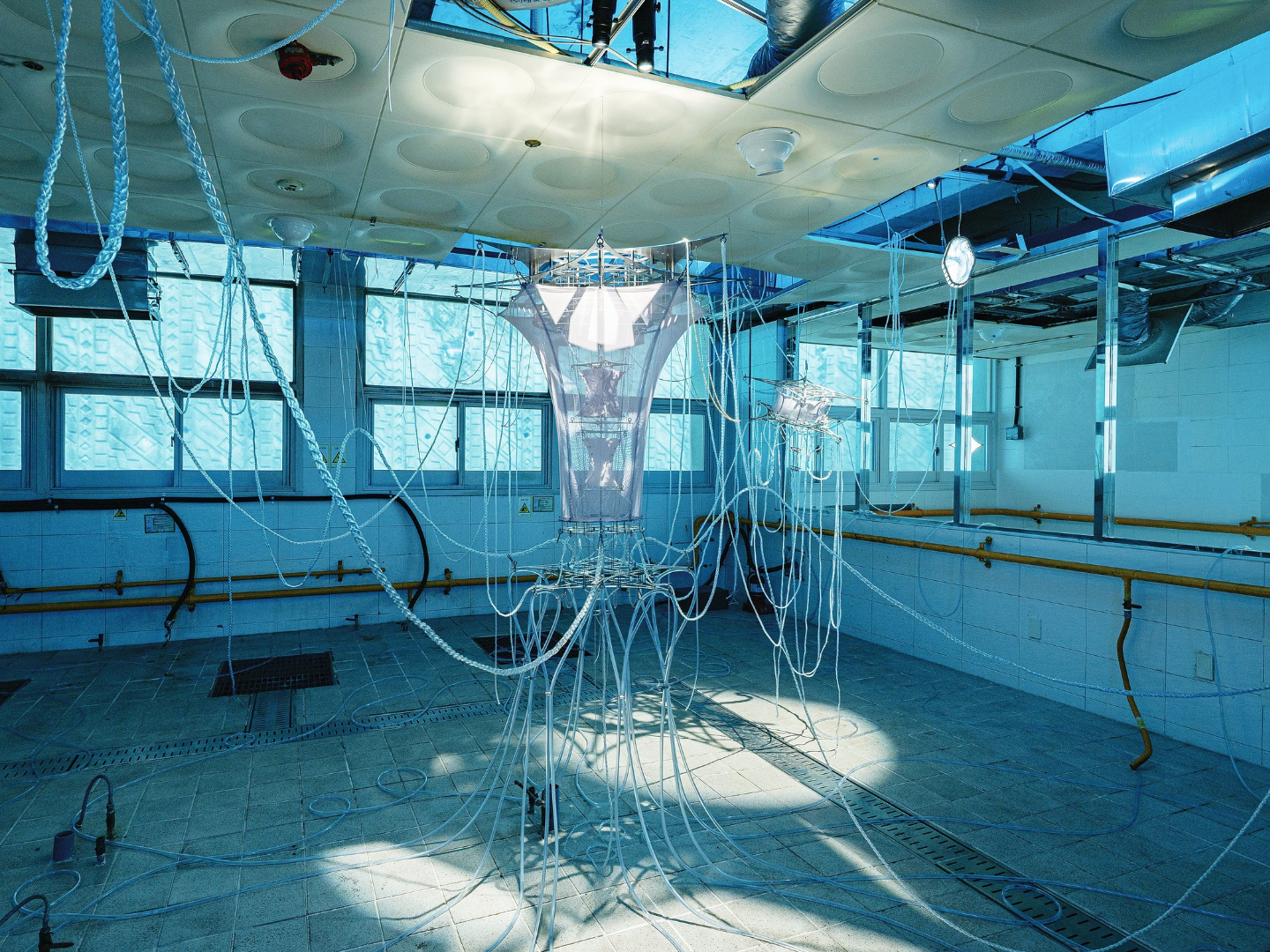
As Long as We Look at the Night Sky by Park Hyunsung (All photos: Busan Biennale)
Before language, there was only sound. The cacophony that resisted containment, piercing through the air and across seas, would eventually birth the ways we communicate and persevere. Those we have come to normalise — the terminology we accept, songs allowed to play uncensored, messaging transmitted without prior sanitisation — decide what stories are memorialised and how they are conveyed.
Yet, verbal and sonic reverberations are forever the first step to sparking discourse and creating enduring resonance. In South Korea, a country whose rich and complex history is punctuated by movements and resistance, the principal port city of Busan is widely seen and studied as a nucleus of tenacity, defiance and renewal.
The metropolis’ geography and maritime history was the simultaneous root of the area’s prosperity and platform for its greatest traumas. Its harbours and shores that enabled booming trade were also the locations for colonial pleasure quarters, detainment centres for Joseon Women’s Volunteer Labour Corps, and the birthplace of countless protest, work and shamanic songs that are hummed to this day. Just as how drops of water make an ocean, Busan has always understood the power of making noise and doing it together.
Honouring this history, the Busan Biennale 2026’s artistic directors Evelyn Simons and Amal Khalaf chose to ponder on the theme “Dissident Chorus” — a dive into the frequencies that have been blotted out from records or diluted into footnotes, an invitation to uncover unarticulated perspectives, underground cultures and non-conformist retellings. This year’s edition is held across the Busan Museum of Contemporary Art, Space OneZ and the former Busan Nam High School until Nov 1, with 46 participating artists from 22 countries whose standalone works come together to make a statement bigger than themselves.
5.png
Speaking up
In 2011, welder and labour activist Kim Jin-suk famously occupied a 35m-high crane in the Busan port for 309 days in protest against worker lay-offs by her anti-union employer. People on the ground joined her, turning her solitary act into a collective movement, demonstrating the power of a single voice as well as the impact of banding together against hardship and injustice.
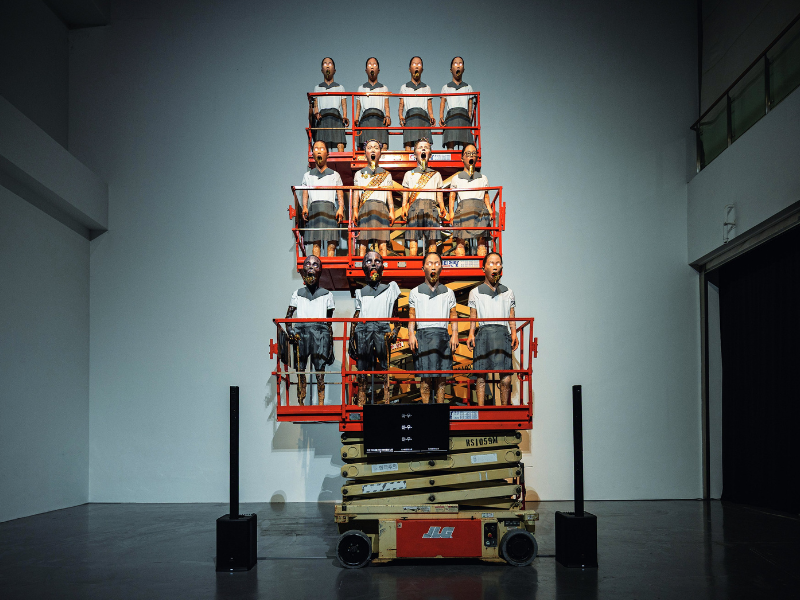
Suspended on static scissor lifts, mouths open in perpetual song, the 12 protagonists of Ryu Sungsil’s Ten Thousand Dreams at the Busan Museum of Contemporary Art paints an eerier but similar picture. Fan motors behind each head switch on and off, fluttering the metallic streamers attached to oral cavities so you know which dolls are “vocalising” at any given moment. Their 15-minute performance tells the plight of South Korea’s aspiration towards globalisation. The country’s lack of natural resources made people its greatest capital. Youths are urged to return to their homeland post-travels and education to pour their skills back into the coutry, and elders are pushed to contribute well into old age. To imagine a dream that diverges from the collective one of production and development is to bring shame and destitution to one’s family, friends and countrymen.
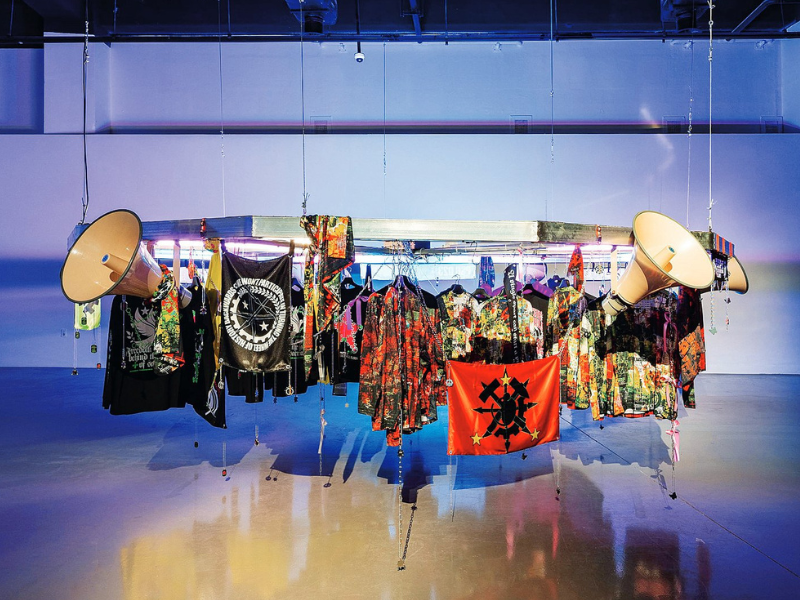
Throughout the exhibitions, sound’s role as a tool for objection rings loud. Thai artist Tanat Teeradakorn’s memorabilia chandelier encapsulates the visual elements commonly seen at public demonstrations — neon T-shirts emblazoned with graphics, horn speakers, printed banners and ribbons, and strobe lights. A soundtrack, anchored by three songs, questions how music — especially after undergoing reproduction and cultural transformation — resonates with those who circulate it. These same tunes can become devices of suppression and state control, their initial content perverted by parties who use them as agents of division instead of solidarity.
4.png
More than just a rousing tactic for those fighting for a better way of life, sound remembers the disappeared and silenced. Mira M Yang’s kinetic samulnori quartet not only references the shamanic natural elements that lie at the heart of Korean culture and spiritualism, but also the instruments’ legacy in the country’s pro-democracy movements of the 1980s. Meanwhile, Zahra Malkani invites visitors to perch on a swing fashioned from shipyard scrap metal acquired in Karachi, Pakistan, while they digest a 20-minute reel of mothers immortalising those who have been killed, an activist reminiscing on her disappeared father’s passion for music, and a doctor who sings a hymn taught by her insurgent mother.
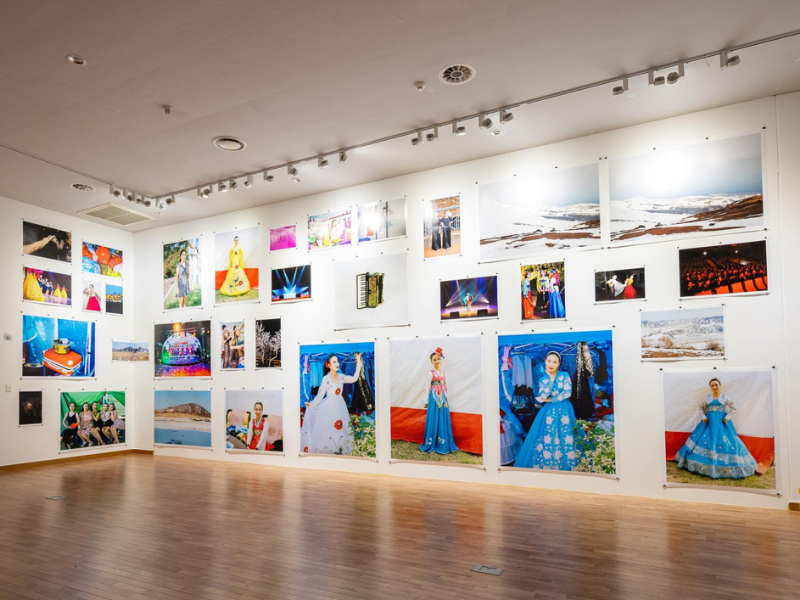
Music gives shape and establishment to those petitioning for selfhood, underscoring autonomy over an individual’s own life. For example, we look at the North Korean defectors and performers photographed in Lee Dong-Keun’s In The Spotlight — Arirang Performance Group. Despite the colourful hanbok they don for the audience, the border-dwelling group does not fully belong to any state. Yet, in the ordinary moments that exist backstage, the political symbolism that follows them in the public eye fades, and their unique experiences with displacement, resilience and resourcefulness are offered permanence and visibility that extend beyond the ephemeral performance.
1.png
Tidal wave
As a port city, Busan’s history is one of prosperity and development as much as of pain and violence. Along Bongnae-dong, Yeongdo, an old maritime warehouse has been converted into Space OneZ — a multipurpose building where a now-eroded interior that stored shipping equipment in a past life becomes the prime location to reflect on the sea as not only the site of oppression but also a symbol of endurance.
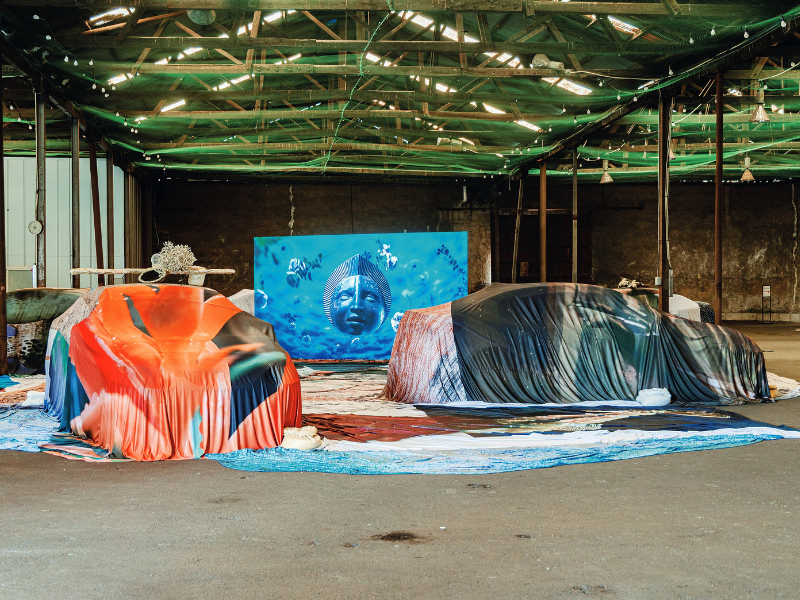
Julien Creuzet’s installation centres around the film Zumbi Zumbi Eterno, which tells the story of the rebel leader Zumbi dos Palmares, who fought against colonialism in Brazil and was eventually betrayed and executed. Here, water is an avenue for memory, grief and ancestral connection. Zumbi’s spirit traverses the depths, where countless enslaved Africans on the Middle Passage were brutalised, abused and thrown overboard by their captors. The puffer fish and devil’s trumpet flower, whose respective toxins have paralysing and hallucinogenic properties, symbolise a state of limbo in which most can only pray for miraculous escape or the mercy of death. Seven cars, wrapped in printed fabrics but still distinguishable in shape, surround the screen like ghostly sea creatures.
Even with its darker stories, the sea holds endless epiphanies, both scientifically and spiritually. Fitting for a space where the mundane and oceanic exist in tandem, Brazilian artist Jota Mombaça’s soundscape and fabric draping transform a nook of the warehouse into a sort of oracle. A mystical indigo hue, the colour of higher awareness, invites you through a small rectangular entryway. Recordings of underwater noises, mixed with the vocal responses of the Yeongdo-gu Women’s Choir and Poema Artcenter, echo throughout the pocket. Surrounded by ripples of textiles dyed in seawater and the chant of waves, you begin to experience the psychological sensation of being submerged without the fear of drowning arrives, enabling you to tune into what the ocean has to say.
And like a tide gradually climbing the shore and building with each crest, a collective force emerges when people with the same lived experiences band together. Nineteen custom-built speakers, each playing a separate voice, give musical form to a poem in English, French and Portuguese. Imagined by Belgian creative Brahim Tall, The Choir of Dissonance: The Creation of the Sea focuses on the importance and beauty of the individual interpretation as each singer improvises the same song; when they come together to utter the same lyric, the harmonies swell and become something greater than any one person alone. As the audience walks about, turning an ear to each input, their presence — their role as the listener to these narratives — becomes an integral part of the exhibit.
3.png
Recollections + ruminations
What is transferred from speaker to listener, friend to friend, one generation to the next, determines what retained in collective memory. Like in a game of Telephone or Chinese Whispers, the material that makes it through each handover has the potential to get diluted or completely morphed based on selective storytelling and imperfect memory. One of the earliest places where the common cache is moulded is school, where adults and children alike believe textbooks and teachers are bound to tell the truth.
From the outside, the former Busan Nam High School may appear as an empty shell, but its hallways and classrooms carry 70 years of student and staff history. For this year’s biennale, the institute’s rooms and grounds — a genre of space associated with education, discipline, homogenisation and propaganda — transform into a series of miniature galleries holding space for the topics that are too often drowned out of popular circulation or conveyed through hushed whispers.
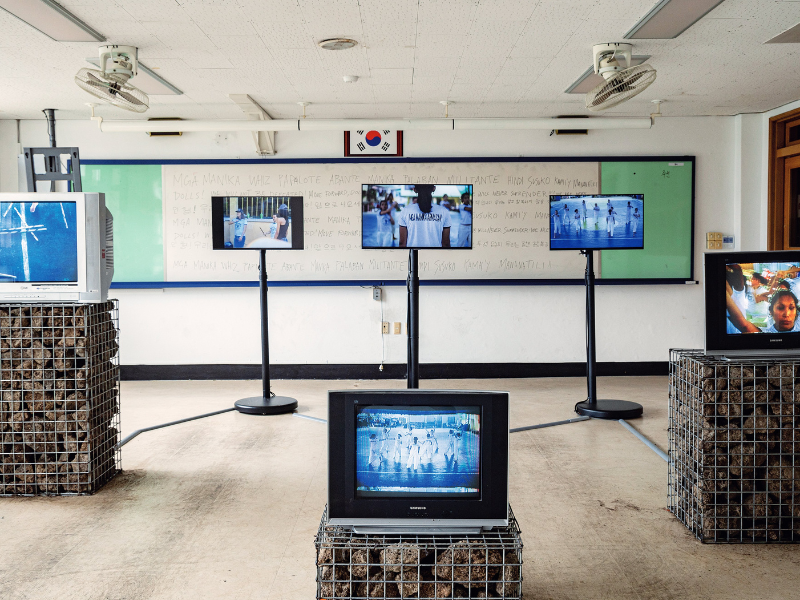
Across several classrooms and corridors that feed into each other, Learning to Dance in Flames by Bhenji Ra unfolds as a 31-channel video oeuvre where queer and indigenous communities become the custodians and guides of a unique way of life. Adorning a classroom wall is a map tracing the footsteps of a chosen family spread out across the globe, and the multiple screens that follow it bring the viewer into dynamics, realities and aspirations that are not usually given a platform in the mainstream cultural zeitgeist. Fire, symbolising destruction and rebirth, is consistently evoked as digital renderings as well as a series of volcanic rock mounds.
Though the issue of sidelining underprivileged groups cannot be overlooked, where history records and books draw blanks lies room for imagination. Natasha Tontey’s film may be set during the Cold War era, but rather than a factual tell-all, it fantasises about the accounts that have predominantly been left out of official archives, with an emphasis on the feminine experience. Applying dance, rhythm and breath, the video shows a fictional female fighter preparing to undertake a ritual. Each scene more surreal than the last, it culminates in the heroine riding a bullet as it hurtles through the night sky.
2.png
Leftover sentiments from the same historic chapter conjure up something equally fantastical and frightening in the classroom restyled by Jantsankhorol Erdenebayar. Arranged neatly as if awaiting eager students are 14 monstrous chairs reupholstered with a variety of wood, metal, faux fur and other found trinkets. The resilience of the artist’s fellow Mongolian countrymen is told through one of the seats and a sound recording, both sourced from a market in Ulaanbaatar. Horns jut out from the chalkboard at the front of the room, as if to command attention and authority over its charges, drawing parallels to the Mongolian educational system where the Soviet Union had sunk its claws deep.
During the biennale’s opening weekend, a head-to-toe silver-painted Joshua Serafin became a medium for generations of ancestral trauma in Relics: An Eye Once Blind. Hoisting a coil of LED lights, the multidisciplinary artist seemed to enter a trance-like state, grappling and dancing with the illumination as choreography and soundscapes traced the forgotten stories of Japanese-Filipino migration in the 20th century. As a finale, the performer exited stage left, trudging into a dense plane of grass as the radiant ribbon trailed in his wake, an eternal thread to his lineage and a glaring reminder of the journeys championed by those who came before.
Still, to dream up abandoned school grounds as something beyond their original intention — the very thing the biennale does at this final venue — brings us closer than ever to the academy’s core purpose: to nurture and unleash the youth’s potential. Washing the former kitchen in a cold blue tone, Park Hyunsung plants the seeds of creativity that transcends the familiar tiled walls. Suspended sculptures, attached hoses reaching out in every direction like curious tentacles or carving waterways, exist between sleep and wakefulness where dreams merge with reality. The mind begins to wonder how abandoned facilities can go on to foster all kinds of life, even when traces of their mundane past have faded into distant memory.
This article first appeared on Oct 5, 2026 in The Edge Malaysia.