
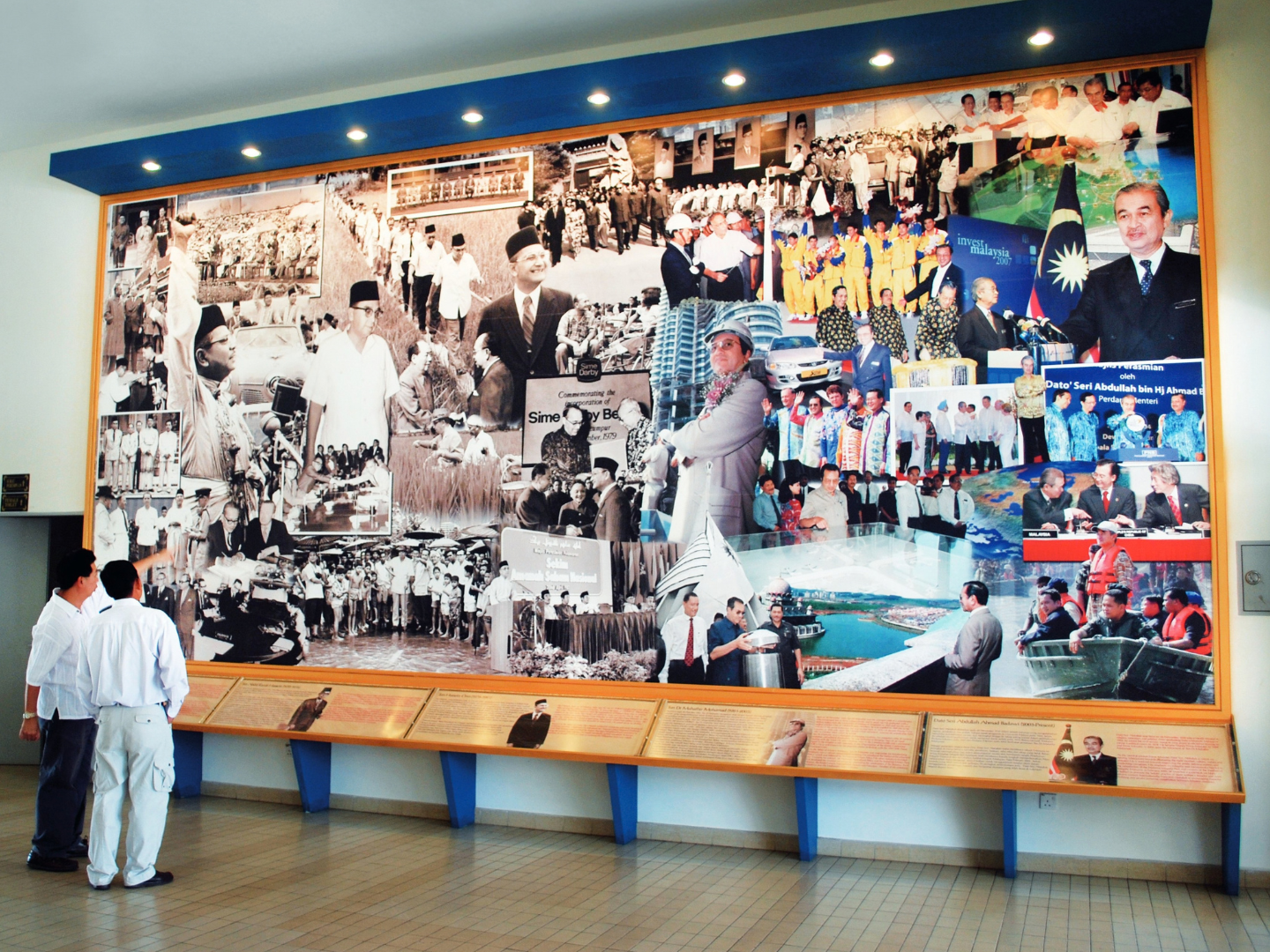
The mural at Stadium Merdeka’s foyer (Photo: Canvas Art)
Of all the photo restorations Lim Sheng Feiyan — who goes by Faye — undertook alongside her late father, Robert Lim Fung Wang, the publication Tunku: Prince of Peace stands out as a watershed moment. Dedicated to Tunku Abdul Rahman Putra Al-Haj, Malaysia’s Father of Independence, the book drew on a rich trove of old images and quotations sourced from the National Archives, including rare materials dating back to the 1940s. Their mission was to recover what time and neglect had eroded, enabling a new generation to see more vividly the pivotal milestones that charted the nation’s development.
“What I remember most was how intentional he [Robert] was about the narrative,” says Faye. “He didn’t just want readers to admire the visuals on the surface, but also understand the wisdom and context behind their significance.”
Robert therefore paired them with the former prime minister’s own remarks on unity, peace and leadership. “They were his thoughts and reflections on the homeland he helped build. My father really wanted everyone to hold on to those words.”
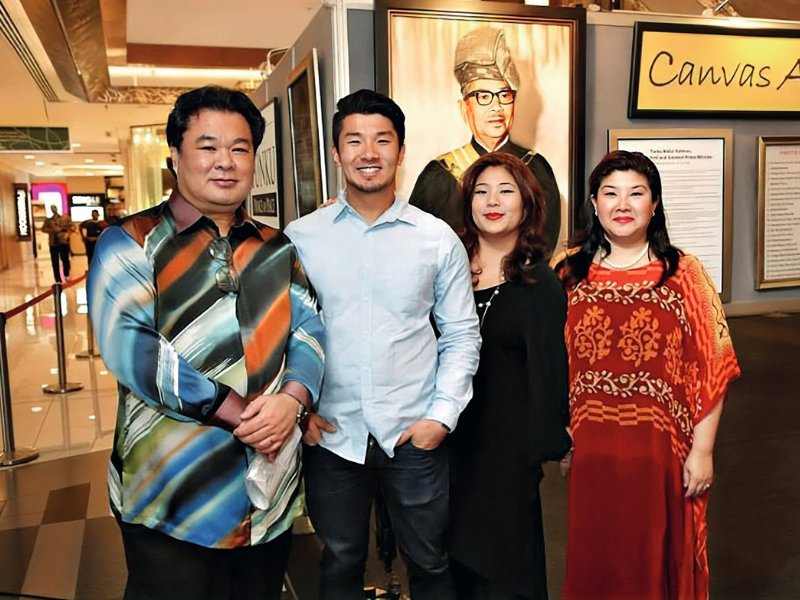
That reverence for historical fidelity and personal chronicles underpinned Canvas Art, the studio Robert founded with his wife, Chew Mann Lin, in 2000. Operating out of Petaling Jaya, Selangor, the modest enterprise grew from salvaging silvering family heirlooms to being tasked with high-profile commissions, from sprawling murals to memorabilia for heritage sites. Though trained in accounting, he yielded to a lifelong fascination with Malaysia’s past, devoting two decades to documenting the legacies of royal houses and ministers, as well as the country’s diplomatic ties with China.
Observing him in action impressed upon Faye that their profession was never merely about rendering the aged presentable again but allowing others to reconnect with what came before. Just as firmly ingrained was another of his rules: Always finish what you start.
4.png
Past Continuous
Before Faye came to inherit Canvas Art, it was simply an everyday fixture of her childhood. From the age of eight, afternoons after the bell at SK Taman Megah meant heading straight — still in school uniform — to the family office in Taman Mayang, settling into a corner while the production floor hummed around her. She listened as staff fielded last-minute changes or technical snags, but paid closest attention to her father, who had an instinctive ability to take in a raw draft at a glance and envision its final form. No less inspiring was his willingness to pass that eye on, patiently showing others how to see a problem through rather than guarding the expertise for himself.
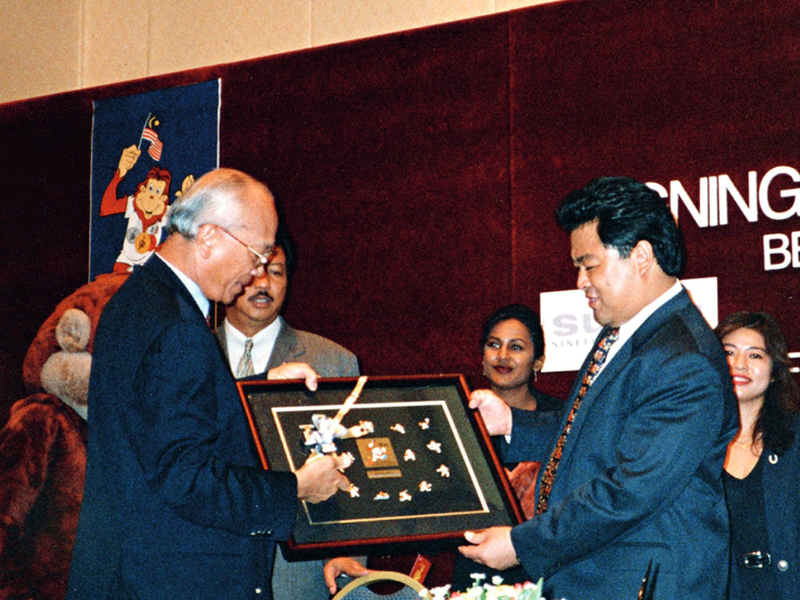
Faye’s front-row vantage of the studio revealed a purpose beyond that of a local workshop. A defining episode was its involvement in the 1998 Commonwealth Games, for which it created 15 limited-edition canvas prints sold to the public as part of an official fundraising campaign. Each set was accompanied by a certificate of authenticity signed by then prime minister Tun Dr Mahathir Mohamad. That gesture — a niche trade entrusted with marking an occasion the nation deemed worth commemorating — suggested that scale and consequence are not always measured by size.
Even decades on, the insistence on uncompromising quality still guides the company, with every job treated as an individual diagnostic challenge. The “forensic” process begins with high-resolution digitisation before the team moves into what Faye calls “digital surgery”, reconstructing lost areas fragment by fragment. Faces take precedence. If part of one has disappeared, another picture of the person — ideally taken from a similar angle — may be used as a reference, while clothing, proportions and surrounding clues determine what belongs.
“It’s not about replicating a version that looks good,” she says. “The outcome has to be recognisably the same and fit naturally within the image.”
This is also where technology runs up against its limits and stops short at the threshold of empathy. Although artificial intelligence can handle some of the heavy lifting, Faye is reluctant to outsource the soul of the craft; no automated fixes or colour filter can replace human judgement. “They can assist, but you still need patience and, honestly, a lot of heart to sit with one photograph and iron out all those tedious, minute details.”
Margin for interpretation, nonetheless, narrows considerably when the subject enters the public record, requiring a fundamentally different ethic.
“Our role is not to add to the history but stay faithful to what is already there,” Faye explains. Damaged or obscured elements can be carefully repaired, but the people and setting are not open to revision. Private keepsakes or mementos, by contrast, permit more freedom: a couple might be isolated from a larger group, or separate portraits brought together into a three-generation composition.
“In those cases, we can customise a piece to create something meaningful. The responsibility is to always be clear about the kind of intervention we’re making.”
3.png
For years, Faye could test those finer points of discernment against her father’s experience. That changed in August 2022, when Robert passed away, followed just five months later by her mother.
Today, though the workbenches are noticeably quieter, she carries on with the same commitment her parents brought to every story placed in Canvas Art’s care.
“They each left me with very different lessons,” she adds. In 2023, Faye secured a grant from Yayasan Hasanah for Stories Behind Old Photographs, an exhibition she was preparing even as her mother’s health declined. Overwhelmed by the circumstances, she considered putting it on hold. The indomitable matriarch, however, was having none of it.
“Being the strong Nyonya woman that she was, she literally slammed her hands on the hospital bed and said, ‘Don’t you dare quit! You’re prohibited from coming to see me until you complete this!’ That was her. Tough love.”
Heartbroken yet galvanised, Faye resolved to push ahead with the showcase. On opening day, Chew watched her daughter’s launch address via Instagram Live, before warm messages from attendees began pouring in.
“Even while battling cancer, she was still checking on me. When I finally visited her, she looked up, raised her hand and said: ‘Praise God! Well done, Feiyan! I bless you! I bless you!’” Two days later, she was gone.
2.png
Long exposure
Taking the reins has not only compelled Faye to determine which practices should remain intact, but also what can be adapted while leaving her imprint. Canvas Art may still be grounded in the principles established by her parents, but under her direction, its scope has widened to encompass cultural programmes and direct engagement with indigenous groups, craftspeople and the youth. Its impact now extends well beyond the physical frame, using heritage as an active bridge across generational and cultural divides — most perceptibly through her social enterprise TRP Creatives, whose flagship initiative, The Rojak Projek, celebrates diversity through art, food and culture.
“After I lost my father, one of the things I feared most was, ‘What if one day I forget what he sounded like?’” she recalls. “I was incredibly grateful that he had been involved in one of my projects under The Rojak Projek, where he spoke about friendship and unity. I still have that recording.
“Sometimes I listen to it and it makes me smile or laugh, because I don’t just remember the words; I hear his voice, manner of speaking and personality. It brings something back to life in a way that a photograph alone cannot.”
The precious audio was a small but lasting reminder that memory could reside in more than what was visible.
“If you could hear the voice of your elders once more, why wouldn’t you? Moving into filmmaking was a natural extension of what we had already been doing through restoration. We can better understand how our forefathers lived as well as what they loved and believed in. Their stories remain alive for future generations to encounter and relate to. Because when a person is gone, we don’t just lose an individual, we lose an entire body of knowledge.”
1.png
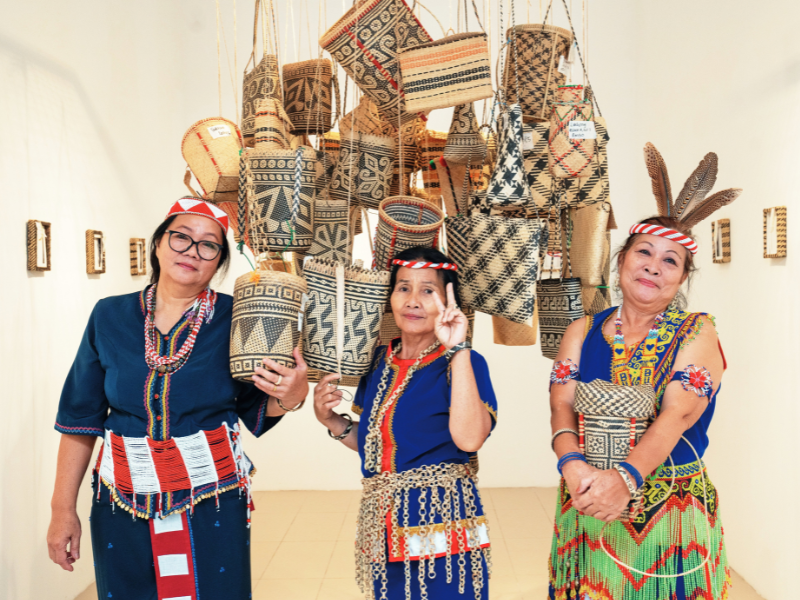
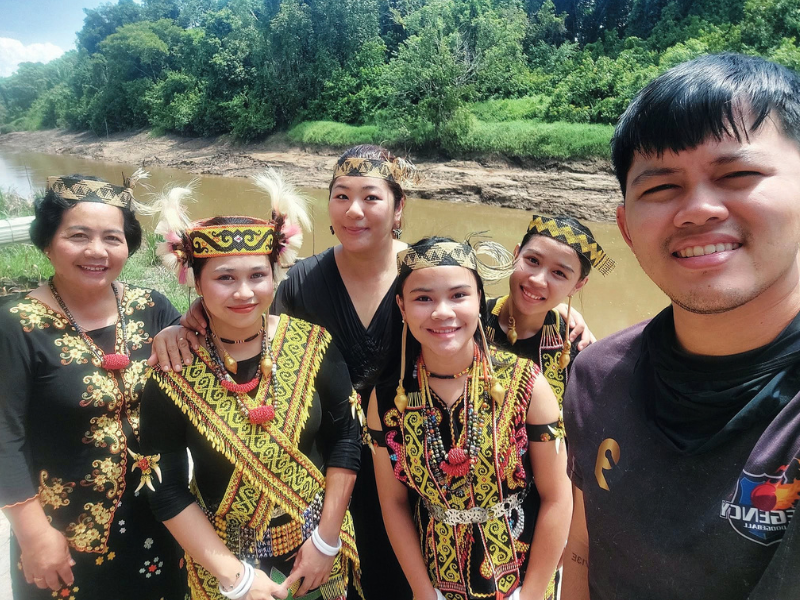
For Faye, the expansion also unveils a systemic blind spot in the chronicling of history, which tends to prioritise monuments, headlines and prominent figures. Her research increasingly addresses this omission, shifting the focus to the vulnerable, unwritten traditions that shape communities from within. Travelling across the country, including a recent trip to Sarawak, only reinforced that belief as she discovered groups whose rituals, skills and ways of life rarely enter mainstream discourse. Often, what is at risk is not an object at all, but a technique passed from hand to hand, a folklore transmitted orally or an ancestral dish no one knows how to prepare anymore.
National identity, in her opinion, is far too nuanced and multifaceted to be contained by bureaucratic labels. “We have more than 250 ethnic and sub-ethnic communities, many of which are categorised under ‘Dan Lain-lain’. Malaysia is a tapestry of distinct cultures, languages and customs. We hope to impart something that sparks curiosity, so people can revisit their lineage with pride and recognise the value in what they carry, however small or overlooked they may seem. Heritage isn’t only what is bestowed upon us, but also what we choose to protect and pass on. That, to me, is the art of service: less of us, more of them — their voices and their truths.”
Looking ahead, Canvas Art seems to be transitioning from a standalone entity into a collaborative, digital treasury for the subtle, everyday traces of society that might otherwise slip from view.
“Pursuing what my parents built has been intertwined with my journey through grief because the company carries their good name as well as their values,” Faye reflects. “Sometimes, continuing their work feels like a privilege; at other times, it brings the ache of wishing they were still here to see where it has gone. But over time, I’ve learnt that honouring them doesn’t mean remaining in that sorrow or loss.
“Their legacy does not have to be a museum piece. It should evolve, remain relevant and serve those who come after us. I hope I’ll have the courage to take it somewhere they may never have imagined.”
This article first appeared on Sept 14, 2026 in The Edge Malaysia.