
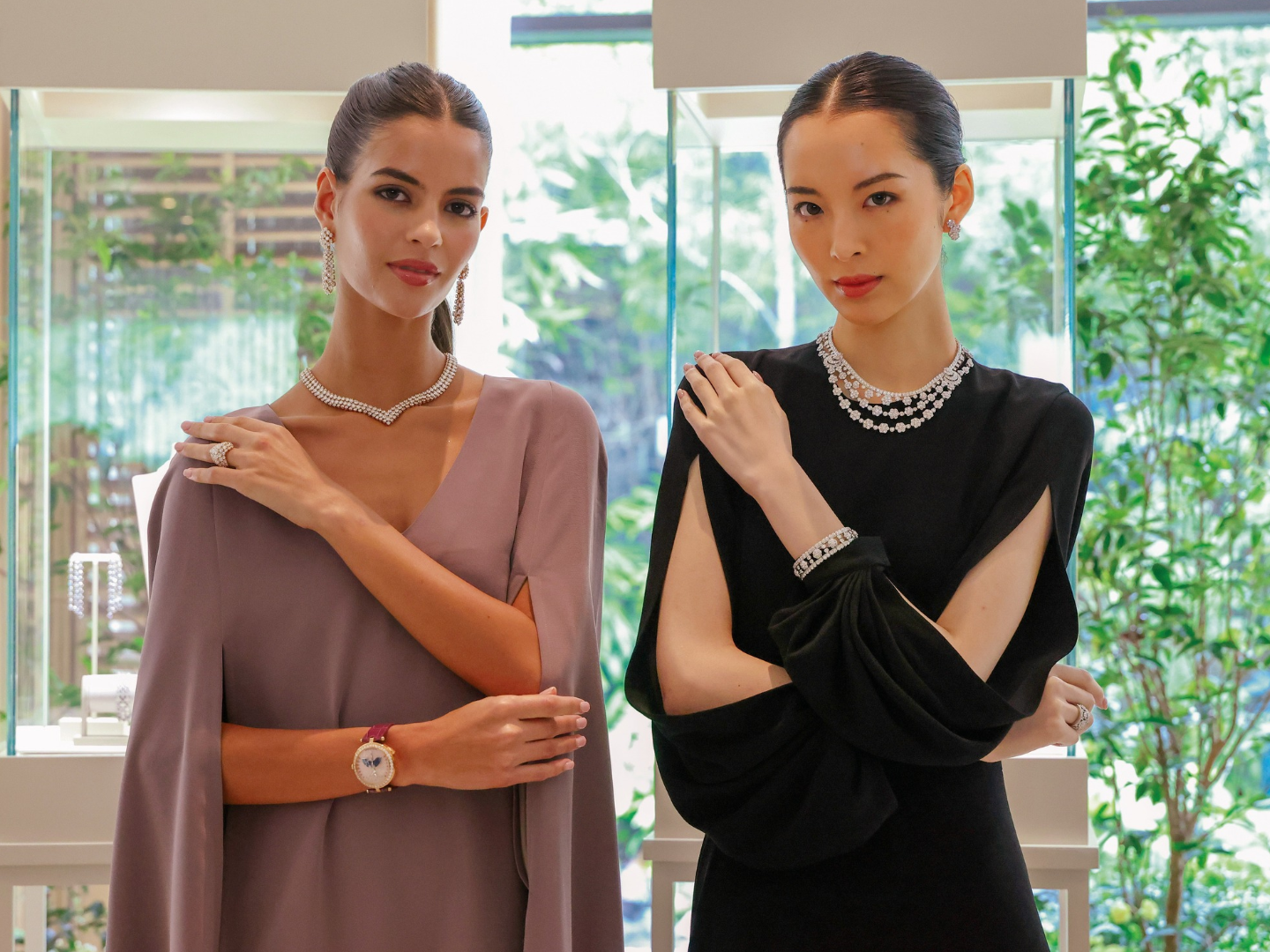
Models donning transformable pieces from the À Cheval (left) and Snowflake lines (All photos: Low Yen Yeing/The Edge)
Age is not just a number. From vintage wines to cars and antiques, it provides essential context — and rocks and minerals are no exception. According to the Gemological Institute of America and modern geochronology, diamonds are vastly older than mankind itself. To put this into perspective, the oldest examples that have been studied were forming around a billion years before our atmosphere became oxygenated. In fact, one can step into a reputable jewellery store knowing that every natural diamond glittering beneath the glass predates the extinction of the dinosaurs 66 million years ago.
Although diamonds are commonly associated with regions like India, Brazil, Russia or Botswana, these areas abound with mines for a deeper reason. Once upon a time, their unique geology enabled the precise conditions needed for the minerals, which are formed deep within the Earth’s mantle, to survive the oxidising environments of kimberlite eruptions that delivered them to the surface.
In early history, while the stone’s rarity alone inspired desire, it was its indestructible nature that truly captivated civilisation. Diamonds were venerated for their invincibility, standing as sacred talismans and emblems of authority. While we have the Mohs scale to inform us of its hardness today, ancient Hindus once viewed these unyielding gems as fragments of a thunderbolt, forged when lightning struck stone, while the Greeks and Romans believed they were frozen tears shed by gods or pieces of broken, falling stars.
Over time, the diamond’s cultural influence expanded. Once symbolising divinity and sovereign power, it is now known as the ultimate token of romance and a staple of fine jewellery. Modern technology also revolutionised the craft surrounding it, reshaping the natural octahedral and macle structures into faceted cuts that enhance brilliance and fire.
body_photo_-_2026-11-18t223945.047.png
All that glitters
At Van Cleef & Arpels (VCA), diamonds have been at the forefront of its exquisite creations since it was founded 120 years ago. Its archives reveal bijouterie born of the Belle Époque era, which centred on naturalism. Pavéd birds were captured mid-flight, while sparkling corollas bloomed within precious bouquets. During the golden age of cinema, elaborate jewellery — from sumptuous necklaces to dress clips — shone radiantly on Hollywood’s silver screen. By the 1980s, the maison had turned its gaze toward the world of couture, translating the graceful movement of ribbons and bows into bejewelled finery.
The essence of VCA is articulated across six high jewellery lines, each embodying its core signatures of transformable designs, gossamer settings, vibrant gemstone harmonies and expressive figurative motifs.
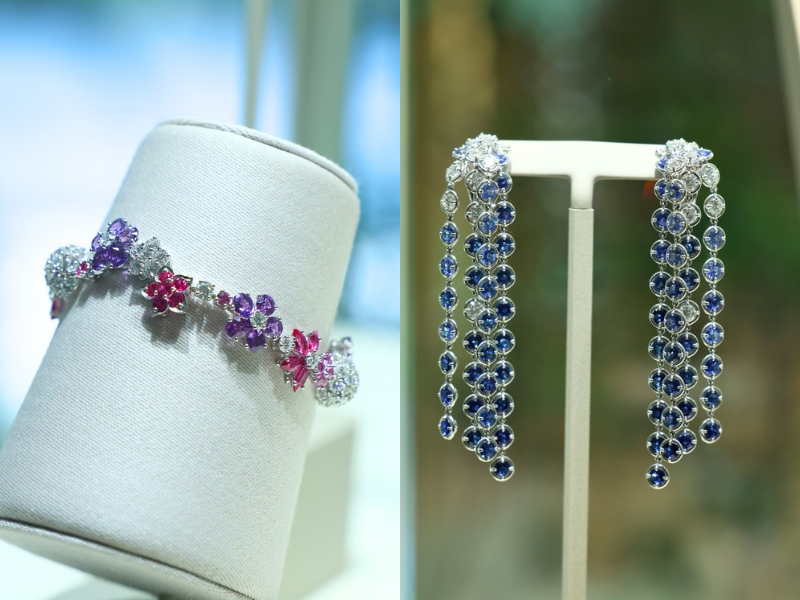
As one of the brand’s most enduring inspirations and foundational pillars, the natural world is beautifully illustrated by a handful of collections. Drawing from flurrying crystals in winter, the Snowflake creations unite seven round diamonds in luminous clusters held by subtle V-shaped prongs. Set on openworked mounts that maximise light reflection, these motifs grace necklaces, rings and earrings with concealed mechanisms that offer versatile styling. Meanwhile, the diamonds cascading across the Palmyre pieces mimic shimmering water. Each gem rests in a bezel within a flexible framework to accentuate movement, swaying gracefully with the body. In the newest iterations, pink and blue sapphires stream down in dramatic rows.
Celebrating the beauty of wildflowers, the Folie des Prés’ design uses various shapes — round, pear and marquise cuts — to express the vitality of each florette. Extra attention is paid to the elegance of the cut to ensure the harmony of proportions. While pure diamond and white gold variations evoke a sense of pristine clarity, the addition of vibrant sapphires in the latest novelties imparts a compelling vivacity. As for the Flowerlace collection, the fleurette motif is fashioned through the lens of haute couture, with diamonds tracing an asymmetrical bloom with the fluidity of ribbons.
The Olympia set honours femininity through graphic, interwoven rings. To ensure a comfortable fit, the structure is hollowed out and openworked using the nid d’abeilles (honeycomb) technique. Each creation wraps seamlessly around the neck and wrist, with clever hidden clasps that preserve the pattern. Lastly, the À Cheval suite spotlights the maison’s virtuoso setting technique where the gemstones are assembled row by row to engender a superimposed effect.
body_photo_-_2026-11-18t200304.722.png
Hidden wonders
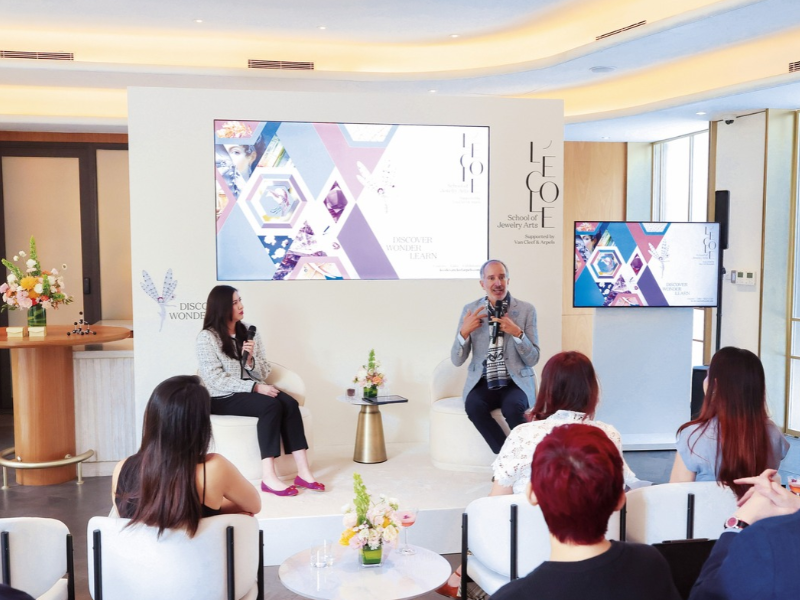
At a recent private viewing of VCA’s high jewellery collections, Olivier Segura, managing director of L’École Asia Pacific, School of Jewelry Arts, was joined by guest speaker Billie Hughes, a gemologist and co-founder of Bangkok-based laboratory Lotus Gemology, to host a conversation about diamonds and precious stones.
“We actually have so many important gem localities in Asia,” Hughes noted, shedding light on the treasures that can be found within our region. “The most famous ones are probably in Myanmar. While it is very well known for Burmese rubies, there are actually a lot of stones there. They have peridot, topaz and, of course, jade. There are also ruby mines in Thailand and Vietnam, which are lesser known, with beautiful spinels — one of my favourites. In India, the Kashmir region is very famous for sapphires.”
“There were diamonds in Java when I visited a few years ago,” Segura added.
“And also diamonds in the Phuket area. Between Thailand and Indonesia, there is Malaysia, so there may be an opportunity to find them here,” he hinted gleefully.
But what truly draws us to these gems? Is it their inherent beauty, or their rarity? The answer is elusive. “When I was a kid, I was not looking at the stars, I was looking at pebbles,” Segura recalled with a smile. “And when it was shiny, I would keep it inside my pocket, to the despair of my parents because I would bring back blocks. But when it’s shiny, I don’t know, there was something that moved me. I cannot explain it.”
“It is fascinating,” he continued. Because humans and minerals share common fundamental elements, there may be a resonance of energy and emotion. “We wear jewellery on our bodies. It’s the only art form we can have close enough that it literally touches us.”
As synthetic alternatives and digital intelligence increasingly mediate human experience, Segura believes the role of natural gems and jewels will evolve once more. Rather than serving as ornamentation, they will also keep us connected to our environment. “In a future with a lot of technology, maybe coming back to nature will be very important to us.”
This article first appeared on Nov 2, 2026 in The Edge Malaysia.