
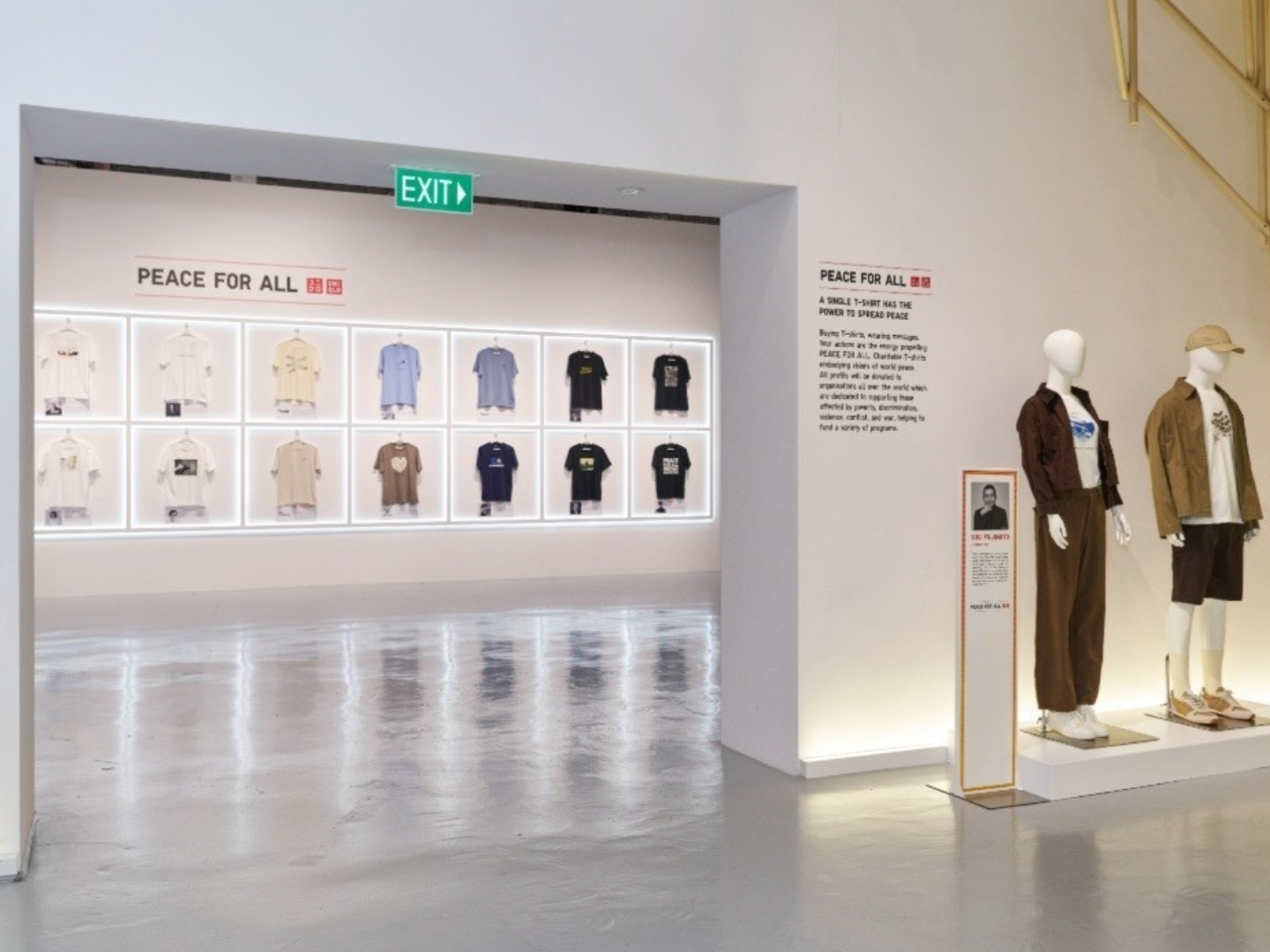
Uniqlo works with international organisations to address some of humanity's most serious challenges (All photos: Uniqlo)
The scars of childhood are not always written on the skin. Sometimes, they are felt in the sting of a harsh reprimand; at other times, in the weeks and months spent away from school.
In Kampong Cham, an agricultural heartland along the Mekong River in southeastern Cambodia, the harvesting season of cashews and mangoes can leave classrooms half-empty as students trade their books for back-breaking hours in the fields. Here, daily routine is governed by an unforgiving set of rules: survival always takes precedence, punishment is accepted as discipline and education must wait until all the work is done.
The end of a reign of terror does not necessarily bring its consequences to a close, as history has so starkly demonstrated. In 1975, Pol Pot’s Khmer Rouge seized power, plunging Cambodia into four years of unimaginable brutality that claimed up to two million lives through mass executions, starvation, disease and forced labour. The country’s intellectual spine — its educators and government officials — was systematically persecuted, leaving its institutions and social fabric in tatters. Although Vietnam’s military intervention brought down the regime in 1979, its collapse could scarcely undo the devastation wrought upon an entire generation. Five decades on, the struggle to protect the nation’s youngest citizens continues, particularly in rural communities, where the right to grow up free from fear remains far from guaranteed.
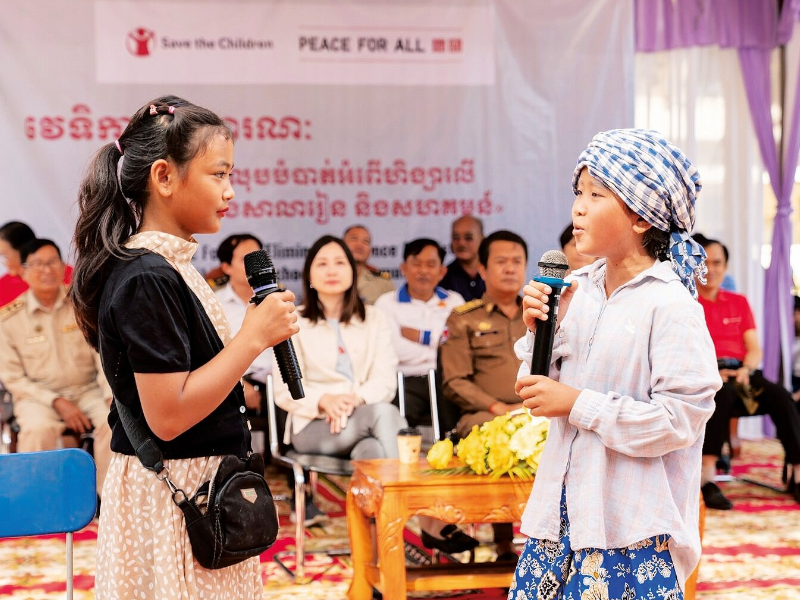
Inside 43 elementary schools across the province, however, that silence is starting to break. Children raised to obey without question are now turning the tables on their elders by staging plays that hold a mirror to uncomfortable realities long concealed beneath the guise of family tradition. Performed before parents and teachers, these productions tackle subjects seldom discussed openly, compelling the adults in the audience to consider their own attitudes and actions. In one scene, for example, a mother sends her daughter to toil for another household in exchange for money, leaving the girl miserable until sympathetic neighbours come to her rescue. For these pupils, confronting domestic taboos has sparked a resolute dream — their days should be defined by learning and curiosity, without the threat of a physical strike.
The distance between a Cambodian village and a clothing store thousands of miles away may seem vast, but an unlikely thread connects the two. Through its Peace for All project, which turns an ordinary wardrobe staple into a source of humanitarian funding, Japanese retailer Uniqlo has been working with international non-governmental organisation (NGO) Save the Children since 2024 to defy a deeply entrenched mindset towards violence, equipping youth with the knowledge to recognise abuse and the confidence to speak out. Rather than relying on one-off campaigns, the programme in Kampong Cham incorporates weekly awareness sessions into assemblies, encouraging students to reflect on their ordeal and foster more conversations within the wider community. So far, the effort has reached 12,600 beneficiaries, while reported cases on academic grounds have fallen from 30% to 17%.
body_photo_-_2026-11-25t174244.550.png
Peace by piece
The T-shirt is fashion’s great equaliser. A plain cotton square asks little of your wallet, requires zero ironing credentials and looks just as convincing on a Silicon Valley mogul as it does on a broke art student. Unburdened by the conventions of class or occasion, the laundry basket staple doubles as the ultimate mobile billboard — a democratic canvas for big ideas that demands nothing more of the wearer than pulling it over his head.
For Tadashi Yanai, chairman, president and CEO of Uniqlo’s parent company Fast Retailing, who has made good clothing accessible to the masses rather than the privileged few, the appeal lay in making an act of solidarity as commonplace as getting dressed. In 2022, as UNHCR, the UN Refugee Agency, announced that the number of forcibly displaced people globally had surpassed 100 million for the first time, Yanai saw an urgent need to extend the brand’s core LifeWear ethos — everyday clothing designed to improve lives — beyond the wardrobe. Through Peace for All, launched that June, Uniqlo transformed its popular UT line into an ongoing funding engine, pledging to donate all profits from sales (equivalent to at least 20% of each shirt’s retail price) to organisations aiding those affected by conflict, poverty, discrimination and natural disasters.
The journey from a retail rack to the pavement has turned out to be a surprisingly effective pipeline for social change. Sales of more than 11.8 million tees worldwide have translated into US$22.2 million in funding for non-profits across 24 projects in 17 countries. In Asia, Plan International assists girls in northern Vietnam to resist early marriage and remain in school; UNHCR offers Rohingya women in Bangladesh’s Cox’s Bazar refugee camps sewing skills and a source of income; while Save the Children gives vocational training and internships to the disadvantaged in Bangkok.
Peace for All’s latest chapter has just unfolded across the Causeway, in a city whose gleaming skyline and economic prosperity often belie the hardships faced by survivors living on its margins. In Singapore, Uniqlo recently joined forces with Community Chest, the philanthropic arm of the National Council of Social Service, to extend a lifeline to the underserved. Unveiled during an event at Whitestone Gallery last month, the crossover will benefit two entities: Allkin Singapore, whose Achieving Kids programme nurtures literacy and social skills among youngsters from low-income families; and Heart@Fei Yue Child Protection Specialist Centre, where art and therapeutic activities provide children who have experienced mistreatment with an outlet to process trauma and regain a sense of security.
body_photo_-_2026-11-25t174222.401.png
Noble endeavours, nonetheless, rarely command the headlines, and a little visual persuasion certainly does not hurt. Uniqlo has frequently drawn on the cultural cachet of celebrated artists, athletes and other luminaries to give its humanitarian ambitions greater visibility, the latest being two titans of Japanese architecture, Kengo Kuma and Sou Fujimoto.
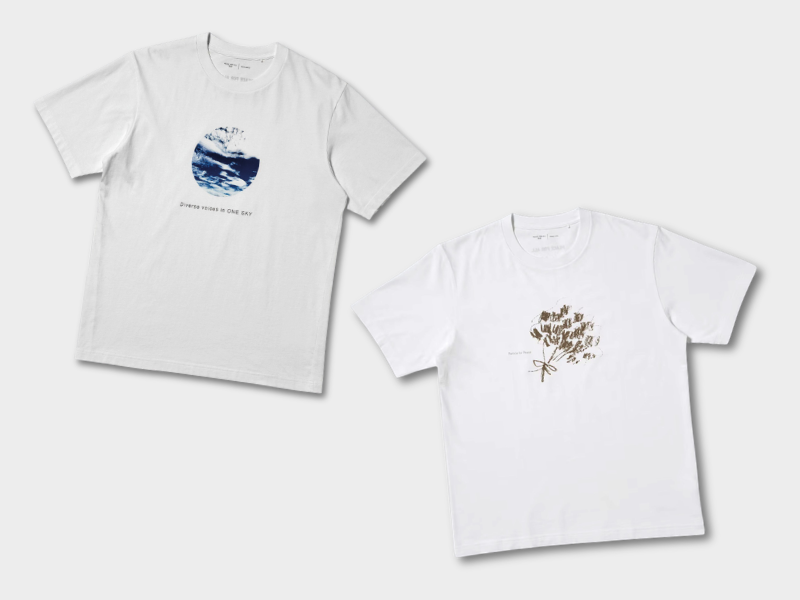
For the former, whose oeuvre has sought to blur the divide between nature and the built environment, this philosophy finds expression in a hand-drawn bouquet bearing the inscription “Particle for Peace”. Averse to imposing monoliths, Kuma prefers what he calls a “collection of grains”, in which the smallest elements acquire strength through their relationship with one another. His floral illustration carries a similar perspective: like scattered particles, we are perhaps better able to coexist precisely because we remain separate, each as delicate as a single bloom, at liberty to extend compassion without losing our individuality. Visitors to the Singapore launch also encountered his signature aesthetics on a grander scale at the gallery, where an intricate lattice of intersecting wooden and bamboo elements evokes a forest, lending the otherwise pristine interior an almost organic warmth.
“I decided to join this project because I still feel peace could return [despite what is transpiring in the world],” Kuma shares in a video message. “When you receive flowers, somehow they make you feel happy. I want everyone to experience that, so I put my own feelings into this design.”
Fujimoto, who served as venue design producer for Expo 2025 in Osaka, Japan, takes his imagination skyward. His inspiration dates to an early visit to Yumeshima, when the future exhibition site was still a sprawling, empty expanse, its uninterrupted horizon sparking the idea for the colossal timber Grand Ring. Beneath its sweeping circumference, strangers from every corner of the globe would eventually converge, united momentarily by the same patch of blue overhead. For his iteration, the Hokkaido-born architect revisits that celestial perspective with the inscription “Diverse voices in one sky”, a poetic reminder that humanity has always shared the heavens, however fiercely it may contest the ground below.
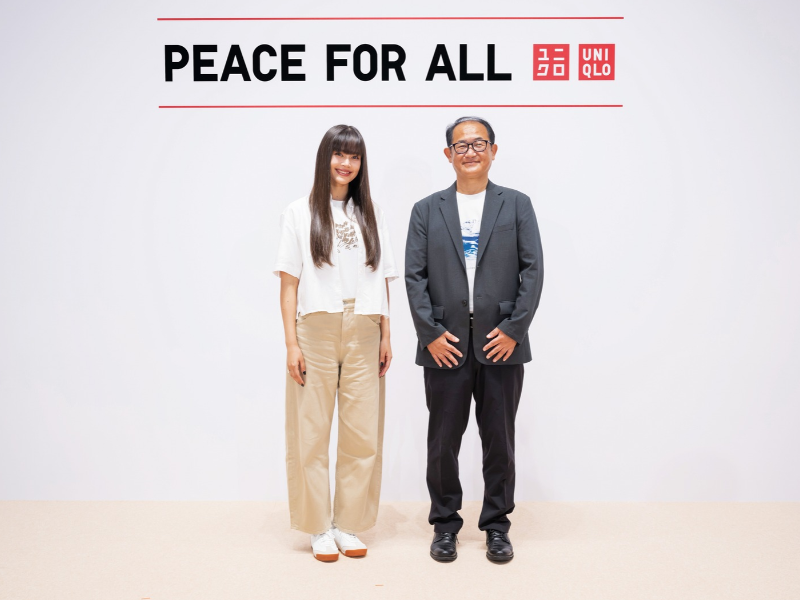
The creative roster expands further with the addition of actress, model and Uniqlo Thailand brand advocate Urassaya Sperbund, better known as Yaya. Introduced as the campaign’s 55th collaborator, the Thai star brings a regional voice to the cause with a forthcoming T-shirt.
“I hope to inspire more people across Southeast Asia and beyond to turn kindness into action,” she said. “When people feel seen, supported and empowered, hope can grow into positive change.”
body_photo_-_2026-11-25t174236.918.png
Beyond the seams
For all its laudable intentions, Uniqlo faces a dilemma familiar to philanthropy: When crises seem inexhaustible, how does one decide whose plight warrants attention? The needs are immense, the resources finite, and even Fast Retailing’s formidable machinery cannot extinguish every fire. So which burning house gets the hose first?
Group executive officer Yukihiro Nitta, who oversees sustainability and plays a role in selecting organisations as well as assessing their impact, is candid about the limits of what the company can accomplish. Across the 26 countries involved in Peace for All, priorities differ considerably, from natural disasters and climate change to poverty. Determining where to channel resources calls for careful judgement, informed by conditions on the ground and the capacity of credible partners to yield meaningful results.
“Of course, we cannot solve all of these problems,” he concedes. “Therefore, we have to identify the most pressing ones in each locale and consult trusted NGOs, whose local knowledge and networks are essential to ensuring assistance reaches the most vulnerable.”
Nitta offers no grandiose promises about saving the world single-handedly, acknowledging that such choices inevitably necessitate trade-offs. Nor is he content to make them from the comfort of a boardroom. He travels to the actual sites to gain a first-hand understanding of the circumstances and makes follow-up visits to ensure the funding has brought about lasting improvements.
Despite Uniqlo’s commercial success and established presence on our shores, it has yet to launch a dedicated initiative, although Nitta is optimistic about the possibilities. In the meantime, every Peace for All garment sold under the banner carries a little Malaysian generosity well beyond the country’s borders.
Ultimately, Nitta recognises that genuine progress seldom relies on quick fixes and tidy milestones. “It is undeniable that the issues we’re facing today are very complicated, and the outcome is too difficult to gauge in just one or two years. That is why we approach everything as a long-term commitment.
“Setting the right goals is important because sometimes, you cannot see where the end is. So, what is the final answer? Perhaps, it is when the government steps in, or when the charitable organisations are eventually able to fund themselves. Until then, we intend to do whatever we can to make a safer and more liveable tomorrow.”
This article first appeared on Nov 2, 2026 in The Edge Malaysia.