

Expatriate (1993) (All photos: Harta Space)
It is best to be freed from moorings.
Like Joseph Conrad, perhaps, who — in shifting from Polish to English — described the experience as akin to “skipping upon tongues”. There is something about Dada also — that seductive tradition — that promised liberty or, at the very least, a freeing from the shackles of imagination.
This is a disposition that could well describe the yearnings of Askandar Rudolph Walter Unglehrt who, in an attempt at a definitive self-portrait, framed himself as “a diluted German, intellectually grown in Paris and culturally adopted in Malaysia”. Pointing a sturdy finger (or two) then to this devouring thing called “identity”, as opposed to the attitude offered by the school of surrealism, he studied and partly adopted Dadaism. Dada, said its principal advocate Tristan Tzara, offers simply the grand notion of “nothing”; or like the glowering parrots perched on a skyline in front of a broken egg in Unglehrt’s painting modestly entitled Untitled, poses the question: “Is art serious?” — also the title of his first group exhibition.
Born in Weingarten, Germany, a garrison town in the early 20th century, shadowed by the Weingarten Abbey and edged by the Schussen River, Unglehrt trundled his way to Paris in the 1960s to attend the famed Sorbonne. Europe was in a time of upheaval, and much of that dissent was located in the university campuses he attended. Student riots were directed at the ancient regime of post-WWII Europe, culminating in the wide, often violent, student protests of 1968 that spilled into the streets of almost every principal European capital, along with the names of its main protagonists — Rudi Dutschke, Daniel Cohn-Bendit and Tariq Ali.
“The city was filled with the smell of tear gas, and I had to walk to my part-time job in the German Embassy because no public transport was available,” he would tell his friend and fellow émigré to Penang, the painter Ricardo Chavez Tovar.
2.jpg
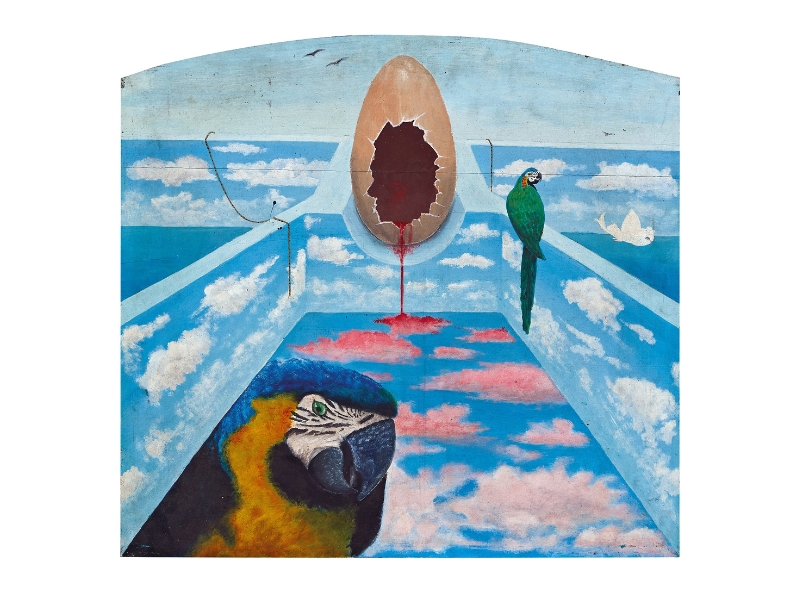
A student of literature, translation and languages, Unglehrt developed an interest in surrealist painter and poet Jean Hans Arp. Apart from the walk to his part-time job at the German Embassy amid the world falling apart around him, there was no admission that Unglehrt took part in any of these protests, opting perhaps to take the position of the poet-sculptor Arp who, in his poem The Plain, urged, “As I sat on the chair, I pondered sadly/Why the core of the world exuded such black light.”
In what could be described as a peripatetic life, in Paris, Unglehrt met his singular constant, a fellow student of linguistics, Tengku Idaura, who would become his wife and traced her lineage to the region of Kelantan-Pattani.
As a student, he ventured to Morocco and Greece where, apart from a deeply affective experience that further shaped his aesthetic, he would develop the habit — so often unduly derided — of “hoarding”. Bric-a-brac, the assemblage of something from many things, would serve as a foundation for his approach to art-making.
Settling in Penang, Unglehrt taught in the Department of Languages at the then radical Universiti Sains Malaysia. By his own confession, he did not receive any formal training in art: he did not know how to draw or paint. “Composition” was the most fundamental approach to art-making for him, and collage, even kitsch, remained sustained practices. His aesthetic sense, however, was placed in the notion of the eye, especially the esoteric “third eye”.
“I observe the East with one eye and the West with the other. A ‘third eye’, which is my creative eye, combines the fragments of my observations into experiences of their own. Most of my works are humorous explorations of modern life,” he described.
south.jpg

Writing for an exhibition at the Valentine Willie Fine Art Gallery in 1997, the critic Beverly Yong insightfully encapsulated the Unglehrt experience, “In the late 1970s, Askandar Unglehrt made his first forays into art. Rejecting the traditions of easel-painting, and without formal training, he worked with different processes of making art such as collage, photomontage, found object constructions and most recently, painting over magazine print.
His working method is integral to the philosophy of his craft, a process of transforming familiar and prosaic images into food for thought, to broaden the scope of our vision.”
“Scope”, “vision” and the irrepressible “eye” are aspects that give A Third Eye all of its vitality. That, and a squint into history. Earlier works bear traces of tentativeness, surely a testament to the excitement and pleasure of trying. Social commentary — such the pervasive trend in the time of Unglehrt’s nurturing — offers insights into social obsessions. Selling Malaysia, a collage on an anonymous painting, features the popular TV serial Dallas’ J R Ewing (played by Larry Hagman), replete with a wicked grin and wearing a 10-gallon hat, which displays all the symbols of “development” sitting on it. This, against a simple watercolour painting of a kampung.
Grand and profound is the mixed media work Hikayat Munsyi Abdullah, replete with references of voyages made by the great pendeta (scribe), a peering Raffles (the Malay language student of Abdullah), set amid a heavy compilation of texts handwritten and printed — excerpts from the marvellous hikayat (tale).
3.jpg
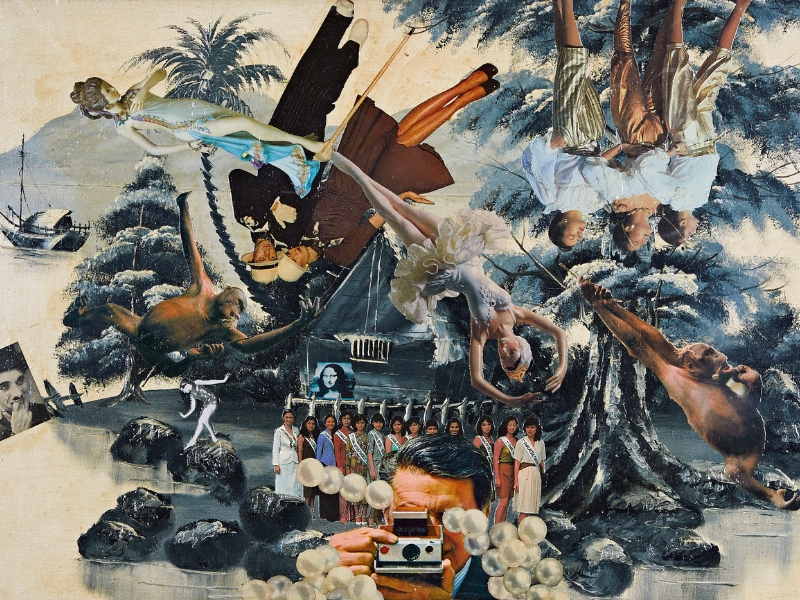
A particularly arresting painting is After Hours, which demonstrates a great command of the control of paint, a firm hand for application and a brilliant digestion of colour.
“I’m a ‘Baroque’ person. I don’t feel comfortable within a void,” Unglehrt once said. “In A Third Eye, restlessness, adventurism, laughter, the absurd, humour and history are more than present. They offer a journey into the curve of an artist committed to practice within the boundaries of an inveterate observer. Perhaps it is the lack of formal training, the near certain diffidence, that must have permeated the artist Unglehrt in his venture into art-making that is never quite resolved but focused in its energies.
There are sustained presences — black, for example — that evoke the pleasure of recurrences, and always the vast expanse of the surreal. “The field is dark and lonely now,” Unglehrt writes in a poem, probably written “when he couldn’t sleep”, his daughter Adela, the principal organiser of A Third Eye, suggests. “And from the newly painted pole, The moon, the star, the stripes, Still wet, Hand down.”
The hyphenated, the ellipses were Unglehrt’s muses, and they hover powerfully here. The title of one of his last exhibitions was Walau Bagaimanapun … (However …). And from A Third Eye, a reaching back to the days of the Sorbonne, everywhere the phrase n’est-ce pas … isn’t it?
‘A Third Eye’ by Askandar Rudolph Walter Unglehrt (1943 - 2022) is being exhibited at Harta Space in Ampang, Kuala Lumpur, until Aug 31.
This article first appeared on Aug 18, 2025 in The Edge Malaysia.