
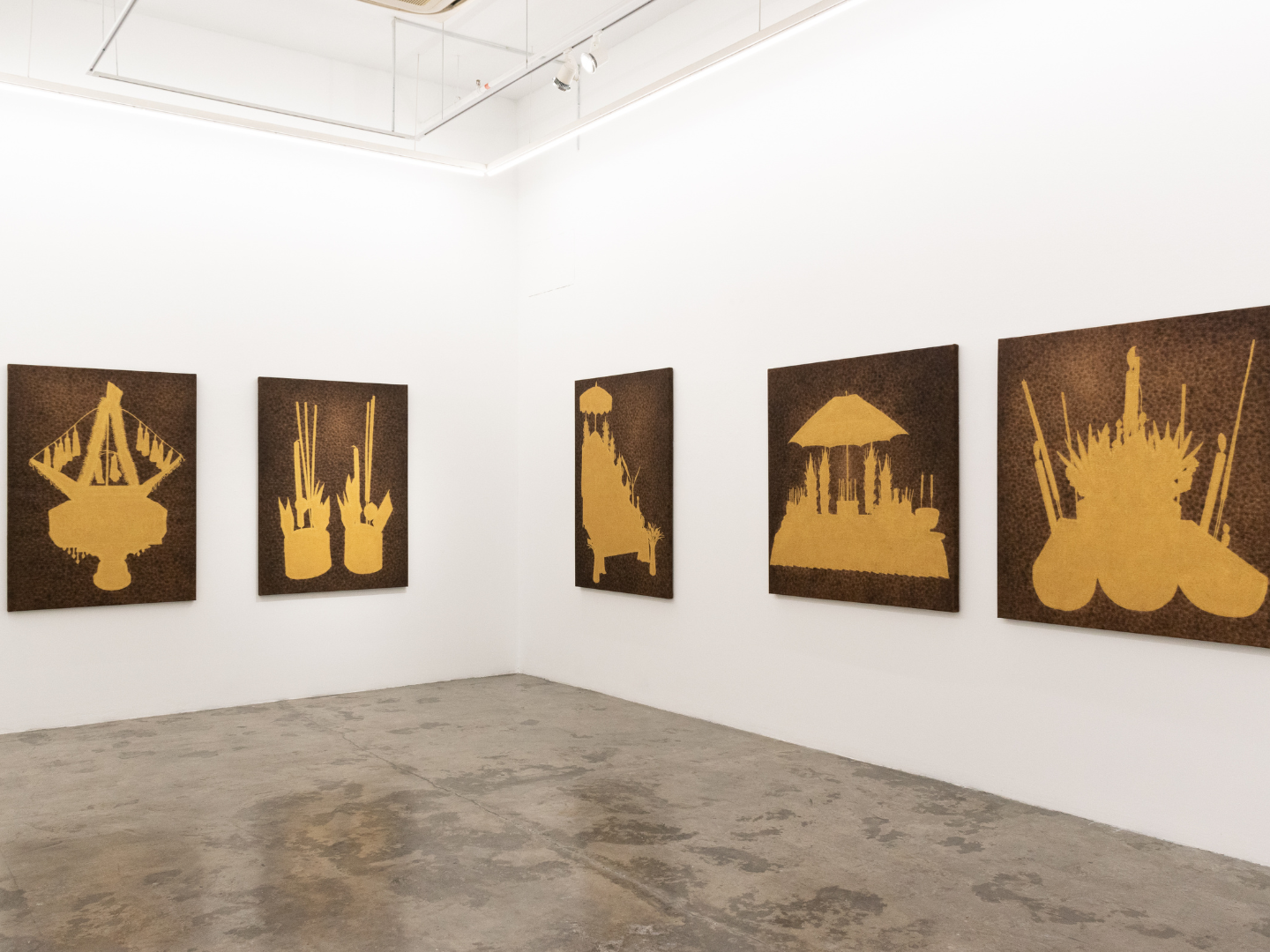
Totems, offerings and objects of worship are the main subjects painted upon burnt surfaces (Photo: A+ Works of Art)
For many in the local creative community, it is the artistic image of Ibrahim Hussein that has left an enduring impression of Cambodia’s recent history.
In a large work commemorating the plight of contemporary Cambodia, he painted an expansive impression of the crumbling stones of Angkor Wat laid out against the canvas, all-looming and monumental. Within that grand background is a miniature figure, almost a thumbnail in scale, emerging from the rubble — that of the creator of Year Zero, Pol Pot.
The art of encounter, or bearing witness, was naturally the early preoccupation (some would say, “fixation”) of the post-Pol Pot generation of Cambodian artists.
Perhaps no single artist has encapsulated this creative posture more than the filmmaker Rithy Panh. Writing of Panh’s film, Meeting with Pol Pot, film writer Minh Nguyen notes: “Rithy Panh has spent his life reconstructing the world of the people who killed his family.”
Several decades earlier, the roving Singapore theatre director Ong Keng Sen created The Continuum: Beyond The Killing Fields, featuring the famed Cambodian dancer Neak Krou Em Theay in a recreation of Khmer Rouge atrocities.
For much of the post-Khmer Rouge experience of obliteration, creating artistic spaces has meant re-creating, literally, from the bricks and bones of the Year Zero blight. Among the principal efforts at this reconstitution was the re-assembling of the Royal Cambodian monarchy.
There existed, manifestly, a separation of experiences between artists defined by exile and those who remained, or were forced to remain, in Cambodia (then known as Kampuchea) to live through the Khmer Rouge experiment of creating the “pristine Communist” utopia.
By the 2000s, following the political transition in the country, new artistic initiatives and approaches flowered. Beyond the art of “testament and testimony” were deep forays into the nature of tradition and interrogations into the contradictions and paradoxes of a Cambodian society emerging from genocide.
Artistic movements such as the art collective Stiev Selapak launched initiatives like the Sa Sa Arts Project, which explored multifarious mediums — from photography to installations — to explore the legacy of Cambodia’s recent past.
1.png
Others, such as the artist Than Sok, carved out a seemingly more conventional path. A student of one of the leading and few female professors of painting in Cambodia, he studied the art of painting in “traditional” style, only to later experiment with form and elevate the notion of tradition through various mediums into expansive contemporary realms.
At the Busan Biennale, Than Sok presented a powerful and resonant work, comprising a series of eight paintings using acrylic and ash on burning canvas. Entitled Tomlorb, the work delved into animist and Hindu forms incorporated into Buddhist practices — in this instance, the commemoration of the Buddha’s death.
A preoccupation with ritual and the enactments of spirituality contained within such acts of ritual has dominated Than Sok’s more recent art, creating a sense of lived practice and contemplations of both the mysticism and social contradictions that exist within tradition, a culture bearing the weight of history and the tensions between them.
The present exhibition, The World as Ritual, at A+ Works of Art in Kuala Lumpur, is an evocative, intriguing and quite mesmeric representation of Than Sok’s intellectual deliberations, spiritual contemplations and gaze at the great question of tradition and its continuity.
The showcase settles on themes and methods Than Sok has developed through a process of improvising with material and advancing inherited methods and traditions into more fluid spaces. Kbach Teuk is an expansive and extensive exploration of the water motif that is laid out in a current of energies and incessant flow.
Crocodile Form, Stamen Form and Hyacinth Form contain impressions gathered from traditional painting, traditional ornamentation in Buddhist temples and even textiles. While a second theme explores the more colloquial aspects of ritual and practice through representations of offerings, totems and objects upon burnt surfaces.
“In these works,” he tells Andrea Fam, curator of The World as Ritual, “objects of belief appear to float on darkened canvases in shades of light and dark gold. Through this use of colour, the exact form and precise lines become difficult to discern. Instead, the works demand focus, concentration and careful examination.
“The act of practising belief, the belief itself, imagination and emotion, reminds me of the moments when I burn the paintings, a process that creates a great deal of smoke. The smoke is carried upward by the wind, like incense smoke, bearing prayers to another world….”
2.png
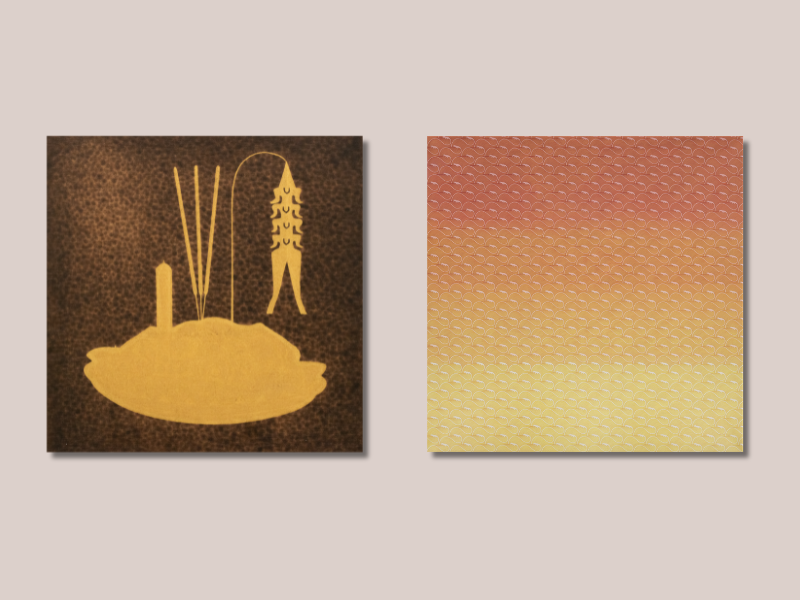
Much must be said of the astute, imaginative use of space in the clever and — that which is more difficult to capture — moving curation by Fam. Thematic concordance for the water paintings and the suggestion of a “thematic procession” for the burnt ones provides a sense of a comprehensive and lucid experience.
The signal painting Bay Ben, with its clear allusion to the mimetic, commences a series of interlocking inner experiences that culminates with walls plaid with the water paintings, accentuating the quintessential Buddhist concept of “stillness in movement and movement in stillness”.
Crocodile Form remains one of the outstanding paintings in The World as Ritual, commemorating that most totemic of beasts, in separate layers of colour.
What is most difficult to achieve in the aesthetic reaches of Than Sok is achieved here in The World as Ritual — the sense of an enduring tradition that encapsulates history, the practices of a people and the weight of the contemporary through the processes of repetition that make for flow, and the act of getting under the (burnt) skin of why we do the things that we do, especially ceremonially.
“Offering is an act that has existed for a very long time,” Than Sok tells Fam. Ceremony, commemoration, remembrance — all the things of ritual — that is everywhere in The World as Ritual.
This article first appeared on Feb 9, 2026 in The Edge Malaysia.