
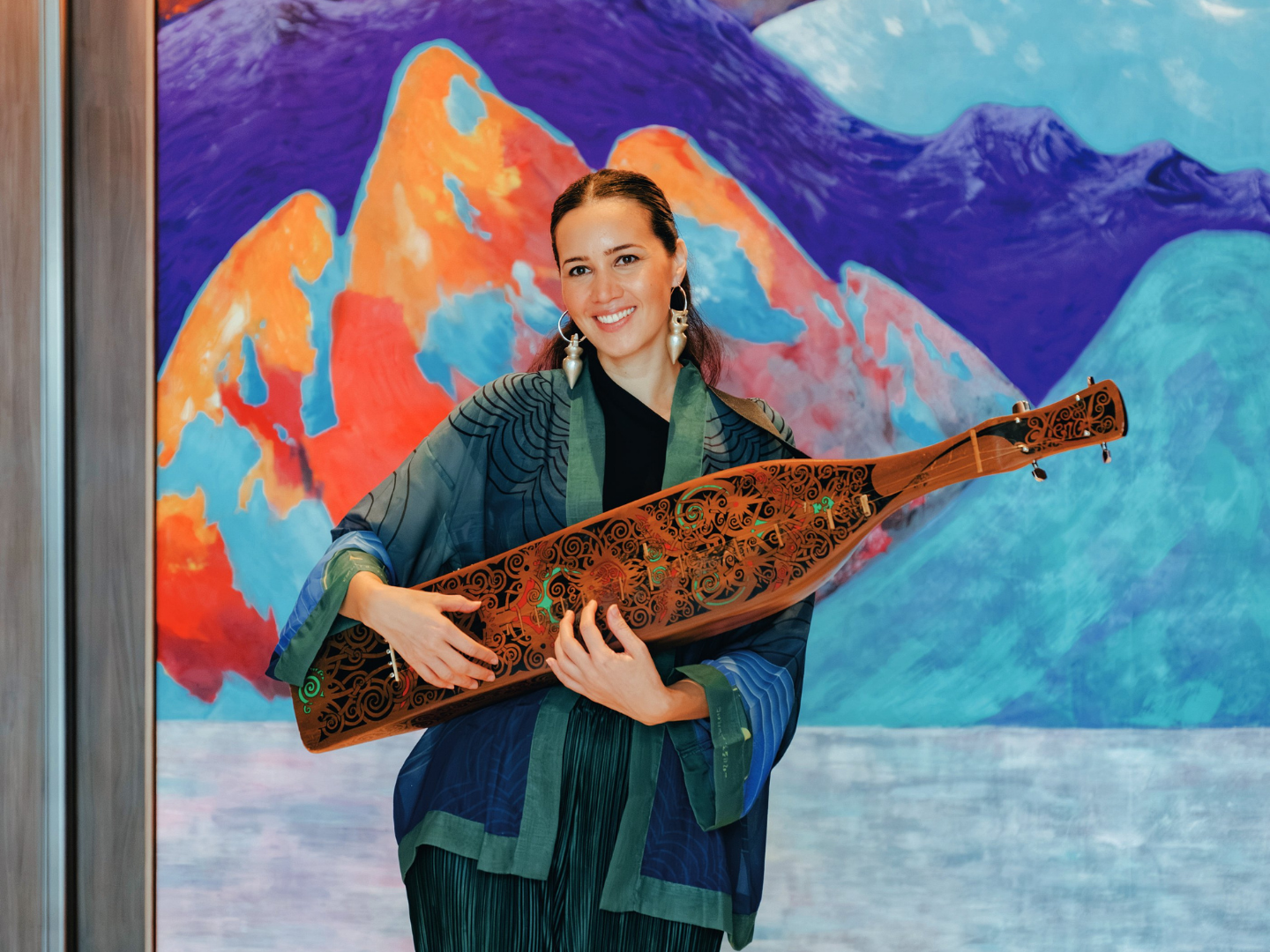
Alena poses with Cradled by Mountains at Voco Kuching's opening last July (Photo: Voco Kuching)
Options: You made your name with the sape (boat lute) and singing but few people know about your artsy side. Tell us about your journey as a visual artist.
Alena Murang: I have always loved drawing since I was a child, and well into my teens, but didn’t get formal training until I was 23. After graduating from business school and working in management consulting for two years, I felt that my heart really yearned to be in and around the arts. I picked up painting again, but only in the evenings. I also didn’t feel like I was very good as there were images in my head that I just couldn’t technically execute. I then decided to leave my job for a 10-month foundation visual arts course in Singapore. It was difficult but I loved it and learnt a lot. Upon completion, a Malaysian band called Diplomats of Drum invited me to join its music tour in the US, playing the sape. Of course, I said yes! The music slowly took off from there, and, because I was hardly ever in one place, it became difficult to focus on my art.
When or how did the art bug first bite?
My mother would bring us to art galleries whenever we travelled as a family, and I just loved being in that environment. She would share the stories behind the works and artists with us. It was Van Gogh who really moved me, because my father would play Starry, Starry Night, which is inextricably linked to it.
It is said that your art is strongly inspired by your Dayak Kelabit heritage.
Interestingly, in Kelabit and many native Bornean languages, there is no word for art… or music. To me, it reflects how art is not separate from life or something to be sold, commodified or gazed upon. Art is everywhere in our culture, from the motifs that adorn the walls of the headman’s section of the longhouse to those for protection, like the ones you see on baby carriers and sun hats. In Kelabit, we call the swirls arit, which used to be carved or painted on wood and rocks, marking walls and the land. With little historical material or communal memory as reference, I am learning the meanings and interpretations of arit through the process of making. By doing so, historical enquiry becomes a physical conversation across time and generations, and I hope to deepen my insights into ancestral intention.
2.png
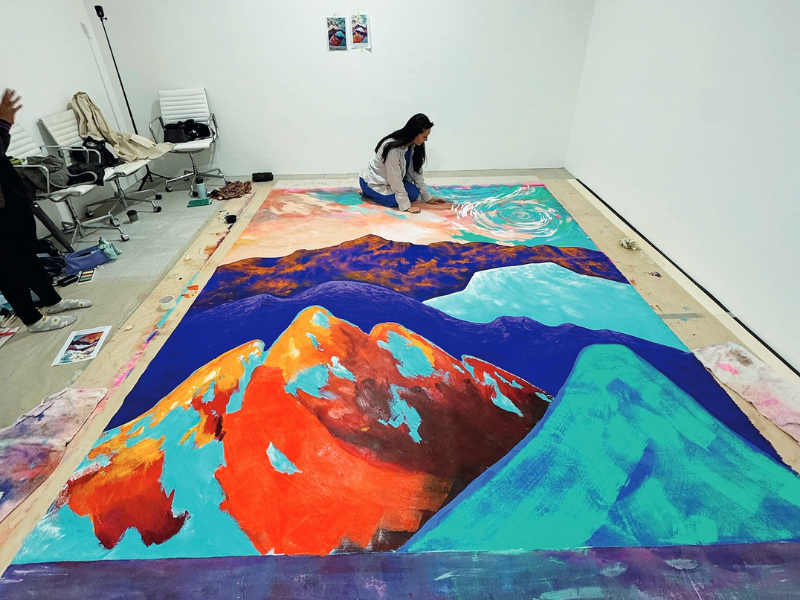
Your artwork Cradled by Mountains and the newly opened Voco Kuching hotel are inspired by the mountains surrounding the city. Tell us about it.
There are five mountains depicted in the painting and these are the peaks that cradle Kuching. Gunung Serapi, part of the Matang Range, is where the botanist Odoardo Beccari — considered one of the greatest tropical botanists in history — lived in 1865 to study and record plants and animals. It is also said to be named after Putera Serapi, the infamous folkloric prince whom Puteri Santubong and Puteri Sejinjang were fighting over.
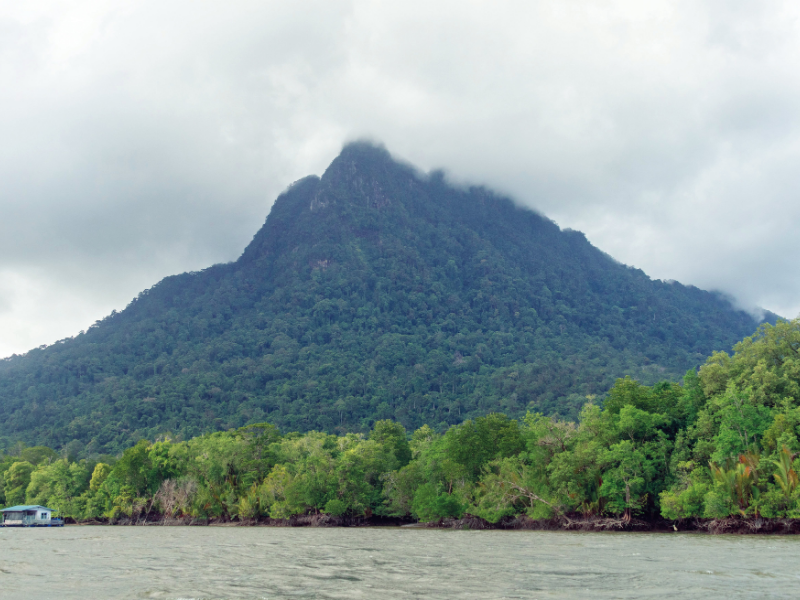
Gunung Singai, meanwhile, is home to the Bidayuh Singai people. For centuries, the mountain was revered as a protective fortress, its flat top representing a sacred altar that connects the heavens and the earth and a realm governed by nature spirits. In the early 1900s, the tribes embraced the Catholic faith, and on the mountain later became a place of pilgrimage, with a church built halfway up the slope. Santubong, on the other hand, tells the legend of a princess who died in a fight with her sister. Her body was then covered in earth, from which trees grew, becoming Gunung Santubong.
What inspired you to paint Kuching’s mountains?
The brief that was given to me comprised just one word — home. I did not have to think too much because every time I am about to land in Kuching, the first thing I look forward to seeing from the plane is Gunung Santubong. As the aircraft taxis along the runway, you can probably make out a really cute conical mountain called Gunung Staat. And upon exiting the airport, you are greeted by Gunung Serapi, which overlooks Kuching. Oh, I must also mention my assistants: Daviana Anak Depen, Sharmine Syahira and Stephanie Henry.
What do you want guests to feel when they come face to face with Cradled by Mountains for the first time?
I know everyone will have their own reactions to the piece, depending on their own experiences, but I would love for them to feel the great love and grandeur of the mountains — always constant and steady. It was so nice reading some comments on social media saying they felt the [depiction of the] mountains marked home for them. Much has changed in Kuching over the decades, yet the mountains remain steadfast and enduring, watching every sunrise and sunset. Gunung Serapi in the Matang Range, Gunung Singai, Gunung Staat, Gunung Santubong and, further out, Gunung Gading, are among the peaks that define the landscape of home. Cradled in their embrace, our home of Kuching rests beneath these mighty, wondrous mountains.
Do you have a preferred place of inspiration?
Returning to the Kelabit Highlands is always inspiring.
1.png
Which galleries and museums are among your favourites?
MoMA New York, because it’s where I got to see my favourite, Van Gogh’s The Starry Night. Also, the Borneo Cultures Museum, as its artefacts are so well-curated and displayed in such an honourable way. In Kuala Lumpur, Ilham Gallery. Its curation of Malaysian modern and contemporary art is thought-provoking, and serves as a much-needed art space in Malaysia. Oh, and also the Leeum Museum of Art, South Korea, where I first encountered the works of Icelandic-Danish artist Olafur Eliasson and how he communicated climate change to the public.
What are you reading right now?
I’ve just finished R F Kuang’s Yellowface. I really enjoyed the theme of cultural representation and appropriation through a work of juicy fiction. I’m also about to start Breath by James Nestor, which delves into the “lost art” of breathing.
Describe your ideal way to spend a weekend in Kuching.
Enjoying a bowl of Sarawak laksa at the Double Happiness Café or Signature Madam Tang’s, then a matcha cloud from Coby or Elementary. A Sunday hike in the jungle with mum and dad is always good, followed by yummy Dayak food at The Lamin. For a meal with the girlfriends, it would have to be at The Junk, Rumē or Fifty8.
This article first appeared on Aug 10, 2026 in The Edge Malaysia.