
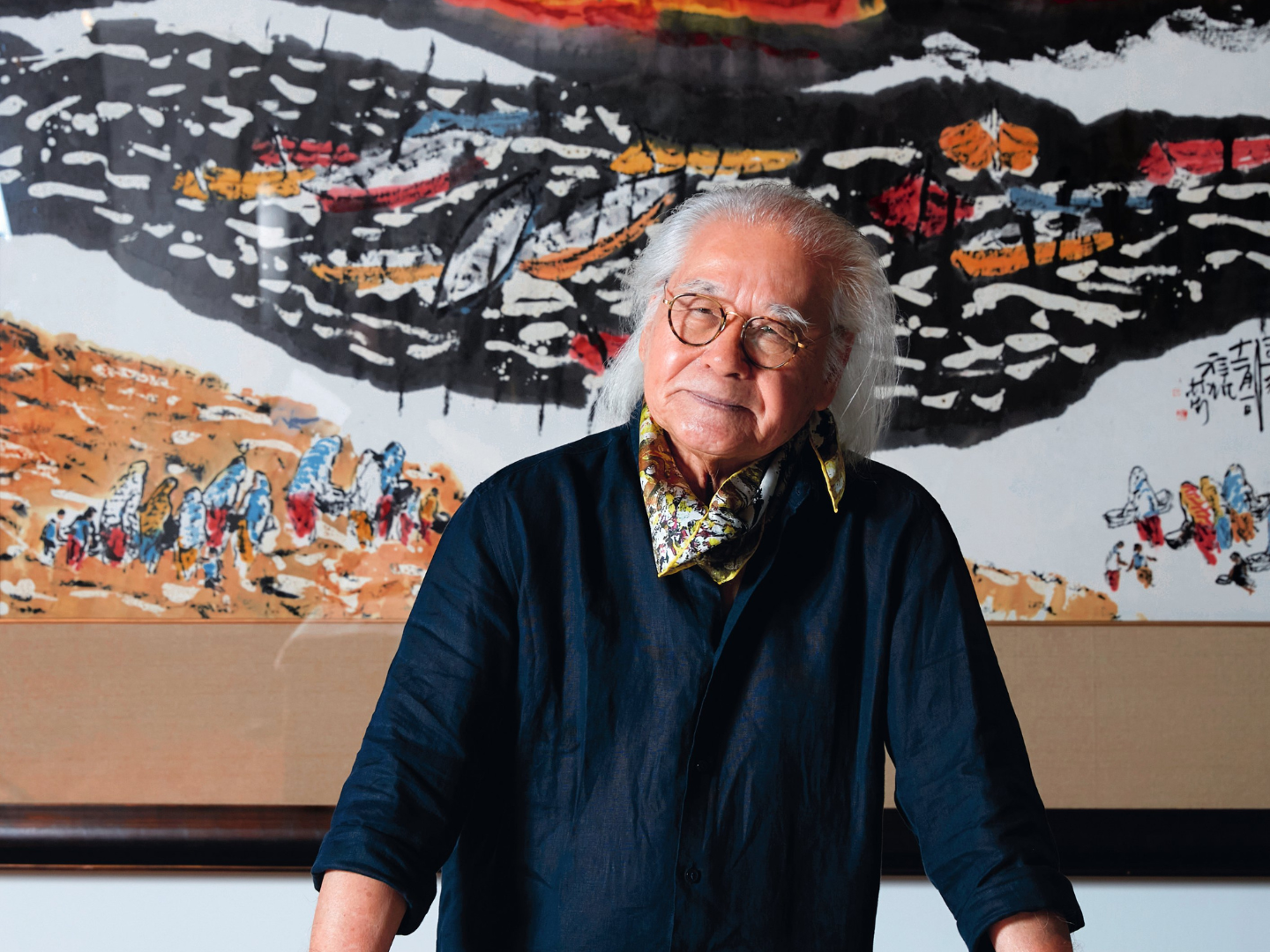
Lin navigated a childhood rife with turmoil, remaining hopeful and ambitious to nurture his artistic skills (Photo: SooPhye)
When German artist and teacher Joseph Beuys first articulated his famous statement “Everyone is an artist” during a lecture given in the late 1960s, he was met with a barrage of criticism from professionals who viewed the remark as devaluing the rigorous technical skills and specialised training required to become a creative expert. Later, scholars began to analyse the concept and presented a counter argument that maybe, Beuys had meant that each person possesses the ability to reshape the world through the unique way they communicate their thoughts and feelings.
China-born Singaporean painter and CNMC Goldmine Holdings CEO Lin Xiang Xiong wholeheartedly agrees, saying: “Even before the beginning of human civilisation, art has been important. My understanding is that art is born with each human being. It runs in our blood. Hence, everyone is an artist. As a multi-talented society, we explore different kinds of mediums, whether it is painting, singing, dancing, writing or designing. For me, I use drawing to express my thinking.”
What are the things that weigh on the mind of this 81-year-old, you might ask? Once upon a time, it was the lives of his local communities; in the last few decades, it has been the depressing subjects of war, poverty and environmental degradation. His eponymous art gallery in Penang, which opened last December, showcases more than 400 of his paintings created over a span of 60 years, inviting people to ponder the past and engage in thought-provoking conversations that hopefully will drive change in the future.
Against all odds
Being able to build one’s own gallery is a remarkable achievement but Lin’s journey to this point was no easy feat. Born in Guangdong, China, in 1945, he led a comfortable life until his father became a victim of political scandals, forcing him to flee the country. Lin, who had just turned two, was forced to stay behind with his mother and two older sisters. Having lost their support system, they had to rely on other people’s leftovers and foraged plants as their main source of sustenance.
The dire situation escalated significantly when the Land Reform Movement was initiated shortly after. The family was targeted by the community, who accused them of being “evil landowners”. “We became homeless and my mother was treated inhumanely for almost two years. Eventually, she passed away. She was very young, only about 36,” he recalls.
As the only son, he had the responsibility to go and search for his father. Villagers who took pity on the children helped him with documentation and the necessary permits to travel to Singapore. In 1956, he arrived in the Federation of Malaya and found Lin Senior. But the latter, who had remarried, was struggling to look after even himself and his new wife.
1.png
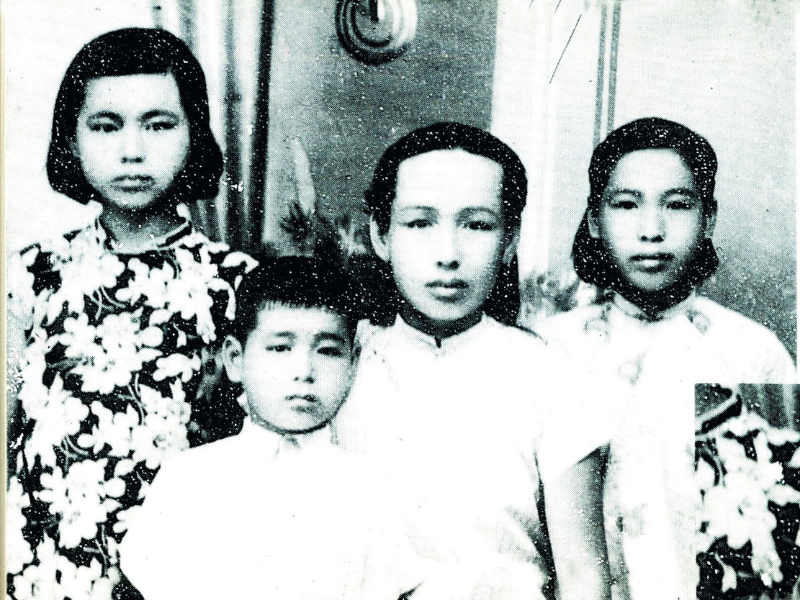
As a result, Lin decided to live with his maternal grandmother, who had migrated earlier to Nanyang to work as a helper. To support the household, the tenacious teenager took several odd jobs, including as a newspaper and vegetable seller, bootblack and dock labourer. “In my life, the most important person was my grandmother. Without her, I don’t know what would have happened to me,” he recounts.
Despite the hardship, Lin remained hopeful and ambitious. He continued to nurture the artistic skills he had developed in primary school. “I remember following my mum to the farm when I was about six. I would draw the scenery in art class and got first place for three consecutive years.”
In Singapore, Lin attended Ai Tong School and River Valley High School. A somewhat stable living environment afforded him the time and space to cultivate his interest in art, literature, history and philosophy. He went on to enrol in a specialised course at an art academy founded by Sun Yee, one of the prominent figures who championed Chinese and Western techniques. There, Lin started participating in exhibitions and selling paintings, which would allow him to fund his studies in Paris.
Art out loud
After a couple of years abroad, Lin made his way back to the Little Red Dot — now his home — to seek mentorship from acclaimed local artist Liu Kang. The virtuoso was known as a pioneer of the Nanyang Style, a modern art movement characterised by a unique integration of Eastern and Western aesthetics, combining Chinese ink and motifs with a Western modernist approach to capture Southeast Asia’s climate and community.
Under Liu’s guidance, Lin mastered the fundamentals and methods derived from centuries ago. He was heavily influenced by his teacher and artists of that generation, leading him to produce a series of artworks focused on the outdoors and nature. “From 1990 onwards, after I had received a strong foundation in drawing, watercolour and oil painting, I wanted to develop my own style.”
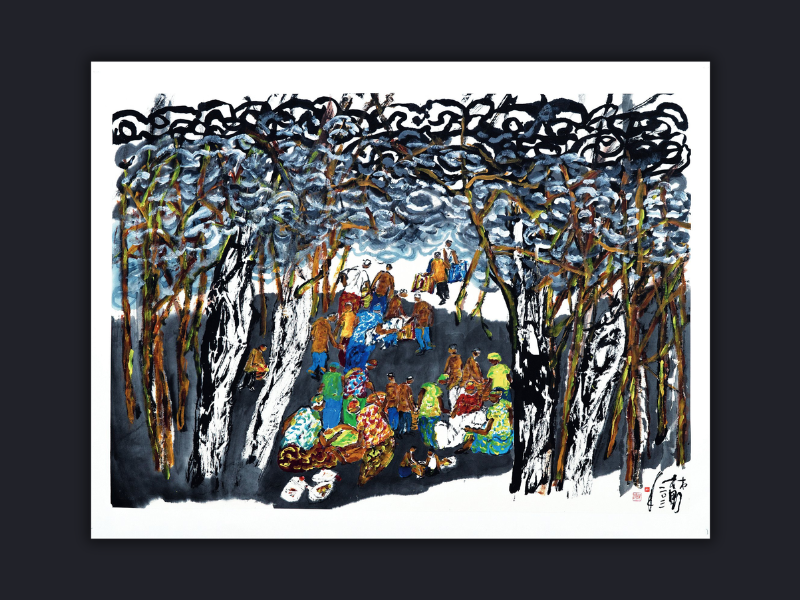
Vibrant shades used to portray idyllic countryside landscapes, lush vegetation and bustling waterways were slowly replaced with a subdued colour palette to spotlight the unpleasant truths about the human condition as a result of rapid modernisation. Each stroke of his traditional Chinese brush formed a narrative of exploitation, alienation and oppression faced by the poor and disadvantaged labourers of the time.
2.png
Expanding on his study of capitalism, Lin shed light on its effect on the environment and the underserved. Provocative paintings depict all-too-familiar scenes such as thick smoke plumes in the sky, barren forests lined with leafless trees, murky rivers full of industrial waste and malnourished livestock grazing on brown patches of land.
“I use my paintings to say, ‘Look, when climate change happens, it will cause massive floods and impact one’s living conditions’. In a capitalist society, the group most affected by this is the poor. Most unfortunate people are living in a dark corner. They can hardly survive. I want to advocate for those suffering from financial difficulties.
“It’s so heartbreaking to see that even though we are rich nations, there are still many who live from hand to mouth. What’s going to happen to them? Who is going to look after them? Should we do anything to change that? We have to.
“I am not someone in a position of power who can transform a country, but I can use my platform to make the government or leaders become aware of these pressing matters. Hopefully, they take note and take action, setting out rules and regulations to tackle the problems. If that happens, I will achieve my goal.”
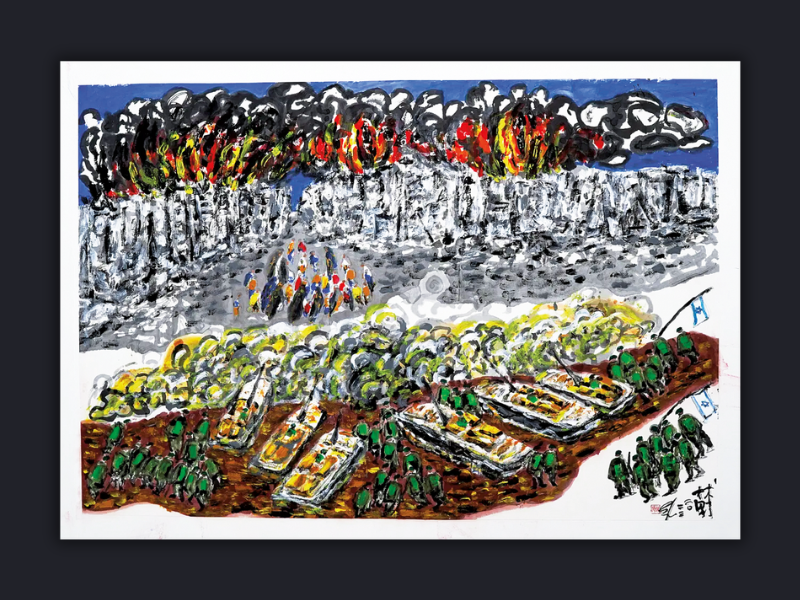
As an artist, he believes he bears the responsibility to document history and highlight the suffering of the innocent. Relentless footage of the wars in Gaza and Iran keeps him up at night, though he stresses that the conflicts have been a constant contemplation in his art since the turn of the 21st century.
“My work demonstrates what happens in reality. It is meant to inform people about atrocities and what they do to humanity. One thing is for sure, no one wins a war; everyone loses. You kill thousands of people and destroy a whole city. And for what purpose?” he asserts.
3.png
Having benefited from learning from a diverse range of mentors and delving into different disciplines, the polymath emphasises the importance of education in shaping his life and creative journey. He has travelled to many countries, from Asia to Europe, to explore unfamiliar territories in his mission to broaden his horizons.
“An artist has to be knowledgeable. He must know philosophy, history, theory, politics and economics. When he has a clear understanding of these fields, he will be able to think critically and make compelling art that triggers action.”
Palette of possibilities
Art is what makes a civilisation and gives it meaning, Lin says. “In prehistoric times, there were very limited ways for people to express themselves. They went out to hunt and would draw the animals they had captured to share their thoughts. When we understand the history of art, we understand its role as a tool for sharing emotions and what is inside our heads.
“For example, when we look at a painting, we can almost immediately get the message without any written word. Even when we speak different languages — like how I speak Chinese and you, Malay — and may not understand each other completely, we still get what an artist is trying to convey.
“In this regard, after being in the circle for more than 30 years, I had thought deeply about what I wanted to do. I asked myself, as a responsible human being — also someone who suffered as a child — who knows the value of art and the way it influences society, what are you going to do in the future?”
Taking into account his moral duty and personal ambition, he decided that the best way to honour both aspects was by having a gallery of his own — a platform where he could house his repository of more than 1,000 paintings.
“It’s a tough job for me. Many would rather set up karaoke or entertainment centres for profit. But to me, if I can afford to have a place where I can display my works and give people the opportunity to learn, I want to do that.”
4.png
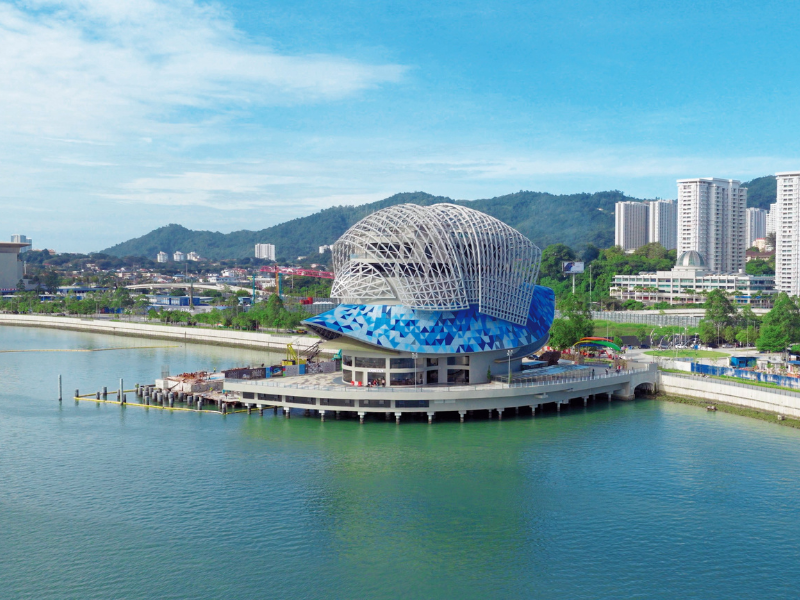
Erected on a 57,000 sq ft site at the Light Waterfront Penang in Gelugor, the Lin Xiang Xiong Art Gallery is a RM100 million endeavour. It is possibly Lin’s second biggest investment after his Singapore listed mining company CNMC, established in Kelantan in 2006 to manage the Sokor Gold Project.
This facility is designed to exhibit up to 400 pieces of his art at a time, arranged according to four main themes — “Story of Xiang Xiong”, “Story of Nanyang”, “Story of Nature” and “The Vicissitudes of Life”. Additionally, the cultural hub will promote home-grown and international talent whose works seek to bridge the gap between East and West. Dedicated zones such as an education centre, special exhibition gallery and conference hall may be rented out for a variety of events.
“It’s going to be a space for exchanging knowledge,” Lin says matter-of-factly. “From time to time, we will be organising dialogues and forums about politics, economics, culture and civilisation.”
The eight-storey edifice is modelled after a turtle, a highly revered symbol in Chinese culture that carries the message he wants to communicate to the world. “It represents peace, harmony and longevity, and I want these values to reach as many people as possible.”
The architecture also pays homage to the shape of Penang Island, a location deliberately chosen for its historical significance as well as artistic and tourism value.
“Penang was founded in 1786 by Captain Francis Light of the British East India Company and it was among the first in the region to receive Western culture. A lot of Chinese immigrants and traders also came here. You can see plenty of buildings in George Town, which are over 150 years old, have very similar patterns to those in Quanzhou, Fujian. The city is rich in Eastern and Western culture.
“Number two, it’s the most harmonious state in the country. I feel like everyone here lives peacefully like brothers and sisters regardless of race — Malay, Indian or Chinese. On the Street of Harmony (Jalan Masjid Kapitan Keling), you will find four places of worship from different religions. I think the community here really teaches you how to live in unity despite our differences.”
5.png
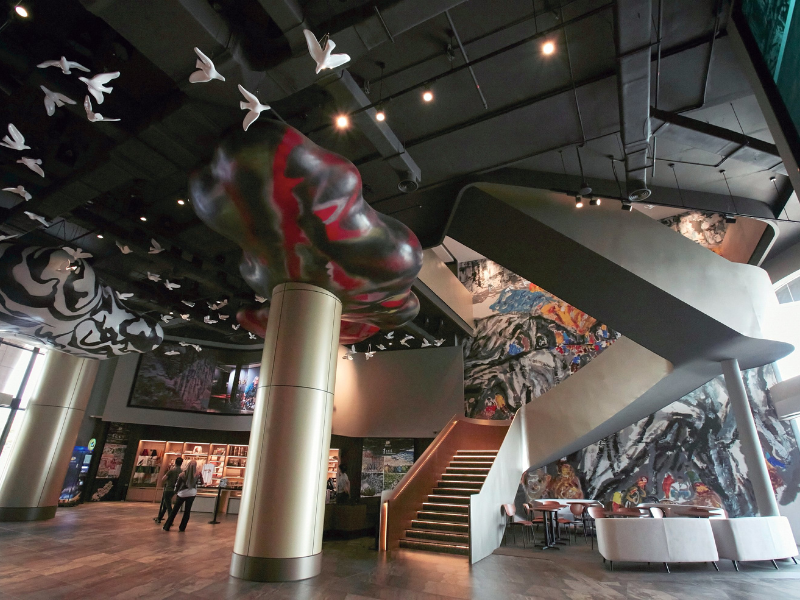
George Town is renowned worldwide as a Unesco World Heritage Site. Tourists travel to the culinary and cultural capital to discover its array of food offerings as well as its well-preserved colonial buildings and captivating street art.
“It’s easy to promote the gallery to outsiders when I go overseas. If I can live for another 20 or 30 years, I would be very happy because I want to see the gallery become a popular destination at the international level. For the first three years, I will spend a lot of time in Paris telling people about it and invite them to visit. Slowly, maybe it will become an important art museum for humankind.”
Leaving a lasting legacy
For the longest time, Lin has been advocating for peace by himself. He talks about the challenges of driving change as an individual and how transformation takes a while to materialise when one operates solo. “I have been working hard as an artist for more than five decades, but I don’t think I got the results I wanted. It is not easy to get people to see what you do,” he laments.
“People have asked me, ‘Lin, do you believe that if you work hard for more than 30 or 40 years, you will be able to change your life?’ Frankly, I cannot say. But I believe that if someone works non-stop to get better, there will be some good results waiting for him.”
His consistent efforts and dedication have paid off and his next goal is to achieve immortality. “I would argue that any artist dreams of opening their own gallery to display their paintings,” he says. “Because our life is too short — you only live until you are 100 or 120, then you have to go back to your creator. But if you have a place to showcase your art, you can live forever through it. My painting, writing and other sharing will still be here in the next 500 or 1,000 years.”
6.png
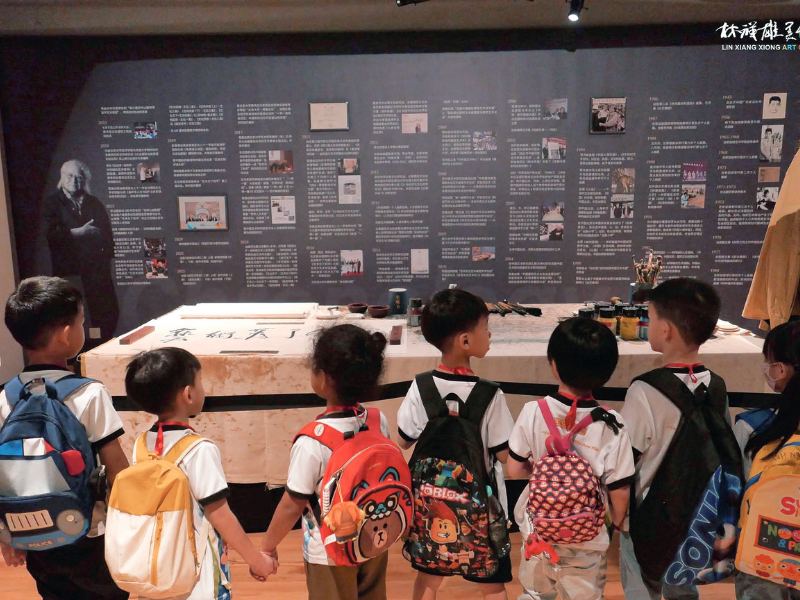
Since launching the gallery, Lin has gained attention from international institutions that recognise his efforts in foregrounding the tragedy of war and giving voice to a wounded world. Last year marked an important milestone as he joined Paris-based non-profit foundation Leaders for Peace as a board member. Established by former French prime minister Jean-Pierre Raffarin, the organisation brings together like-minded activists to encourage discussion about high-risk situations and their consequences.
Lin also organised an art competition in Paris last September, which drew impressive participation. “In just one month, we received almost 2,000 pieces of work from about 100 countries. It proved that these topics attract people and this somehow reassured me that I have followers who advocate the same cause and that I should continue on this path.”
He is currently in talks with the French government to coordinate another contest next year, focusing on combating climate change. “The fact we are planning a second instalment means there are voices demanding to be heard. It also shows that people are still actively using art to work together to look after themselves and society, fighting for a liveable future in their own ways.”
There are also plans to team up with Unesco Education to connect with schools around the country. “We want to offer as many children [as possible] the opportunity to visit the gallery, giving them exposure to the state of the world, as well as teaching them about art and culture. The goal is to raise a civilised and informed generation, making them understand a person’s duty towards themselves and humanity.
“Art is not about telling people how powerful or rich you are. If the world’s richest person passes one day, his money will not follow him. One day, when I ‘go home’, people will recognise me through my work. Always keep in mind, if you are a good person, humble and dedicated to making things around you better, people will always remember you for that.”
This article first appeared on July 6, 2026 in The Edge Malaysia.