
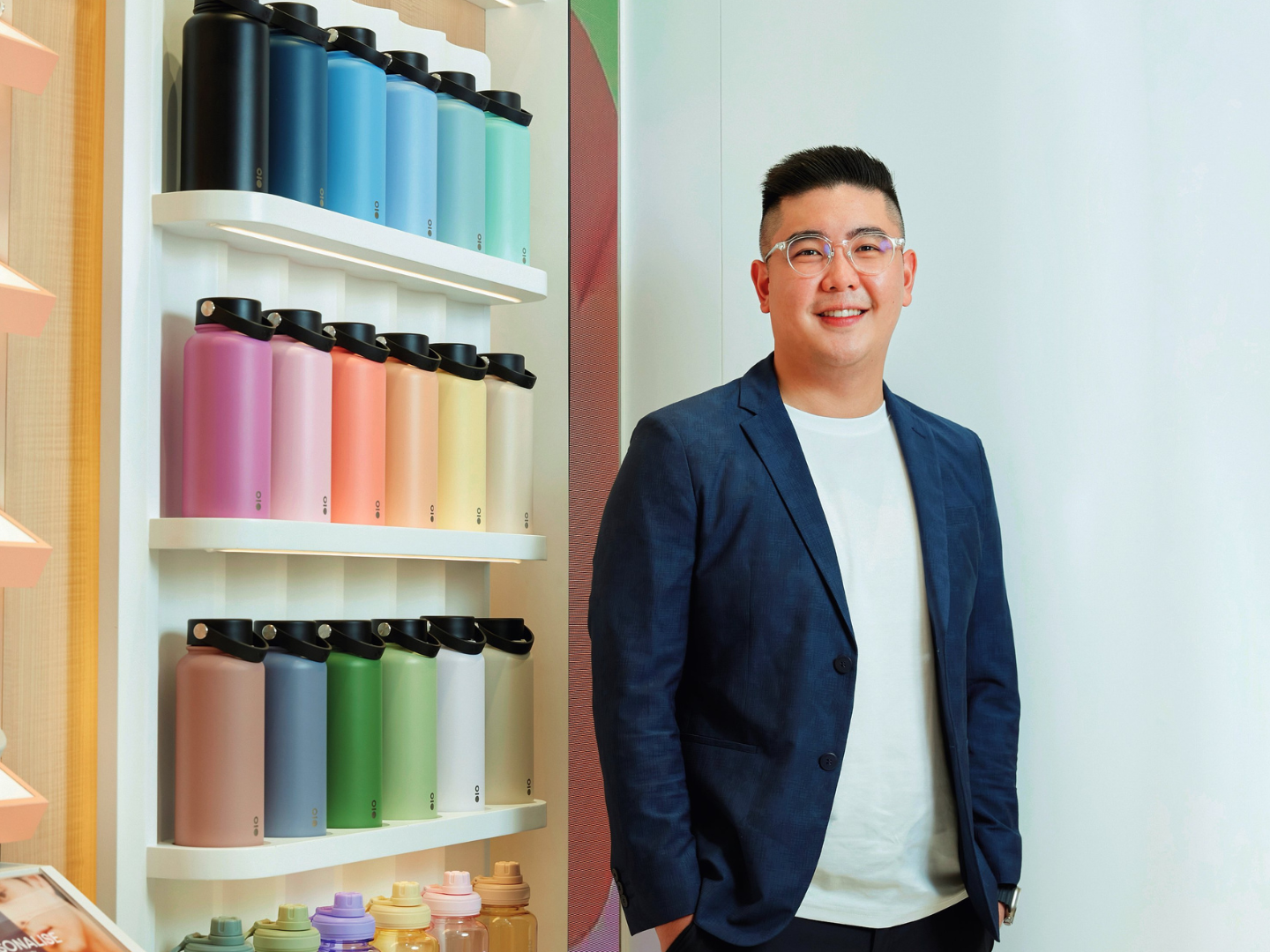
Chee has moved across industries and is now co-founder and CEO of RPG Commerce (Photo: SooPhye)
When post-pandemic disruptions rippled through global supply chains and consumer spending patterns, Melvin Chee found himself confronting an unusual dilemma: 200,000 pairs of underwear marooned in a US warehouse, racking up storage costs by the day. Returning the stock was not an option; neither was consigning it to landfill, as disposal came with its own paperwork and price tag. What could have been written off as dead inventory became, instead, an act of improvisation. Partnering with the American Red Cross, he donated the lot across Los Angeles.
“There was a famous saying going around in LA,” he recalls, still struck by the absurdity of what became one of the biggest takeaways of his life. “If you turned over the underwear of any homeless person in the city, odds were it was our brand, Comfort Republic.”
A glut of unmentionables may seem an unlikely place to begin a story about a Malaysian entrepreneur with a knack for making the customary covetable. But the shrewdest minds sometimes reveal themselves in ungainly problems. The predicament holds in miniature much of what has come to define Chee, whose career resists the neatness of a single industry, moving across fashion, cookware, tech and drinkware. Today, he is co-founder and CEO of RPG Commerce, a direct-to-consumer social e-commerce group with a growing stable of lifestyle product categories.
It is worth noting, at this point, that Chee was never likely to sip from the conventional cup — a fact distilled early in his company’s name, established when he was 23. Founded in 2017, RPG began life as Rocket Paradise Group, a nod to Rocket Internet, the prominent German incubator known for backing and scaling technology start-ups. The fledgling local outfit, originally focused on dropshipping, had set its sights on North America. But when Covid-19 drew the shutters there and sales collapsed, Chee and his team went looking for what might sell next. Scanning Amazon for where demand was gathering, they landed on home-based goods, a domain already well within their grasp. This time, they would target Southeast Asia, giving each idea six to 12 months to prove itself before deciding whether to double down or let it go.
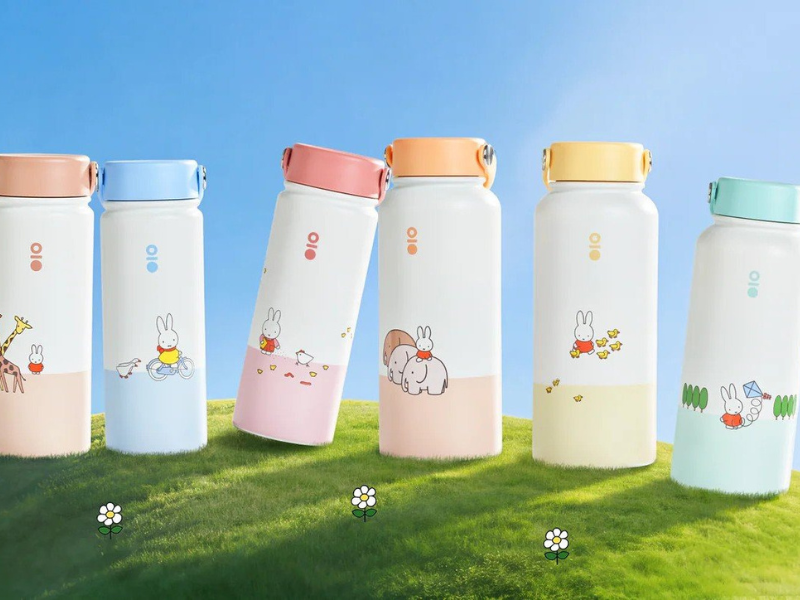
From that calibration came Montigo at the end of 2020, RPG’s tentpole label for insulated bottles and tumblers that have become mainstays of holiday carry-ons and aesthetically pleasing desk tableaux. Engineered to keep beverages at their optimal temperature for hours, they remain heatproof and condensation-free to the touch. What lifts them above utility is colour: popsicle pastels and speckled “funfetti” finishes, earthy neutrals and deep steely hues, refreshed regularly through limited-edition collaborations such as Pixar, Miffy and the Peanuts gang.
1.png
Within five years, Montigo had lived up to the altitude implied in its moniker — a nod to “mountain” — emerging as a serious contender with more than 70 physical stores including in Singapore, Thailand and Indonesia. But RPG has not treated that rise as its only vessel for growth, widening its portfolio through Cosmic Cookware and Casebang, a line of magnetically swappable phone cases.
Impetus needs ballast, and that arrived by way of capital. In 2020, Chee raised RPG’s Series A funding — US$5.5 million at a US$35.5 million valuation — while still, as he puts it, “a 26-year-old kid” steering a business already worth more than RM100 million. Nearly 12 months later, another leap ensued: Series B for US$29 million at a US$130 million valuation, backed by Vertex Ventures, East Ventures, UOB Venture Management and RHL Ventures. Now eyeing either a Series C or an initial public offering (IPO) in the next two to three years, the rule-breaker is no longer selling investors on possibility alone — the numbers are flowing in his favour.
Sip city
Every entrepreneur has a version of a lemonade stand, and Chee was no different — though his involved false starts and hunches that seemed considerably better at midnight than they did by morning. Nothing in his upbringing in Sitiawan, Perak, immediately suggested the multi-hyphenate he would become. A student at SMK Methodist ACS, his days were ordinary but eventful in the way happy childhoods often are: school, games and a home where conversations came easily.
“Believe it or not, I was a state bowler,” he admits. “A group of Koreans turned up in town and opened a bowling alley — it was super random — so my mother enrolled me with a professional coach. I got into table tennis too, because of my dad. We’re pretty close. He called me almost every day when I was doing my software engineering at RMIT in Melbourne, Australia, up until I quit after half a semester. He was really angry and told my mum that if I continued to play around, he would have to drag me home,” adds the freewheeling middle child.
His father, a businessman in oil palm and traditional agriculture, hailed from harder-won roots. Chee’s grandfather, a plantation estate manager of modest means, borrowed what he could to send four of his sons to the UK, convinced that education was the only way out of poverty. There was little room for sentiment. By 21, Chee had long been warned, the family purse would close.
3.png
“That’s why I was doing a ton of things,” he explains. “I wanted financial freedom. Naively, perhaps.” Switching to economics and finance unexpectedly loosened his days. His first exposure to e-commerce had come at 18 during winter break, through his cousin Fong Wai Hong, who was running OzHut, an award-winning company managing specialised virtual storefronts. Chee also flipped items on Gumtree, Australia’s classifieds site, or roughly, for Malaysian readers, the Lelong equivalent. That curiosity led him into digital marketing, and then onto the street, where he went door to door selling Google Business Profile services.
The brief was simple: “I went up to people and said, ‘Hey, pay me A$200. I’ll make sure others can find you online. Otherwise, you’re losing a lot of visibility.’” His targets were salons, laundromats and small shops around Melbourne, many of them with barely any web presence. Rejection was frequent, but it taught him grit — or what he regarded as being thick-skinned. “I wanted to experience the real, ground-level sort of learning. My friends were making A$15 to A$18 an hour at McDonald’s, but my one successful sale could bring about A$80 each, sometimes more. Imagine five in a day.”
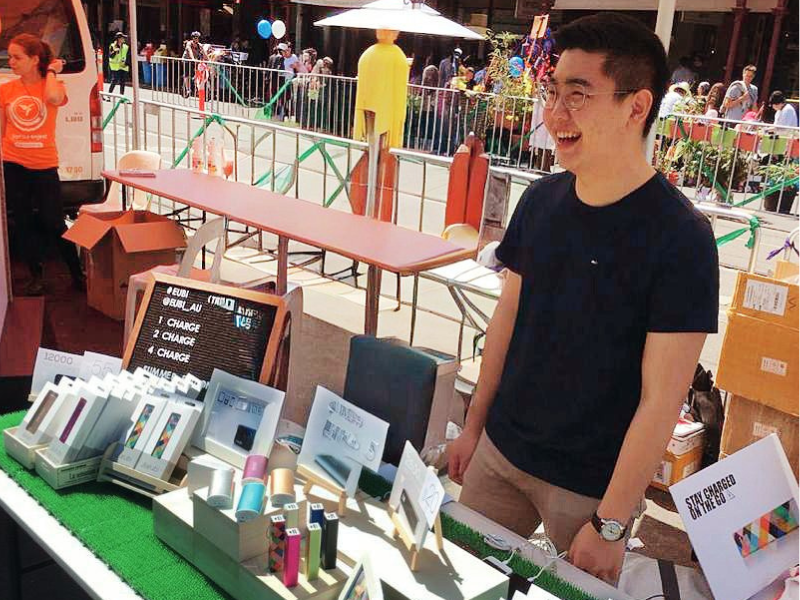
What began as experimentation soon outgrew the confines of a student side gig. GoPitch, his proper swing at something of his own, was short-lived, but the acumen behind it endured: Chee studied opportunity in whatever was trending. At Groupon Malaysia’s business intelligence team, that meant gauging consumer appetite through watching live deals. Power banks kept surfacing among the hottest sellers, answering a niggling but urgent hassle of the era: iPhone batteries that rarely lasted the day. With his brother roped in as an investor, Chee set up Eubi, the earliest registered venture to earn him his first real dime.
“It changed lives. I went back to the same guys I sold the Google Business Profile to and told them, ‘Hey, now this power bank only costs A$50.’ Some took it on consignment; others bought outright,” says the intrepid trader, who did not stop at his existing network. “I also set up a booth at a creative market, which cost about A$100. Since I was only a student, my mother lent me some money for a second-hand Nissan Dualis, an SUV large enough for tables and stock. On one occasion, I easily made anywhere from A$5,000 to A$8,000 in a day. If that happened every weekend, that was A$30,000 to A$40,000 a month.”
For a go-getter educated by restless hustles and YouTube rabbit holes, Silicon Valley, naturally, emitted the glow of inevitability. Upon graduating in 2016, Chee applied to Tradecraft, a San Francisco programme that placed local and international candidates on secondment at Bay Area start-ups. The premise suited him; the hierarchy, however, did not. “I couldn’t follow instructions. I’m a very jumpy kind of guy, always hopping to the left or right and finding a shortcut.” Rebellious, impatient and constitutionally allergic to bureaucracy, the eager recruit nevertheless saw the programme through, even as the stint confirmed what had long been obvious: the employee life was never going to sit well with him.
By 2017, after landing yet another hit — the Alexia push-up bra, which at its peak moved roughly US$1 million a month and bankrolled what he recounts as a nomadic year of travelling and diving across Asia — Chee decided to come home. Captivated by Kuala Lumpur’s fertile start-up ecosystem, he leased a modest space at the co-working hub Common Ground in Damansara Heights and began assembling what would become RPG.
2.png
Keeping it cool
The limitation of an enterprise that exists entirely on a screen is that, in the end, it remains a rumour of a product. Photographs can flatter and a spec sheet can persuade, but neither can reproduce the decisive moment of touch: the weight, texture and finish against the palm. For a digital native with the margins and anxieties to match, the thought of putting Montigo directly into buyers’ hands had begun to make sense. After moving office to Damansara Uptown, Chee got to know his landlord, See Hoy Chan Sdn Bhd, the developer behind The Starling Mall. Through its vice-president, he learnt of a central spot that had been vacated during the pandemic by Hydro Flask, the American bottle maker.
“She asked if we wanted to take over. The rent was RM4,000 a month, about US$1,000, so it felt doable — a no-brainer. We launched our first outlet at The Starling on May 1, 2022, which I remember vividly because it was Labour Day. It was a humble setup, but customers recognised us immediately after a year of digital groundwork. We went on to open more kiosks in malls like KL East and Paradigm in Petaling Jaya. And you know what? Every one of them was profitable. That was when I thought, hey, we’re on to something here.”
The timing was fortuitous. Water bottles had become, curiously, a genre of consumer psychology worth examining. Fuelled by the #WaterTok trend in 2023, users filmed themselves dosing H₂O with flavour drops to create “birthday cake water”, while treating their hydration gear as fashion objects, flaunted as casually as a tote or a pair of AirPods. They are practical enough to justify the purchase, yet costly enough to signal discernment without inviting the accusation of flexing too hard. Montigo may not have been chasing that status-marker yet, but for many imbibing Malaysians, the appeal was clear: its Sense Straw range, which keeps drinks cold for up to 12 hours, or leakproof Roamer Tumbler with built-in handle, made commute-to-weekend mobility extremely convenient.
“We have this big belief that the future of retail is experiential. You walk into our shops and tinker with the cap, lid, every part of it, right? We want it to feel like a playground — to ‘Drink Your Way’, as our tagline goes. This isn’t about reinventing the wheel; we’re here to make the product better. When Montigo started, I wanted to lean into an omnichannel approach with a universal SKU (stock keeping unit). Unlike fashion, where a medium in Asia and the US can mean very different things, a litre of water here and in the Middle East is essentially the same,” observes Chee.
“In the early days, I never fully grasped the magnitude of the drinkware market until I visited our manufacturer in Zhejiang, China, in 2023. The factory was probably the size of five 1 Utama malls, with 10,000 staff. I remember thinking, surely they don’t only produce bottles. But they did, supplying major global coffee chains and outdoor recreation giants. They even had a small museum, where I discovered it was a third-generation specialist with almost 60 years of history. That trip shifted my perspective and made me realise we could survive as a mono-store concept in Malaysia.”
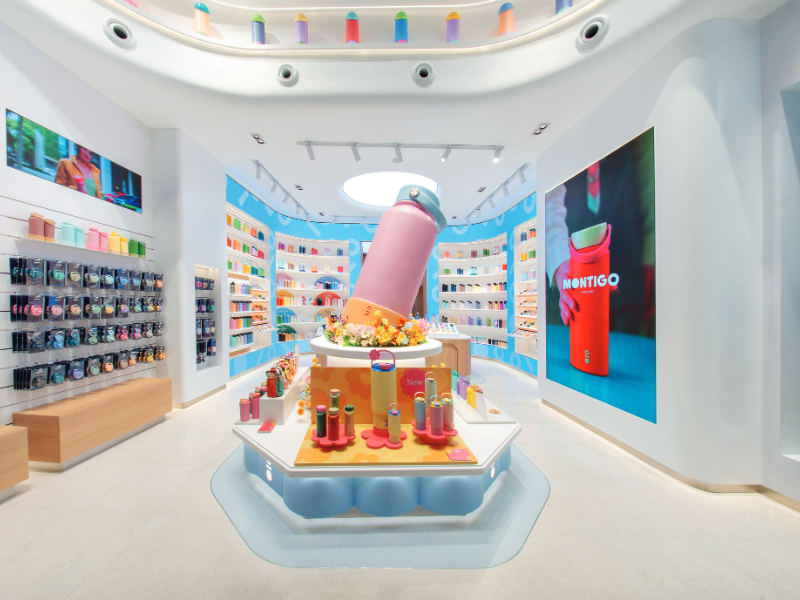
The irony is that the same malls that once sidelined Montigo have become central to its ascent. “When we went to Pavilion KL, nobody wanted to talk to us because we were still a tiny entity.” Today, its Pavilion presence is hard to miss: a large flask installation anchors the interior, surrounded by rows of merchandise arranged like books by spine colour. In 2025, Montigo grew from 30 to 58 outlets, yet it continues to rely on shopping centres for footfall. Unlike Melbourne or the US, where a sunny day sends crowds to parks and beaches, Malaysians love their air conditioning. Women currently make up about 70% of its customers, a following Chee puts down to word-of-mouth among mothers, who have become the brand’s de facto ambassadors. Having earned their trust, the team launched sister brand OiYo for children who want matching bottles of their own, using BPA-free Tritan material with higher shatter resistance to withstand daily wear and tear.
Experience gave Chee a proposition he could test abroad: if Montigo could turn a utilitarian staple into a mall fixture locally, it might travel well in other locales centred around shopping complexes. Sharing the same heat and habits, the Middle East came into view through a personal mentor living in the UAE. “One of the siblings running Sacoor Brothers, the Portuguese fashion label, urged me to visit. I had been to Dubai as a tourist but never as a prospector.” Through a commercial lens, the city read differently: its culture and climate echoed the conditions that had lifted Montigo at home. Subsequent trips to Kuwait, Saudi Arabia, Qatar, Bahrain and Oman clarified that theory.
That said, cracking the international model has demanded a different playbook. Chee tried building a team from a small co-working base in the UAE, only to find out how difficult it was to oversee a market 7½ hours away by flight and four hours behind Malaysia.
“In the Middle East, nobody had heard of us. I learnt the hard way that I can’t do it all,” he confesses. His role now is to build the product, marketing and retail concept, then work with the right partners to scale it. With inbound interest from as far as Eastern Europe, Turkey, Egypt, Latin America and South Africa, the goal is no longer to own every counter but to select operators who understand stores and shoppers well enough to carry the format. Chee is also enlisting ambassadors who can give the brand more mileage with a degree of cultural fluency. The right face, with context, can transform shelf presence into relevance and longevity.
4.png
Sealed success
Endurance often requires holding your nerve long enough to be proven right. Chee recognises that in business, though he first absorbed the lesson through a boyhood fixation with Nike and its mythology of invincible athletes. “The brand has always been a big inspiration to me as an entrepreneur. Jordan and LeBron were my idols, and watching how they embodied that entire DNA of winning made me want to follow in their footsteps. I’ve always wanted only to win — that was my game.”
At 32, failure does not seem to trouble him much; conceding does. “The day you fail is the day you give up,” he insists. For all the velocity of RPG’s expansion, his aim is not simply to be a big fish in a small pond, but to prove that one can thrive with the systems and discipline of an international force. “Many operate as local executor offices, taking instructions from headquarters elsewhere. But look at Mr DIY — I’m a big fan of the company. Driven by an aggressive, data-driven, bricks-and-mortar strategy and lower prices, it is now available in nearly 14 countries.”
What we lack, Chee argues, are people who have seen the machinery up close or functioned inside companies with global muscle and come home with more than a line on their CV. His chief of staff, for instance, cut his teeth at Nike in Portland, Oregon — the sort of returnee talent considered rare and necessary. RPG now employs more than 600 people, over 400 of them in retail and nearly 160 at headquarters.
At that capacity, speed has to be translated into structure, and Chee’s management style, by his own admission, is not exactly leisurely. “I’m a bulldozer at the front. I move fast, often alone, and charge ahead before the path is fully built. Somehow, I get across and the team works out how to make the route passable for everyone else. Thankfully, I have a strong crew that knows my pace, reads my body language and understands how I communicate. But deep down, I am still, as my father always calls me, a daydreamer. I spend a lot of time contemplating the impossible.”
This private ritual of rehearsing larger possibilities in his head has narrowed into a constant provocation: why not Malaysia? Years abroad have stripped away the insecurity that often shadows founders from humbler beginnings. “We each have our own capability and should never be discounted based on where we’re from. RPG is currently navigating in the lane that feels most swimmable to us — South Korea, Japan and the US are risky, super competitive waters — but if we do it right, there’s no stopping us from becoming a billion-dollar player. One day, if I make it, I’ll be proud knowing I have built a truly local brand that can stand on the world stage. That is the story I want to tell.”
This article first appeared on July 13, 2026 in The Edge Malaysia.