

Though discouraged from pursuing music professionally, Li saw it instead as motivation and has since graced some of the most prestigious stages in the world (Photo: Sam Fong/ The Edge)
Music, particularly classical, is often regarded as a universal language, expressing emotions where words fall short. Artistes are commonly perceived to be eclectic, sensitive and sometimes tempestuous personalities whose mind, body and soul are wholly consumed by their craft.
Their instrument is their medium of expressing thoughts and sensations that mere verbal description cannot do justice to, and the stage a platform on which the virtuoso momentarily transforms into the beau idéal of culture and artistry.
Unlike some other professions romanticised or over-exaggerated by Hollywood, silver screen depictions of musicians are not all that different from the real thing — at least, that is what Singaporean pianist Churen Li says.
“I actually think they’ve got it pretty on the dot. We’re exactly as they show us to be. Many of us are emotional and risk-taking, and most are free spirits who just want to live to the full. The really good ones, though, are quite boring because they spend so much time working and cooped up in little practice rooms.”
Though poised and polished, Li is anything but pedestrian. Always sharply dressed, she possesses exceptional command of the room when seated on the piano bench and there is an almost electric charge in the air before she starts playing. Like a tidal wave, the symphonies appear to engulf every fibre of her being as her deft hands fly across the ivories. For the audience, that display of sheer passion can often be the final piece in the puzzle when trying to grasp what a song is conveying.
Li’s earliest exposure to music was in a Yamaha children’s class at the age of three. “It was a really good foundation for developing oral and musicianship skills, though I only really got serious about playing a few years later when I did my first competition,” she recalls.
The biannual National Piano and Violin Competition in Singapore was her introduction to a higher level of playing, and each subsequent contest served as a gateway to an even more distinguished stratum. Each achievement was not only an addition to her portfolio, but a marker of personal growth, too. “Every time I got better at playing piano, I grew as a person. It’s a completely immersive, emotional and psychological thing for me.”
2.png
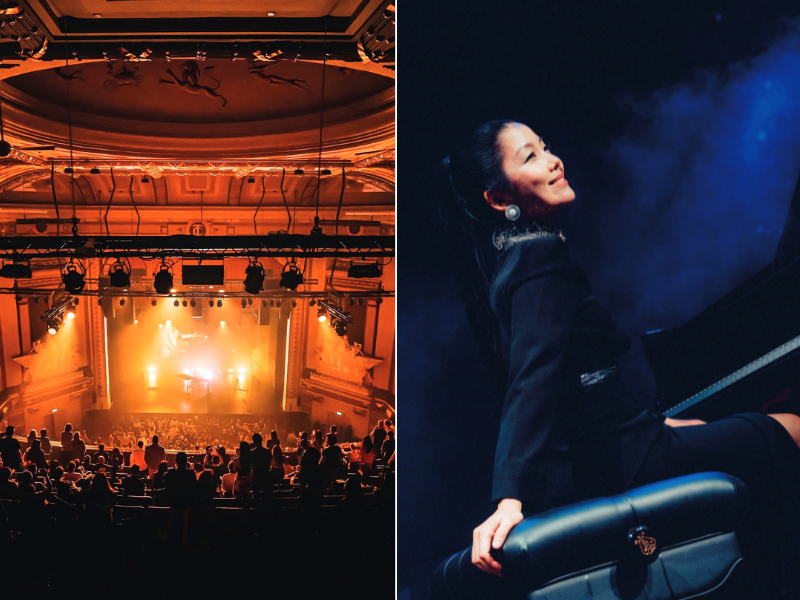
The journey was not all smooth sailing, though. Despite being driven and hardworking, the young Li was discouraged from pursuing music professionally by her elders, including school teachers and her parents. This had the opposite effect on Li, who saw it as a “huge motivator”. Her calling as a professional pianist became clear at age 14 and, two years later, she exited mainstream schooling to enter the Yong Siew Toh (YST) Conservatory of Music at the National University of Singapore. She graduated with a bachelor’s degree at 19, the youngest in her cohort, and went on to obtain a master’s from Yale School of Music.
The creative life is a colourful but sometimes lonely one, as it often comes with personal sacrifice. Li wonders how differently life would have panned out if she had remained in a traditional secondary school. “I always felt that my brain didn’t work as fast as my peers who did A levels or the International Baccalaureate. My regret was not having as broad or well-rounded an education as I would’ve liked. But I managed to sort of make up for that by doing a second master’s degree, in philosophy, at Cambridge and that was the best thing I could have done.”
And when years of hard work culminate in one’s dreams coming true, it is hard to have any regrets. Li has graced some of the most prestigious stages in the world and collaborated with leading brands such as Cartier and Rimowa. Her expertise goes beyond the traditional orchestra recital, too — do not be shocked if you see her playing alongside beatboxers or opening for world-class deejays. Ask her where she would love to play next, and she might just say the Antarctica, where, given the chance, she would stage the performance of a lifetime. “I’ve done the desert in the United Arab Emirates, so now I want to do a different terrain,” she replies. The song she would play in this frigid setting? Alexander Scriabin’s Mysterium — a piece that the German composer envisioned would herald the end of the world.
There is no feat, however, quite like representing one’s country. In July 2025, one of her greatest aspirations was realised when she performed at Singapore’s National Day Parade, joining several top musicians and performers to commemorate the nation’s diamond jubilee. “The stars first aligned in 2024, when a Straits Times reporter asked me what was on my bucket list. I said I would like to perform either with [Hong Kong singer-songwriter] Jackson Wang or at the National Day Parade. That became the section headline and I was put on the radar because of that article. A year later, the opportunity came knocking,” she recounts.
1.png

While she has solidified her place in the current musical zeitgeist, Li’s love for her art does not stem from the splendour of glitzy outfits or blinding stage lights. “The most memorable moments are the most personal ones. They are the times when somebody came up to me after a show and told me ‘That was my late mother’s favourite piece’ or I hear someone sniffling in the third row while I’m playing [Frédéric] Chopin. These might not be big, extravagant concerts but they’re the ones where I can feel the reaction of even a single person. That’s what matters to me most,” she says.
That desire to help listeners reconnect with their humanity was a key factor for her venturing into teaching, with her alma mater YST Conservatory and Yale-NUS College among the names on her résumé. And, now, she has taken her mentoring chops across the Causeway as the latest artist-in-residence at Sunway University, Kuala Lumpur. “The first time I ever visited Sunway was in 2022 for a Cambridge alumni gathering,” she says. “It was in the room on top of the Graduate Centre, the one that faces Sunway Lagoon. You can see across the park, which stretches towards the mall and the hotel. I remember standing there and thinking, ‘Sunway is a magical place.’ It’s amazing that students could look out to this huge playground from where they study and have top-notch facilities nearby.”
Li’s experimental, contemporary outlook fits right into the institution’s ethos of developing well-rounded performers through an interdisciplinary approach. This comes at a critical point in music history. We are observing a revitalisation of classical sounds, spearheaded by artistes such as Olivia Dean, Raye and Rosalía, whose recent output have included live jazz ensembles and orchestras, and operatic influence. In Li’s view, there is much to be learnt from this phenomenon.
“If you have a good thing, you should share it. What classical music brings to the table, particularly for non-classical artistes, is a level of craft, tradition and history. It’s something that pop and jazz practitioners can tap into to anchor themselves in a lineage that is longer-lived than themselves and their respective genres. It gives their art more depth and weight,” she notes. Traditional artistes also stand to gain from merging genres with their contemporary counterparts, that is, how to connect with listeners — a crucial skill to attract and retain a younger audience.
For a long time, classical music, including the spaces where it is performed and the communities who support it, were deemed upper class, alienating the common man, who could barely afford the expensive tickets. Streaming Beethoven online is an easy way to enjoy the genre, but it is in the environment of live performance — where you can witness the maestros in their element, sense their emotion, marvel at their improvisations — that audiences truly experience each note. Musicians such as Li are helping to forge a new cultural era, one in which classical sounds and modern tastes thrive in harmony.
“Years ago, classical music was a part of many people’s lifestyles. We want to make that a thing again, bring back the culture of going to dinner and then a show. We need to keep what is good and valuable about the classical genre but also hear the voices of those listening to us.”
Sound bite
Ahead of her Women’s Day concert on March 8, Churen Li talks about the women who inspired the masterpieces of great composers
Options: Tell us a little of what to expect from your upcoming concert.
Churen Li: The repertoire will feature pieces inspired by women who were the partners and muses of great classical composers. I wanted to give voice to the often invisible labour of the women who supported composers such as Chopin, [Robert] Schumann and [Claude] Debussy. So often, we mythologise the solitary male ‘genius’, forgetting the network of creative energy that made it possible for them to compose these celebrated works in piano repertoire.
This programme invites us to hear artistic greatness not as something solitary but as something communal and nurtured in a web of human relationships. For example, Schumann wrote his piano suite Kreisleriana as a present to his wife, Clara, who was not only the great love of his life but also an extraordinary pianist herself. It was she who edited and premiered many of his compositions. Chopin, meanwhile, had a tumultuous relationship with his long-term partner, the female writer George Sand, yet his letters reveal how deeply their connection fuelled his creative and musical life. Debussy, on the other hand, wrote L’isle Joyeuse after a holiday to the island of Jersey with his second wife, Emma Bardac. In fact, the early years of their marriage coincided with the most fertile creative period in his life, giving rise to other masterpieces, such as La Mer and Images.
You come with equally impressive credentials, with the National University of Singapore, Yale and Cambridge all listed in your CV. What made you decide to blend performing and music academics so strongly?
My first two degrees from NUS and Yale were in piano performance, but my third at Cambridge was a Master of Philosophy in Music. I am naturally curious about a lot of things and I find that my academic work provides rigour, inspiration and depth to my pianistic explorations. Again, context is so important — I believe one can’t interpret a piece of music without understanding the historical, philosophical and cultural milieu that it originally inhabited. All in all, my musical life is made a lot richer by the intellectual inquiry that surrounds it.
You even based your dissertation on George Crumb. Tell us about it.
I chose to focus my dissertation on him because his work represents a profound exploration of extended techniques and the symbolic use of sound, pushing the boundaries of what the piano can express. He even experimented with making sounds inside the piano by plucking, strumming and hitting the piano strings. I loved how free my body felt when performing his music, and it was like a natural extension of my own interests in sound worlds beyond traditional tonality.
His passing four years ago must have affected you deeply then.
I am surprised people remember that he passed in 2022! Alas, I never got to meet him in person, but his influence on how I approach sound and colour remains strong.
You also have an upcoming residency with Sunway University. Tell us more.
Over the course of the year, I will be presenting concerts and working with fellow faculty members and students to develop new projects that connect classical piano with contemporary ideas, as well as mentoring students through workshops and masterclasses. I am really looking forward to creating, teaching and collaborating with the Sunway community. What excites me most is making classical music feel alive and relevant, and helping students see artistry as something they can shape in their own voice. — As told to Diana Khoo
Churen Li will perform at Deciso Fine Violins in Bandar Sri Damansara, Kuala Lumpur, on March 8. Entry is by donation (RM98 for adults and RM68 for students). Register here.
This article first appeared on March 2, 2026 in The Edge Malaysia.