
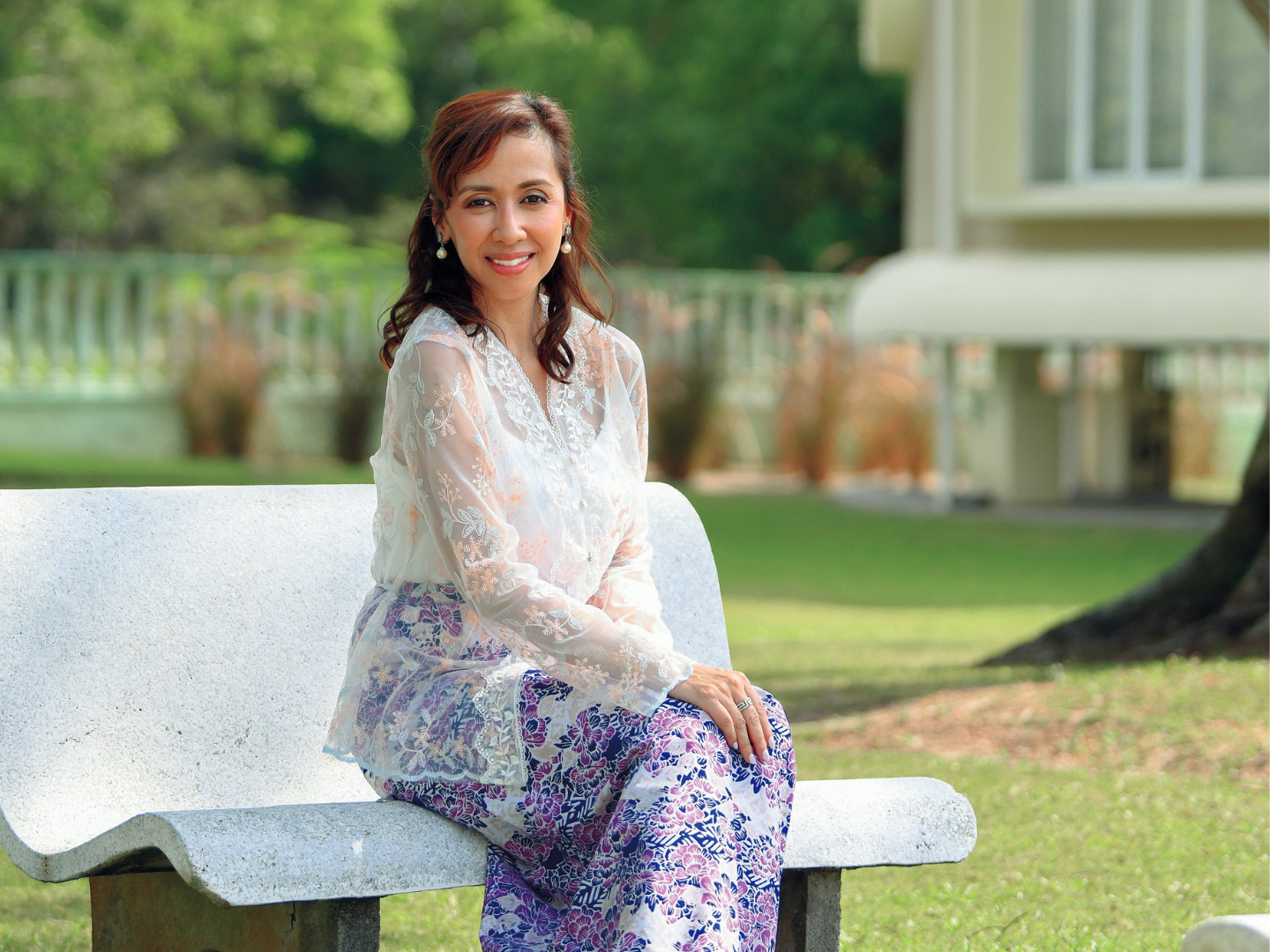
Tengku Zatashah in the Botanika skirt inspired by nature (Photo: Low Yen Yeing/ The Edge)
Batik has long carried stories within its folds. Passed down through generations and worn in different settings, from daily attire to significant ceremonies, the textile exists not merely as a fabric but also as collective memory.
Although the true origin of the ancient art remains a mystery, evidence points to the wax-resistant dyeing technique that dates back more than two millennia, with its existence mentioned in ancient India, China, Egypt, Japan and even Africa before prospering in Southeast Asia. Today, it is a significant symbol of identity in the region, specifically Malaysia and Indonesia.
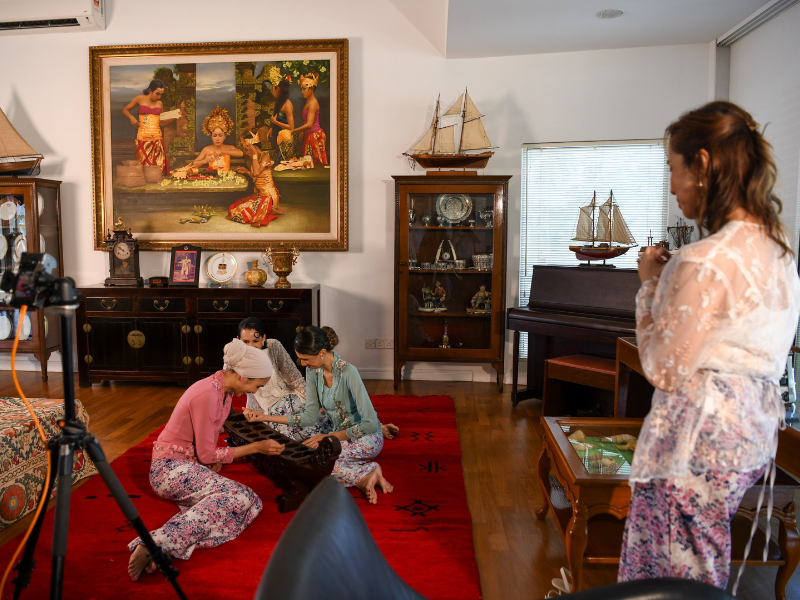
Inside a coastal palace overlooking the Strait of Malacca, this long history feels especially present. Istana Pantai Bahagia — a private residence of the Sultan of Selangor — is the chosen backdrop for the campaign. Heirlooms and antiques fill the traditional structure with even more character. Walls and floors are lined with ancestral portraits and models of the royal family’s boats and ships, juxtaposed with pristine blue and white porcelain.
Seated outside on the patio, YAM Tengku Datin Paduka Setia Zatashah Sultan Sharafuddin Idris Shah speaks about batik not as costume, but as something deeply embedded in everyday life. She is excited and radiant-eyed, seeing her creative conceptions finally take physical form.
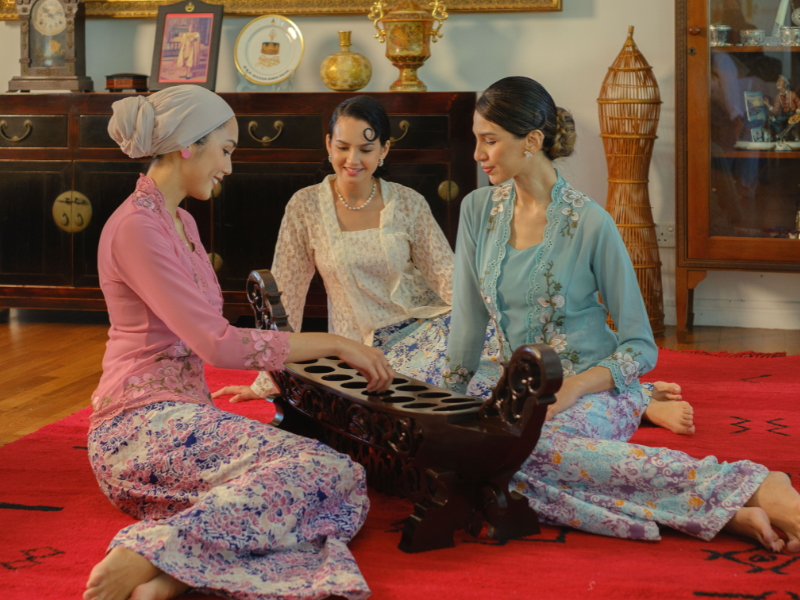
Nearby, the Kapten Batik team has all hands on deck. It is an energetic yet serene scene — girls holding ornamented tiffin boxes and walking across the wide garden hand in hand. Inside, they play congkak while cameras and handphones hover overhead to get the perfect shot.
More than a regular fashion partnership, this limited edition capsule collection serves as a meeting point between culture and wearability. For both parties, however, this crossover began long before the first sketch was drawn.
Woven together
1.png
“I love wearing batik sarong and kebaya, so this was a natural fit for the two of us,” says Zatashah.
A well-known fashion icon, the Selangor princess is commonly seen proudly donning the cultural wear on many public and social occasions, practices fostered from her love of the heritage as well as her mother’s Nyonya Peranakan background and several family traditions. Pieces passed down from her late grandmother fill her personal collection with rare fabrics that are still in use today.
Zatashah was introduced to Kapten Batik through her husband Datuk Aubry Rahim Mennesson, who has been a long-time supporter of the home-grown label since it opened its doors in Bangsar, Kuala Lumpur.
Through the common interest of diving, Aubry and Kapten Batik’s Fadli Muhsin bonded, with Zatashah being inadvertently involved (even though she is not as hardcore, they both agree). “Tengku has always been supportive of our initiatives, so we thought it’s about time we did something together,” says Fadli, who heads the brand’s creative and production department.
Three years of pondering finally culminated in the brand’s debut release for women. Befittingly titled the Princess Collection, the process fell into place at incredible speed, with ideation having only begun in February this year.
“This is not a typical collaboration,” Fadli jests. He says that far more than just being a name stamped on a tag, Zatashah took charge of the operation, even handling the most minute details. In addition to designing the patterns, Zatashah also oversaw the campaign production, from casting to marketing direction, and even gave her thoughts on how the products should be distributed.
This further solidified the team’s confidence that the regal figure was the perfect person to helm Kapten Batik’s first female-focused range. “Being in a team headed by men can be a bit difficult for us to channel our thoughts into womenswear. It is always a work in progress,” says Fadli. “At the end of the day, we need the perspective of women and Tengku has the perfect eye.”
Zatashah adds, “This release is very much Kapten Batik, but with my touch of making it feminine.” The challenge then came in translating her concepts into pieces that felt timeless and wearable, yet personal.
Printed stories
3.png
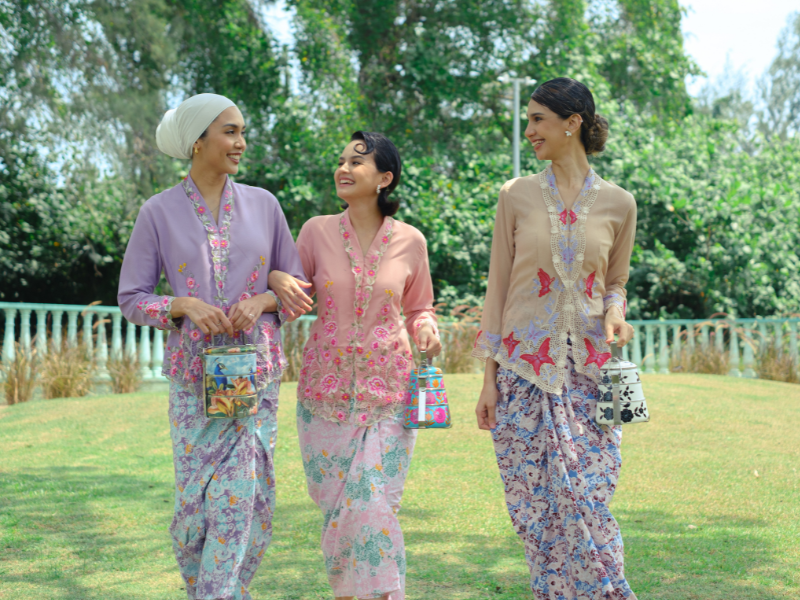
The capsule collection comprises five key pieces in the form of parios and skirts, with the two designs being presented in three colours. Dragon in Cloud offers patterns of the mystical creature surrounded by delicate swirls and small, billowing puffs, while Botanika combines the motifs of peony flowers and needle-like leaves. Each element is a meaningful symbol to the princess, depicting several aspects and values that she holds close to her heart.
Although she was born in the year of the Ox, the naga is closely linked to her upbringing and family heritage. “I have quite a lot of Indonesian batik with motifs of the mythical being. Since young, I have loved the story of the dragon,” she divulges. Additionally, the serpentine creature in the design is a tribute to her Peranakan heritage. “It also reminds me of my grandmother, who was definitely a dragon lady,” she adds cheerfully.
The majestic peony, on the other hand, is her favourite flower. Ironically enough, the blossom is also known as the “King” or “Queen” of Flowers in China, with the imperial flora being an emblem of prosperity, luck, love and honour. These specific blooms have always been imprinted on her psyche, stemming from Nusantara artwork she grew up surrounded by in her childhood home located on Jalan Bellamy, KL.
These intricate patterns, now found in the Princess Collection, are etched into cotton using a variety of techniques. “We are not doing something that can be seen in the domestic sphere,” says Fadli. Instead, the result is a combination of hand stamping (batik cop) and hand drawing (batik tulis). The former uses handmade copper stamps, so repeated patterns can be placed in a consistent manner, while the latter is illustrated freehand using the pen-like tool, canting.
Many standard pieces are two-toned. However, the team decided to utilise colour pulling (tarik warna) which allows multiple hues to come through the fabric. This way, dyes are applied either by dipping (celup) or brushing (colet) to ensure the colours can be placed in certain areas without being mixed. The blend of light and dark shades creates a contrast that lends more depth to the designs, adding a mesmerising three-dimensional effect.
4.png
The textiles are produced in Central Java’s Pekalongan, known as the City of Batik. As one of the most important centres for the industry, the municipality has been part of the Unesco Creative Cities Network since 2014. There, artisan block and mould makers can still be found since the art is well integrated into the local education system and economic development plans. A few times a year, the Kapten Batik team flies out to visit their producer with whom they have been working for almost seven years.
Zatashah’s vision was indeed ambitious, but the team managed to pull through, thanks to motivation from the princess. “I challenged them a lot,” she laughs. “I understand there are limitations because everything is traditional, and I’m still learning. They told me they hadn’t done it this way before, so I kept saying, ‘Come on boys, you can do it!’ and they delivered.”
To Fadli and the team, the difficulty added even more fun to the work process as it pushed them to take the project to a higher technical level and showed that the partnership was truly a blend of different strengths.
A piece for all
“Everyday Grace for Everyday Women” is the spirit that anchors the release. “It’s not just for a special occasion, and it’s definitely not a Raya collection. In fact, it’s quite playful,” says Zatashah. The hark back to heritage is given a contemporary twist through its design language that reflects the diverse expressions of women today, allowing the pieces to transition seamlessly in any scenario. “You can wear it to the office, out for an evening, or even to a party. You will look forever chic but also very Malaysian.”
Fadli adds, “It’s more than just another piece of batik. Ours comes with a story.” He emphasises that the pieces of art act as a sensory portal to the vibrant and historical cultural landscapes of Malaysia and Indonesia.
2.png
Wearers can let their individuality shine by pairing the pieces with their favourite top — a lace, muslin or long kebaya, or perhaps even a babydoll or wrap top for a more modern look. Zatashah recommends trying the sarongs with blouses that have a mandarin collar or puff sleeves for a more unique fit; and with a tank top for relaxed or laidback vibe.
Silhouette-wise, the chosen cuts are easy to put on and can even be styled by those looking for something more modest. Rooted in femininity and strength, the Princess Collection intends to evoke feelings of empowerment and resilience — much like how the art form itself has transcended through time. Zatashah expresses, “This is for every princess out there, and to me, every woman and girl is a princess.”
The princes out there have not been excluded. The upcoming launch will offer the textiles by bale in-store, alongside a tailoring service for customers interested in transforming the prints into shirts instead. Beyond aesthetics though, the line has always intended to carry something more meaningful.
Giving back
Zatashah is a princess who wears many hats — or crowns — and philanthropy is something she holds in high regard. Having served as Royal Patron for Make-A-Wish Malaysia since 2015, she is actively involved in its fundraising efforts and “wish-granting” activities.
In terms of designing for a cause, this is not her first initiative. Previously, she worked with Sereni & Shentel, a Borneo-based brand specialising in handmade headbands. The collaboration resulted in seven bright accessories, each named after a Make-A-Wish Malaysia girl, with the proceeds going to the non-profit organisation.
Similarly, 20% of the funds collected from the Princess Collection will be donated to the foundation. The narrative of the campaign itself is distinct from the usual. Make-A-Wish focuses on youth with critical illnesses such as cancer, severe heart disease and advanced cystic fibrosis. Taking that into account, this batik release tackles the mission from a different lens. More of a tribute to life, it highlights Make-A-Wish children who have started to live normal lives.
“I look at it as a positive thing, as there are many survivors and we want to give hope, strength and joy. That is the power of a wish,” says Zatashah. Now adults with their own careers, they are also invited to take part in the exclusive Kapten Batik launch at the end of May.
In many ways, the Princess Collection mirrors the essence of batik itself — something inherited, reinterpreted and passed forward with intention. Judging by the excitement surrounding its unveiling, this could only be the opening chapter to future iterations such as resortwear. What else will this powerful pairing come up with next?
The Princess Collection is available at the Kapten Batik flagship store at The Gardens Mall, KL.
This article first appeared on May 18, 2026 in The Edge Malaysia.