

Thirty fellows from 19 countries were lauded at this year's edition (All photos: Cartier)
Ramla Ali’s hands are resting in her lap. Occasionally, they curl around a water glass or clasp together in contemplation as she considers a question. Such calm gestures would scarcely warrant notice were they not performed by one of the world’s most accomplished boxers, whose profession hinges on the precise application of force.
“I’ve been fighting my whole life,” says the athlete during a sharing session in Bangkok prior to the awards ceremony of Cartier Women’s Initiative (CWI), the annual entrepreneurship programme that honours changemakers making a positive impact on society and the environment. She means it in more ways than one. Born in 1991 in Mogadishu, as civil war consumed Somalia, Ali was still a toddler when her family fled the city after her eldest brother was killed by a grenade while playing outside. Following a perilous escape by sailboat to Kenya, they eventually settled in East London, the UK.
The war refugee turned sports champion is not alone in having made that journey. Seated beside her on stage is human rights lawyer and activist Amal Clooney, who arrived in England from Lebanon as a child after conflict engulfed her homeland. Both would go on to forge international careers despite upbringings that promised little certainty. But only one trains in a field where a lapse in confidence can result in an actual punch to the face.
“I also studied law because my mother believed it would lead to a stable, respectable livelihood. However, I hated it so much,” she remarks, casting a sidelong glance at her co-panellist. If Clooney — poised, articulate and impeccably composed — was the bar of success and living proof of how formidable that trajectory could be, Ali, who had traded her barrister’s robes for boxing gloves,could only concede how ill-fitting that life had felt. The room erupts in laughter, though the humour carries an undercurrent of truth familiar to anyone who has refused the future others imagined for them.
“I’ve always felt like an outsider, as though I were taking up someone else’s place and hadn’t truly earned the right to be there,” Ali says, as the afternoon’s discussion turns from kindness to imposter syndrome. The admission is striking, especially coming from the first Muslim woman to win an English boxing title and represent Somalia at the Tokyo Olympics in 2021.
4.png
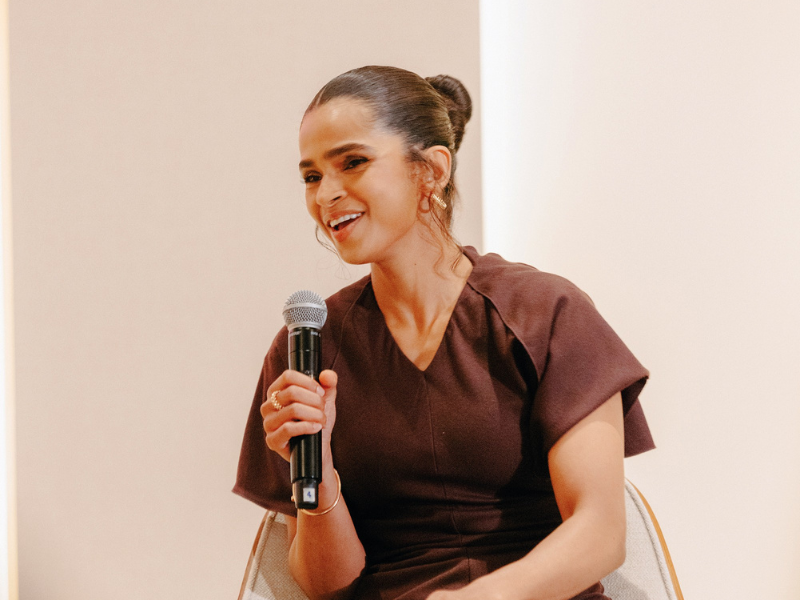
“As a child, I routinely lied about my ethnicity or birthplace, a habit I carried into adulthood until modelling found me and, for once, asked me to be visible. It helped fund my sporting career, and later filmmaking, when I co-founded the production company 786 Entertainment with my [former coach and] husband. But no matter how far I’ve come, people still tend to overlook what I do and address him first. When that happens, I think back to the 13-year-old girl who found her way into the ring, or the teenager hiding a black eye from her mother, who had risked everything to shield her children from violence. The goal was always the same: to be the best. We’re so preoccupied with fitting in that we forget to stand out.”
Doubt is a recurring theme that finds fertile ground at CWI, striking at the heart of the very barriers the programme seeks to dismantle. The pairing of Ali and Clooney is hardly incidental. Twenty years on, the initiative can point to an impressive record of women building companies, securing capital and reshaping industries. Yet year after year, conversations with finalists — or fellows, as they are known — return to the same interior battles that run alongside the practical demands of their ventures: the gnawing need for permission, reflex to deflect praise and compulsion to apologise for wanting more. Left unchecked, these private misgivings harden into self-censorship, dulling the very edge that brought them this far.
Such hesitation rarely begins with the individual alone. During the talk, Cyrille Vigneron, Cartier’s chairman of culture and philanthropy, observes that insecurity is often seeded by culture. In parts of Asia, where humility is prized and assertion can be mistaken for arrogance, female leaders are taught to downplay competence or wait for external validation before claiming authority. “In Japan, there’s the practice of gaman suru, which means to endure; to bear with it. In France [where grievances are more readily voiced], we just go on strike.”
He cites his colleague June Miyachi, who spearheaded the Women’s Pavilion at Expo Osaka 2025, to illustrate how social codes can punish those who depart too sharply from the script. “June explained how her position was expected to be held by either a middle-aged Western man or an older Japanese executive — not a woman in her 40s, and especially not a mother of three. She just had to stand firm and prove she could do it,” says Vigneron, acknowledging that scrutiny falls more heavily on those who do not fit the frame. Therein lies the more uncomfortable truth: sometimes, doubt is not a warning from within but the echo of a world still struggling to make room for leadership in unfamiliar forms.
Her mentality
body_pics_3.png
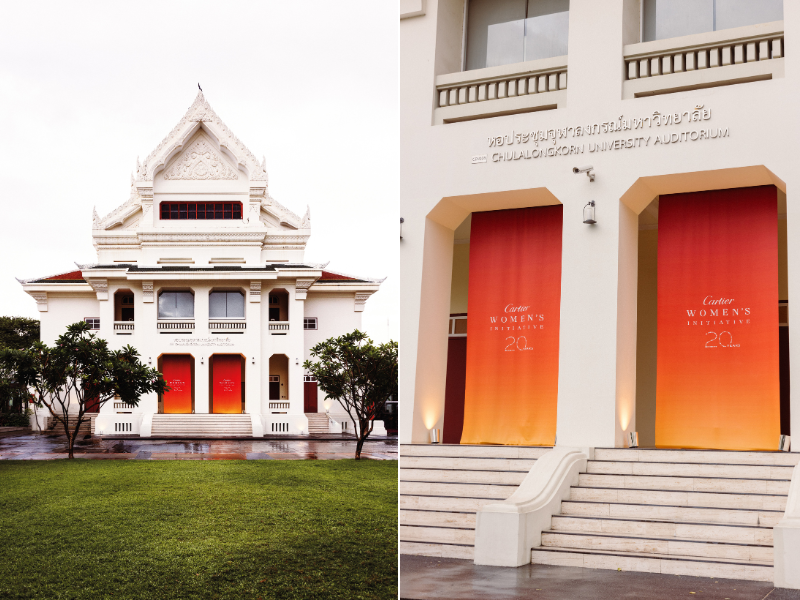
Two decades have opened more doors for women but walking through them is another matter. Launched in 2006 under then CEO Bernard Fornas as a business plan competition created with the Women’s Forum for the Economy and Society, CWI was originally conceived to nurture entrepreneurs at a time when financial backing and mentorship were limited. In 2017, Vigneron restructured it into a freestanding format, broadening its scope as the number of regional awards grew from six in 2018 to nine by 2023, alongside the introduction of a Science & Technology Pioneer Award. The prize model has also expanded: whereas early winners took home a single grant of US$20,000, each category today allocates US$100,000 (RM411,000) to first place; US$60,000, second; and US$30,000, third. They also receive a one-year fellowship and lifelong access to the maison’s wider network.
For its latest edition, 30 fellows from 19 countries were lauded at Chulalongkorn University, notably including its first representative from Nepal. Established in 1899 as a school for training royal pages and civil servants at the Grand Palace, it offered more than a ceremonial stage. Newly appointed CWI director Kiyo Taga emphasises that Bangkok’s thriving entrepreneurial landscape, coupled with Cartier Thailand’s existing work with the university on female entrepreneurship, made the capital a natural host. Last year, that partnership convened 50 candidates for extensive strategic and management coaching, reflecting a broader push to solidify the country’s start-up scene.
“The most beautiful illustration of how the initiative has developed is the growth of our community. It’s a welcoming, dynamic network committed to mutual support, sisterhood and allyship,” says Taga.
On a global scale, the awards have so far supported 330 trailblazers from 67 countries, channelled US$14.1 million in funding and connected 520 active members across more than 80 markets. Impressive as those figures are, its more enduring value lies in an ecosystem that allows honourees to meet as collaborators, sounding boards and accelerants.
The influence is perhaps most clearly seen in the crossover between fellows Lynne Lim and Cécile Réal. Acquainted in Shenzhen, China, Lim, a Singaporean surgeon and NousQ founder, had developed CLiKX, a handheld robotic apparatus devised to make ear tube surgery more accessible. Réal, a jury member and medical device investor, lent a rare fluency in taking medical technologies from invention to market, having built Endodiag before leading Medevice Capital. By December, she had joined NousQ’s advisory board, guiding its strategy, product and business development.
2.png
A similar alchemy emerged with Impact Awardees Kresse Wesling — whose label Elvis & Kresse transforms decommissioned fire hoses into luxury accessories — and Mariam Torosyan, founder of Safe YOU, a mobile service protecting women and girls from gender-based violence through emergency alerts. The two met during a systems-change roleplay exercise that asked participants to explore how their enterprises might benefit one another. Within 24 hours, they had designed a limited-edition wristband online, with proceeds directed to Torosyan’s mission.
That momentum carried into this year’s cohort. Mylène Fifamè, the first-place awardee for Francophone sub-Saharan Africa, said at a press roundtable that a CWI contact had introduced her to a sovereign wealth fund she had been pursuing for months. The payoff for Australian Ruby Riethmuller, founder of the mental health app Womn-Kind, was even more tangible: another participant kindly stepped in to help revamp her platform.
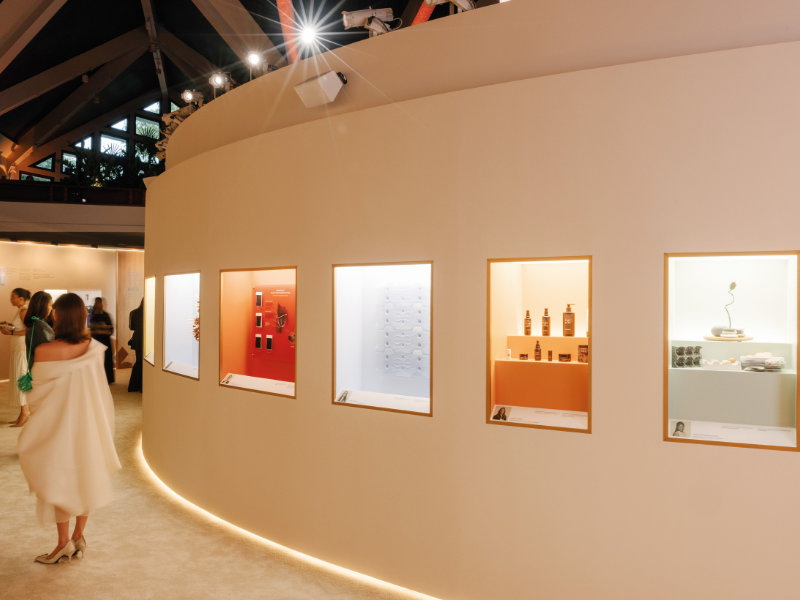
Reciprocity, then, transcends goodwill. It also depends on what institutions choose to put behind the people they elevate. Cartier’s name does not simply confer prestige and, on its own, cannot undo the hierarchies that decide who is funded, heard or taken seriously. What it can do is unsettle them, granting people the institutional weight too often required before gatekeepers are willing to see their ideas as serious propositions. A standalone exhibition accompanying the ceremony made that case without words: The interactive Cabinets of Curiosities displayed tools, materials, prototypes and products from the fellows’ ventures, allowing visitors to encounter them firsthand.
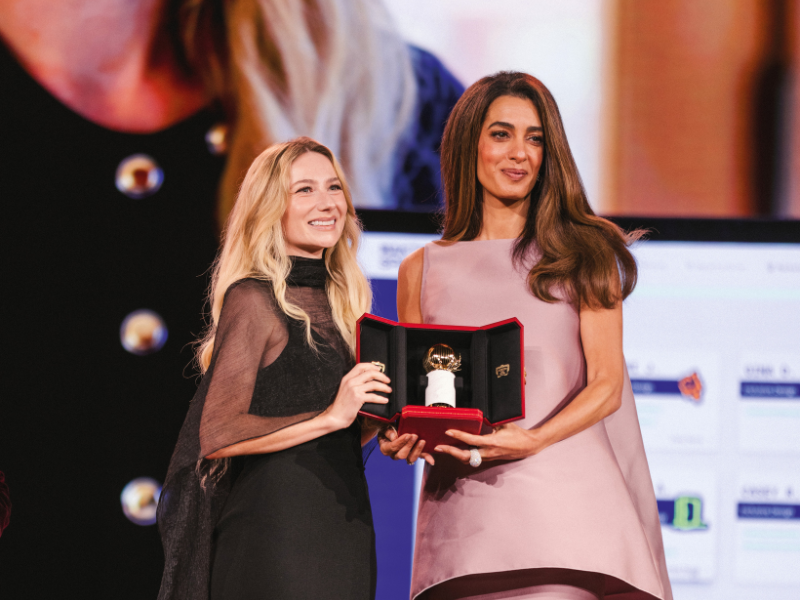
The true measure of solidarity is not sentiment, but what it produces for the people it claims to serve. No one articulates that dynamic more plainly than Clooney, who returns to the gala as a keynote speaker. “CWI has become a sisterhood, in which everyone celebrates and propels each other’s success. It began with a handful of women and a stubborn conviction that talent is everywhere, even when opportunity is not. Now, it shows what that conviction can build. The theme of this anniversary is Women Lighting the Path. These leaders took the road less travelled and in doing so, lit the way for every girl who will follow them. They are the embodiment of the learnings that shaped this evening: be the first, be grateful and be courageous.”
3.png
Pitch, please
CWI’s class of 2026 did not come to be modest. Behind almost every pitch was a personal reckoning — farms struggling to feed communities; a healthcare system buckling under its own gaps; coral reefs vanishing beneath sediment and coastal development. These were businesses that rose from the wound. But some stories just cut deeper.
For South Korean game designer Jeklin Kim, the rupture came with her son’s diagnosis of cerebral palsy. “Discovering that he had a disability meant accepting it was not a disease — not something curable. I had to come to terms with something I couldn’t fix, and learn to build a life around it.” The diagnosis pulled her under. However it also raised the question that haunts every parent in that position: how does care continue not for a week, or a month, but for a lifetime?
Before founding GemGem Therapeutics, she had spent more than a decade as a director at Nexon, one of the country’s largest gaming companies, working on popular titles such as MapleStory. Her job had been to build immersive, joyful digital worlds. That expertise became the unlikely medium for her grief — and the foundation for GemGem400, a game designed for hand rehabilitation that uses a smartphone or tablet camera to track fine motor movements without specialised equipment. Its artificial intelligence (AI) adapts exercises in real time to each child’s ability, personalising treatment while keeping them engaged through story-based play.
That sense of repair reaches back into Kim’s own childhood. “I came from a very poor family. Do you know the rundown house in the movie Parasite? My previous home was worse as it was shared by six other households.” Poverty, she adds, taught her to feel grateful for “every little bit”, even when gratitude could be painful. Today, the clearest evidence of GemGem’s impact comes from other mothers, who tell her that after weeks of playing GemGem400, their children can finally grip playground equipment or join their peers instead of watching from the sidelines. “Mums call me crying,” Kim admits. Those are the moments she describes as her happiest.
5.png

A different kind of redress animates British entrepreneur Keely Cat-Wells, who asks what else might change if equality were no longer treated as an exception. A victim of medical malpractice that left her with a permanent ileostomy at 17, she lost a job in the media industry due to disability discrimination. Galvanised by that trauma, she set up Making Space to help companies train, hire and retain disabled talent, while pushing back against the patronising language of inspiration.
“We continuously saw how disabled people were being applauded and rewarded for literally just getting through the day,” she asserts. “It is not inspirational for a disabled person to just go shopping, get out of bed, or attend school. The world loves to celebrate them for doing those basic things, rather than focusing on what should be created in a more accessible society. Actually, I’m not overcoming my disability, I’m overcoming the hurdles built around me.”
Making Space has empowered more than 10,000 disabled professionals and placed hundreds in roles with partners including Netflix, Visa, Coca-Cola, Red Bull and Salesforce — outcomes that have strengthened not only earning prospects but also a renewed sense of self-worth.
For all the ground these entrepreneurs have broken internationally, one absence lands closer to home: why has Malaysia yet to produce its first fellow? The country’s entrepreneurial soil is rich; its women founders are already driving solutions where need is most immediate, often with fewer resources and less room for failure. In fact, they account for about 21% of the nation’s small and medium enterprises (SMEs), comprising an estimated 241,767 establishments and contributing significantly to the local economy, particularly in service and retail.
What may be needed, then, is not simply more guidance at the application stage, but a stronger willingness and appetite to step forward. CWI looks for more than a flourishing business; it asks founders to articulate their purpose, defend the numbers, pressure-test their objectives and believe that what they are pioneering in Malaysia deserves a global audience. Sound counsel, as far as it goes. But a bracing reminder came from Mexico’s Cristina Campero Peredo, who topped the Latin America and the Caribbean category this year with Prosperia, an AI-enabled retinal screening technology to detect diseases that can cause blindness.
“I don’t see myself as a woman getting special treatment or privilege. I see it as correcting for all the rooms we were historically not invited into. Surround yourself with people who are better than you because we have a tendency to pull each other into our own light. The substance still needs to carry its own weight. At the end of the day, you just need to want it badly enough.”
This article first appeared on July 13, 2026 in The Edge Malaysia.