

"I have worked some four years on this, and I must say that it has proved to be one of my most challenging series, even though it is far smaller compared with the rest of the paintings I have done,” says Yusof about Cenderawasih (All photos: Shahrill Basri/The Edge)
As much as the prolific has defined the art practice of Yusof Ghani — one series upon another, as if these sequences were themselves an extension of that which drives his hand and serves as his principal aesthetic, energy — it is always the painting that stands apart. His work arrives unaccustomed, speaking in other ways of the painter and his versatility, even restlessness.
Set square in the middle of his gallery, Tapak, in Shah Alam is a wall-sized, uncharacteristic Yusof Ghani painting. Separated from the flow and fluidity commonly associated with his hand, this painting is still, ponderous and craggy in its representation and enveloping in its mood. Etched, nevertheless, with the characteristic stark lines of the artist, it conjures faces within it as if they were in a state of siege. The painting is reminiscent of an ancient cave painting yet with a highly modernist sensibility, invoking an early 20th-century German novel — heavy set and stirring — by Austrian novelist Hermann Broch with which it shares the same title, Die Schlafwandler (The Sleepwalkers).
“It’s about my grandson,” Yusof says, simply.
When contemplating his works, it is always best to think of “departures”. “I easily find myself quickly becoming jemu (bored),” he confesses. His work has often been described as being rooted in the iconoclastic, even anarchic, traditions of Abstract Expressionism.
It remains a characterisation Yusof does not deny, himself writing in the catalogue to his latest series Cenderawasih, “Although my art has straddled the realms of both abstraction and figuration, I have always been recognised as an abstract expressionist artist. Whereas labels are for writers and academics, it is a categorisation that I do not resist since I was heavily influenced by many of the great masters of the expressionist movement…”
For one popularly described as a “painter of chaos”, this tendency has been relentless in the sequential “series” that have unravelled: Tari, Topeng, Wayang, Segerak, Biring and Kuda, among others. Some of these — Segerak, for example — have evolved in parts. “Often the paintings overlap,” he explains. “And there seem to be layers and layers to unravel.”
gallery_outside.jpg
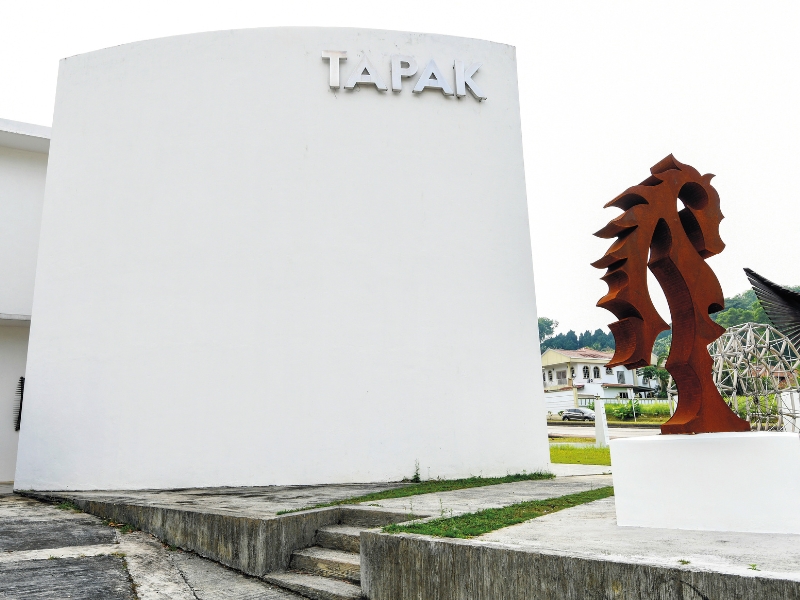
Implicit in this tendency to unfurl is the keen sense of movement and the notion of impulsion. Yusof has described the inherent tensions in his paintings as essentially “political”, and it is a charged sensibility that embraces the “politics” of inexorable movement, of cataclysm and great change.
His first exhibited works revolved around the title Protest, and served as a prelude to his first solo at the Anton Gallery in Washington DC. The show was praised by, among others, The Washington Post’s art critic Joanna Lewis, who described the paintings of Protest as “bold, relentless”. Protest addressed the political conditions in the US, especially its involvement in El Salvador and Nicaragua.
The late 1970s and early mid-1980s were tumultuous times in the US. Yusof was a student at the Catholic University in Washington DC and his wife and long-time companion in adventurism, Siti Meryam, served at the Malaysian Embassy.
Immersion — in movement, in the counterculture, in the art — marked his US experience. A catalogue for one of his exhibitions, Ombak, held at the Bank Negara Art Gallery features a year-by-year account of the life of Yusof. It is splendidly pictorialised, and among the many evocative photographs is one of him attending a remembrance service for John Lennon.
The US experience proved transformative, especially with respect to possibilities that exist in art practice. Picasso was an initial formative experience, particularly the painting Girl Before a Mirror. Where art for Yusof, at a young age, were doodles, scratches and landscapes, the Picasso, encountered in the home of his art teacher Che’gu Minhat, changed everything. “I was smitten,” he would recall. “The incomprehensibly evocative painting was hypnotic. I was struck by the impact of a composition that was abstract yet so expressive and made me realise that beauty did not have to be obvious or blatant,” he would write in a brief autobiographical essay, 40 Years of Yusof Ghani.
The US and the encounter with Abstract Expressionism would begin the process of unleashing. “I had always wanted to study art. I had been denied entry in the early years, both at Institut Teknologi Mara and Universiti Sains Malaysia. And when I witnessed art classes and art students in the States, I thought to myself, ‘What is going on?’” Yusof recalls. “Encountering the Abstract Expressionists who would scratch and tear and plaster their paintings, I began to understand that there is a language, and sometimes the language goes beyond everything else to this practice that goes beyond form and shape, that there is a gravity and pull besides the composition, and there are times when colour is more important than image, and that a painting can go beyond image.”
gaery_inside.jpg
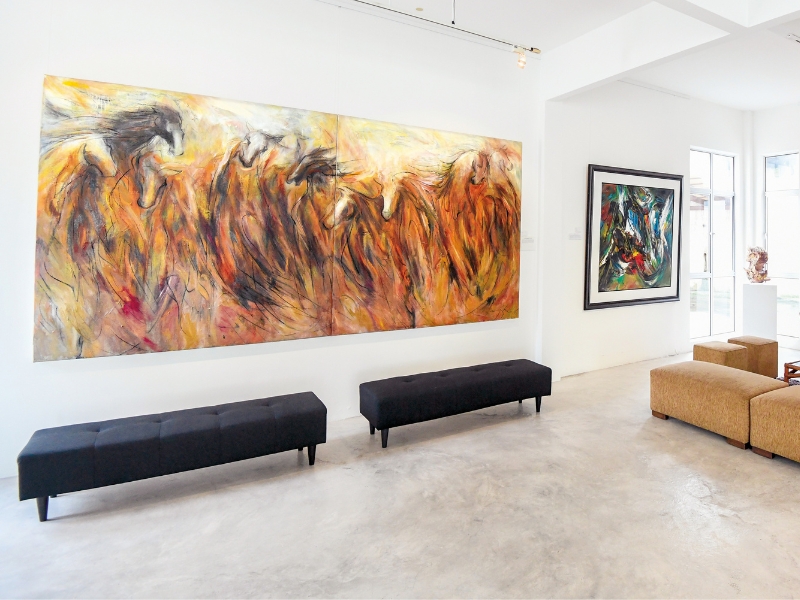
The idiom of the American remained a preoccupation upon his return from the US, and he found art tradition in Malaysia to be largely confined to the decorative. It was within such an artistic climate that he was perceived as “chaotic” even “anarchic”, but a visit with the painter Latiff Mohidin proved to be a masterclass in thought and application.
“Latiff was in the midst of painting his Rimba series, and he said something to me that I have not only retained, but made more intelligible with my own painting practice,” says Yusof. In characteristic Latiff fashion, the remark — almost aphoristic — to him was “lembut atas keras; keras atas lembut” (soft upon hard, hard upon soft).
Contemplation of this is perhaps what inspired the particular Yusof Ghani approach to fine detail and its visual corollary — aesthetic, organised chaos or wildness.
Still concerned about overt Americanisms, the artist is reassured by one of his principal collectors, who remarked, “You can never be completely American — your colours are too belacan and durian.” It is perhaps a fitting and candid description of the colour schemata that has come to define Yusof’s aesthetic expression.
Even as he found himself set apart from the broader art traditions of Malaysia, he acknowledges that the country is inherently “modernist”. It is too “gado gado” (mixed) and is not constrained by the budaya agong (grand traditions) of neighbouring countries such as Indonesia and Thailand. “We could say that we have more freedom because of our mixed realities,” he explains.
A single principle (even a political one perhaps) remains the compulsion for Yusof’s art. “Man cannot be separated from his environment,” he stresses, as the fierce and relentless strokes, which characterise most of his paintings, are given greater light by that self-professed assertion.
pic_1.jpg

An inveterate traveller, he says: “From my teens, I had wanted to travel. It is the only one for the world to renew itself to you, and for you to absorb new experiences.”
Travel, which inspired most of his series, to Sabah and Sarawak, the Middle East and the many islands of Indonesia spawned Cenderawasih: Energy and Emotion.
“Everything is dark in Papua New Guinea. The shaded environment is dark, even the people are dark, but very hospitable. From this I suddenly came across the bird of paradise, which was a total contrast to the place. Florid, so full of colour, the bird was almost something beyond imagination, even to the artist. I immediately recalled our own myth of the Cenderawasih bird, which really is this bird of paradise,” Yusof remembers.
“The bird has a certain way of gazing at you: it does not look at you directly, but askance. That gaze haunted me, and when I returned, I simply had to paint it.”
A deconstructive process occurs. Drawings — sheafs of them — an imaging of the bird, part colour, part poise, takes place. “I have worked some four years on this, and I must say that it has proved to be one of my most challenging series, even though it is far smaller compared with the rest of the paintings I have done,” he says.
It is capturing the “essence” that remains the purpose, yet it is also the most elusive aspect of the series. Cenderawasih is a dramatic series of combinations. Almost taxidermic in its approach, it is a sequence of vibrant colours that undulate into the deeper and further reaches of the birds’ hidden reaches, more redolent and dramatic. Made more so by the simple titles given to each of the paintings — Compositions.
pic_2.jpg
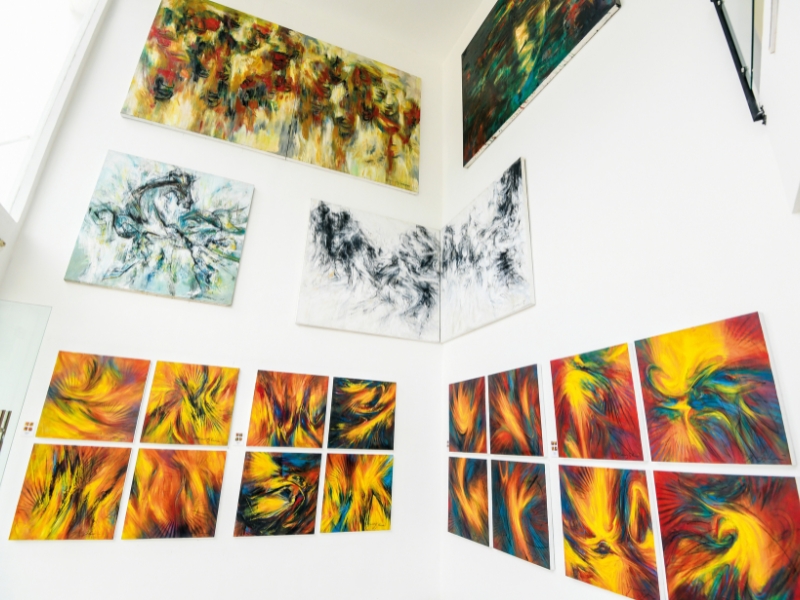
There is an aspect of transubstantiation that takes place in Cenderawasih, that the painting becomes an embodiment of the painter. In that way, the radical streak of Yusof Ghani continues to urge the painting. “It is all about capturing the essence.”
Unlike paintings from his other series, Cenderawasih appears as an act of joinery, of composites forging a whole part. Its movement is disparate but its coming together provides a whole. “I work with my body. Where I move, the painting moves. I sometimes also picture myself as if I was looking in a camera or through a camera, and that is how I perceive the lines,” he says.
In Cenderawasih, it is grappling with the layering and structuring that must have proved to be the principal challenge — the imagined taking apart of a beautiful bird to make it incarnate again in sequence. There are times when art is said to push the boundaries. This “most challenging” series is what Yusof, in all his years, has attempted most tenaciously.
'Cenderawasih: Energy and Emotion' at Tapak Gallery in Shah Alam will be open for viewing by appointment only. For details, call Ahmad Fahmi at 012-9248500.
This article first appeared on June 30, 2025 in The Edge Malaysia.