
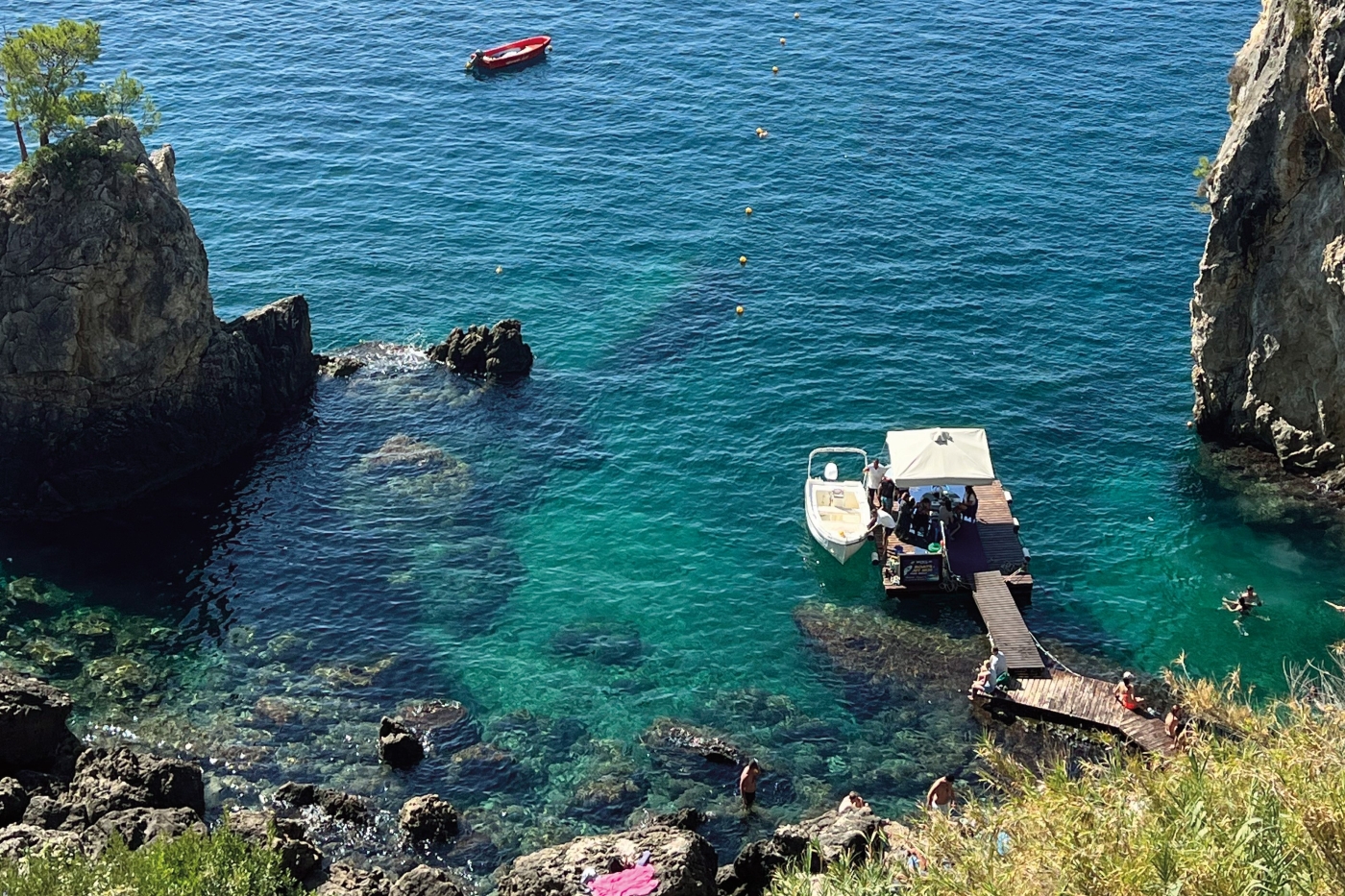
The Ionian Sea’s inviting turquoise waters
The average Asian traveller might answer, without hesitation, Santorini or Mykonos when asked to name an idyllic Greek island. But the literati would probably take longer to think of a reply, given the dizzying number of locations that have both produced renowned writers and poets, as well as inspired them, over the centuries. Top of mind would be Ithaca, the home of Homer’s Odysseus and hero of his seminal Odyssey. There is also, of course, Lesbos, immortalised in Sappho’s lyric poetry to the point she became known as “the Tenth Muse” while, much later, Spetses in Attica provided the setting and inspiration for John Fowles’ Phraxos in his 1966 novel, The Magus. And although Athens does not fall under the category of “holiday island”, it nevertheless enchanted Lord Byron enough to join the Greek War of Independence against the Ottoman Empire, where he ultimately lost his life at the age of 36 while leading a military campaign.
The island enjoying the biggest revival of late, however, has to be Corfu. In the 1930s, it was home to the eccentric Durrell family, namely the brothers Lawrence and Gerald, who became known for The Avignon Quintet (which includes the Booker Prize-nominated Constance) and modern-day classic The Corfu Trilogy respectively.
Gerald was effusive in his love for the island, saying:“My childhood in Corfu shaped my life. If I had the craft of Merlin, I would give every child the gift of my childhood.”
But even if you do not like reading, there is no need for literature to lure you here.
img_3130.jpg

Just an hour’s flight from the capital city, Corfu is perfectly placed in the Ionian Sea, part of a greater satellite of six islands that include Paxos, Lefkada, Ithaca, Kefalonia and Zakynthos, and is a year-round destination, unlike some other Greek islands. British royalists will know of it as being the birthplace of Prince Philip, the late Duke of Edinburgh, who was born at the Mon Repos Palace in Paleopolis. The site now houses a small but charming museum and the grounds is home to a Doric temple, discovered by British engineers in 1822 but whose origins date back to around 510 BC. For a much grander palatial experience, hire a car and head to the pretty-as-a-picture village of Gastouri, where you will find the magnificent Achilleion Palace, named for the mythological hero, Achilles. It was built in 1890 as a refuge for Sissi, the former Empress Elisabeth of Austria, who was mourning the loss of her only son Crown Prince Rudolf, who had committed suicide in a bizarre joint pact with his lover Baroness Mary Vetsera, the year before.
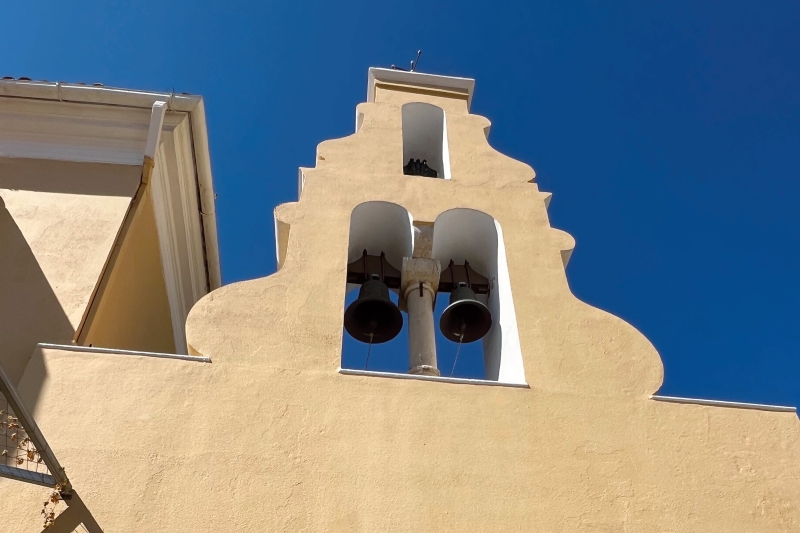
Boasting one of Corfu’s most beautiful coastlines, with jagged cliffs and mighty rock walls, Paleokastritsa is steeped in legend. It is believed to be the capital city of the mythical Phaeacians and where Odysseus disembarked to meet Nausicaa for the first time. Sun-seekers will not budge from the turquoise waters of the famous Agios Spyridon Beach but, if you yearn to connect (or commune) with the divine, make the uphill trek, past olive and cypress trees, to Paleokastritsa Monastery, one of Corfu’s oldest and which dates back to 1225. There is also the smaller but more photographed Holy Monastery of Panagia Vlacherna in Kanoni. The monastery is set on a small islet, and James Bond fans will recognise it from a scene in For Your Eyes Only, starring Roger Moore and Carole Bouquet. Aviation enthusiasts can always be spotted camping here, taking close-up shots of the planes landing at Corfu International Airport, not unlike Maho Beach on the Caribbean island of Saint Martin.
img_2838.jpg
Just beyond is the neighbouring island of Pontikonisi, nicknamed “Mouse Island”. Another iconic Corfiot landmark, it is said to resemble a mouse when viewed from a particular vantage point. Greek historians will also tell you how certain legends allude to Pontikonisi being a petrified ship. It was said that Poseidon, angered at the Phaeacians who dared help Odysseus return to Ithaca against the sea god’s will, turned the vessel into stone.
If you are not keen to tear about, perhaps the best thing to do would be to book a hotel or inn right in the heart of Corfu’s Old Town, affectionately called Kerkyra — its ancient name stems from the poor nymph unfortunate to have caught Poseidon’s eye. It was said he brought her to the island, where she later gave birth to a son named Phaeax. Given the town’s well-preserved historical architecture, it comes as no surprise that Kerkyra has been a Unesco World Heritage Site since 2007.
Undoubtedly the cultural heart of the island, Kerkyra blends several influences. As it has been under Venetian rule for four centuries, from 1386 to 1797, visitors can easily spot the emblem of the winged lion, which represents the patron saint of Venice, at both the town’s Old and New Fortresses.
If it is your first time to Corfu, begin by strolling the grand Liston promenade, which overlooks the main public square of Spianada. From here, it is a short walk to the Old Fortress — or Palaio Frourio — and its panoramic views or the Church of St Spyridon. And while it is a little like taking coal to Newcastle, Asian travellers should not scoff at visiting the Palace of St Michael and St George, home to the Museum of Asian Art Corfu. Filled with a vast collection of objets d’art from all over the continent, it is a wonderful way to spend an afternoon — not to mention learning a few things about our own collective culture at the same time.
img_3133.jpg

Another small but worthy museum to explore would be the Archaeological Museum of Corfu, which was built primarily to store treasures unearthed from the island’s Temple of Artemis. The celebrated German archaeologist Wilhelm Dörpfeld was particularly obsessed by a Gorgon sculpture found on-site. Come by to see for yourself its western pediment, described by The New York Times as “the finest example of Archaic temple sculpture extant” and whose Gorgon wears a belt of intertwined snakes, said to be a symbol of fertility.
For those who love browsing, shopping and sampling local fare, the best suggestion would simply be to lose yourself in Campiello, the Old Town’s medieval core and whose narrow streets — a by-product of Venetian town planning — are called kandounia. Wear proper shoes lest the cobblestones get to you, and enjoy soaking up the atmosphere en pied — you will see pastel-hued buildings with matching balconies and shutters, fresh laundry hung up in between alleyways, gelato shops and churches every few steps. It is said that one can count at least 40 Greek Orthodox churches in a small concentrated area spanning just under 70 ha.
Exploring works up a thirst. Cold pomegranate juice is popular as is tsitsibira (ginger beer), introduced by the British but heartily embraced by Corfiots, who put their own distinctive spin to it. Locals will tell you to head to the market near the New Fortress (a misnomer since it dates back to the 16th century) for the best the island has to offer. Ask around, though, as every stall owner will have a different favourite vendor. If you prefer something icy and moreish, Papagiorgis Confectionery is the place to go. Established in 1924 and currently helmed by the third generation, it has clearly embraced modernity, as you can order from a touch-screen machine before collecting your treat at the counter. All the ice creams are made using pure local milk. And while the chocolate, pistachio and vanilla bean are very good, be adventurous and try seasonal flavours, such as wild strawberry, kaimaki (sheep’s milk with mastiha oil and orchid root flour) or kumquat — another Corfu speciality. Those visiting close to Christmastime should also take the opportunity to stock up on wonderful panettone as well as Greek festive classics: melomakarona (Christmas honey cookies); kourabiedes (almond butter biscuits); and fogatsa, Corfu’s celebratory, sweet, bun-like bread, most famously eaten during Easter but which has since become a favourite year-end indulgence as well.
This article first appeared on Oct 6, 2025 in The Edge Malaysia.