
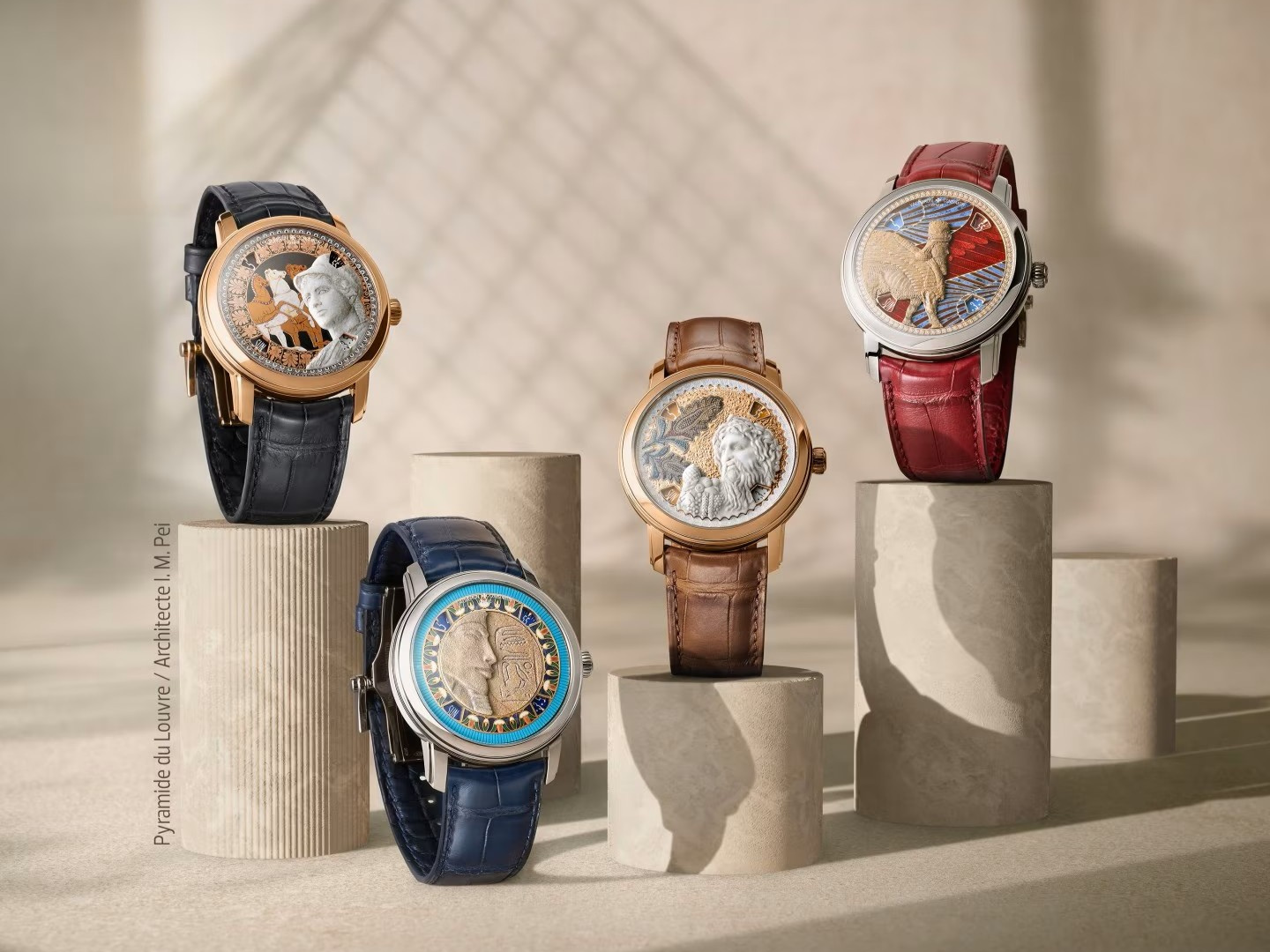
Each timepiece takes inspiration from statues exhibited within the Louvre's halls (All photos: Vacheron Constantin)
It was on day two of Watches and Wonders Geneva that we found ourselves in a private car at eventide, winding down from the sensory overload of the convention floor while being chauffeured towards Vacheron Constantin’s manufacture for an exclusive dinner. After another gruelling day of back-to-back appointments, the conversation naturally drifted to the fair’s triumphs and the spotlight inevitably fell on the maison’s expanded Overseas collection. Celebrating its 50th anniversary, the watches captured everyone’s imagination, with our fellow passengers passionately defending their favourites among the four new Dual Time Cardinal Points.
Typically, brand dinners during watch week are theatrical, high-octane affairs. Imagine hundreds of guests mingling with ebullient gesticulation, fuelled by the day’s lingering adrenaline and a couple glasses of champagne. One year, Vacheron Constantin had even suspended aerial dancers from massive floating globes, drifting above the crowd like captive moons. Last September, it took over the Louvre’s glass-domed Cour Marly for its 270th anniversary soirée, where guests dined beneath the stars, surrounded by the silent, marble gaze of divinities from ancient mythology.
Arriving at the manufacture, however, we were surprised to find a far more intimate audience and far less fanfare for a programme that up until then had remained closely guarded.
CEO Laurent Perves personally greeted each guest before addressing the group in the central atrium. There, he shared the true purpose of the evening: an exclusive, private preview of Vacheron Constantin’s second Métiers d’Art Tribute to Great Civilisations collection, set for a surprise drop the following day. Flashes of colour trailed the magnetised wrists of four models meandering through a sea of peering eyes. Upon closer inspection — a magnifying glass would certainly have been appreciated — details begot details, revealing condensed iconographic reproductions of four ancient civilisations: Pharaonic Egypt, the Assyrian Empire, Ancient Greece and Imperial Rome.
body_pics_3.png
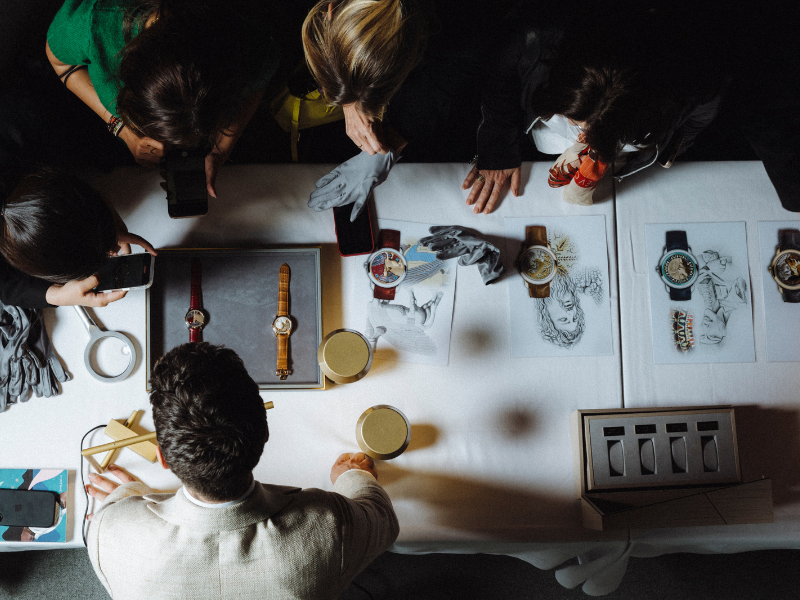
Having meticulously restored King Louis XV’s 18th-century astronomical clock, La Création du Monde — one of the Louvre’s most treasured timepieces — Vacheron Constantin formalised its bond with the museum via a partnership in 2019. Since then, close collaboration has yielded articles that exist at the intersection of horology, art and history, from a bespoke Les Cabinotiers number to the display of the imposing La Quête du Temps automaton, which towered in Room 602 of the museum’s Richelieu Wing for two months.
The first Tribute to Great Civilisations quartet was unveiled in 2022, honouring the grandeur of some of the Louvre’s most prized masterpieces: the Great Sphinx of Tanis, the Lion of Darius, the Winged Victory of Samothrace and the Buste d’Auguste. This year, chapter two looks at major works from the cultural institution’s department of antiquities, highlighting the Lamassu de Sargon II, the Buste d’Akhénaton, Athéna de Velletri and Tibre de l’Iseum Campense.
Olivier Gabet, the director of the museum’s department of decorative arts, as well as Ariane Thomas, the head of oriental antiquities, were joined by Vacheron Constantin’s product and innovation director Sandrine Donguy the next day to shed light on the collaborative sequel and the ways in which diverse expressions of art invite deeper historical inquiry.
Echoes of the ancients
1.png
“The goal was to tell a story with different chapters,” Gabet starts. “We explored how to work together the first time, so the second was to expand the collection. What’s important to underline is that in the discussion between Vacheron Constantin and the Louvre, the question was never to use images of famous artworks, such as Venus de Milo or the Mona Lisa, but to go deeper into the collections with a curatorial eye.”
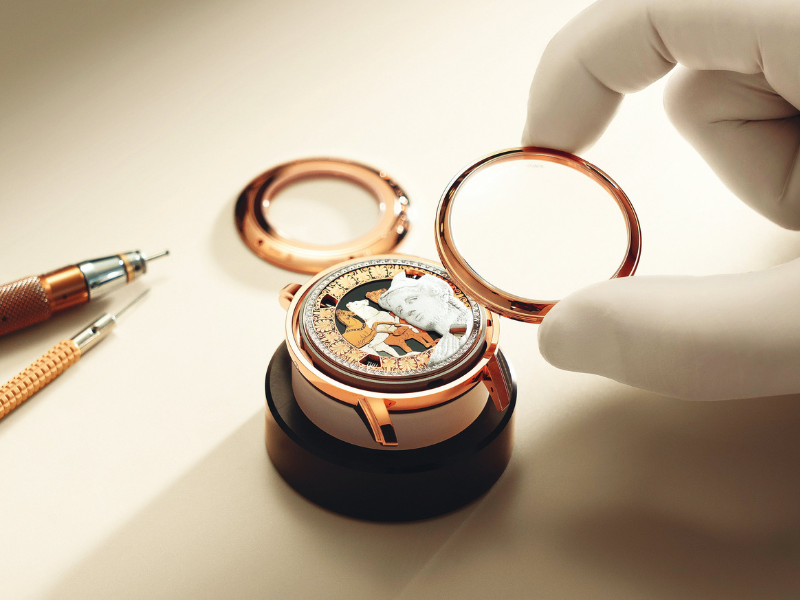
Each timepiece features a central stone-carved effigy representing one of four civilisations, set upon a gold base and framed by appliqués and circumferential friezes, also inspired by pieces exhibited within the Louvre’s halls. The assembly necessitated meticulous calibration to ensure the various artisanal elements fit together like a puzzle.
Distinguished by its peripheral display of the hours, minutes, day and date, Calibre 2460 G4/2 offered a large canvas for artistic expression. The indications appear on discs visible through four apertures at the upper and lower sections of the dial. On the reverse, the oscillating weight pays homage to the Louvre through an engraving of the colonnade on its East façade and peeking through the sapphire caseback are bevelled bridges adorned with Côtes de Genève, a circular-grained mainplate and circled wheels. Bidirectional winding endows the movement, measuring 6.05mm, with a 40-hour power reserve.
The watches are richly ornamented, preserving the authentic elements and aesthetic codes of the civilisation they honour and shedding light onto pivotal periods of humankind. Historical fidelity was scrupulously prioritised throughout the process, so much so that some of the reproduction work mandated the use of the same materials as the originals. The timepieces demanded the absolute best from the manufacture’s métiers d’art artisans, testing their mastery of glyptics, micro-mosaic, engraving, enamelling, marquetry, gilding and miniature painting — crafts that have survived the centuries.
“Vacheron Constantin created the pieces of art according to historical documentation. It’s a very faithful miniaturisation not only in the usage of material, but colours we can no longer see in the museum,” says Thomas, having personally examined the vivid hues through a microscope.
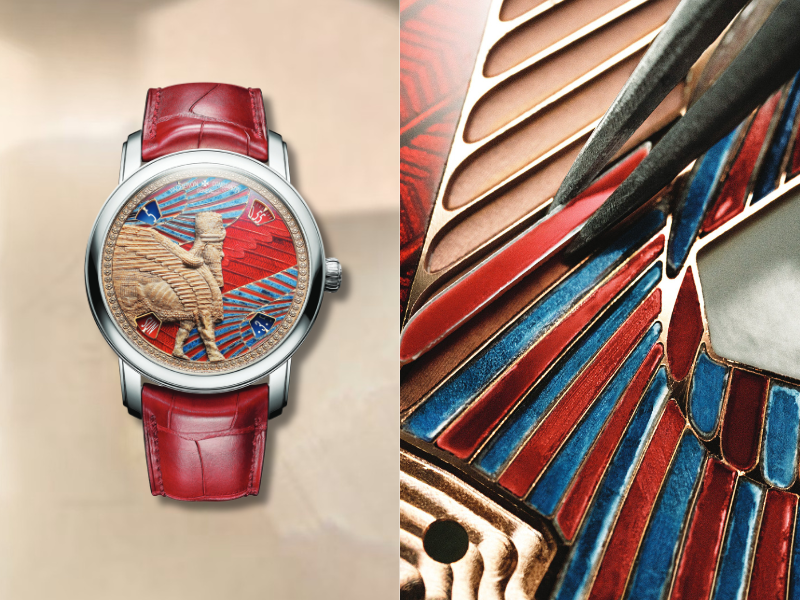
Picking up the Assyrian tribute, Donguy inspects the Lamassu appliqué, executed in glyptics from calcareous sandstone from Italy. Originally carved from enormous blocks of alabaster, the winged human-headed figures from the palace of Khorsabad once guarded its gates and the city of Sargon II, king of Assyria, in what is now northern Iraq.
“We chose a specific painting from the 8th century BC for the background of the Lamassu because we were looking for two colours, blue and red, to stand out,” she says. The artwork in question is a mural of the androcephalous creature discovered at Til Barsip, which has been reproduced on a scroll and preserved at the Louvre. Stone champlevé work sees tiny tesserae of red agate and dumortierite inserted into the engraved framework while the feathers of the guardian are layered under coats of translucent enamel. As for the outer frieze, it is made of engraved gold and based on a motif delineated in an 1863 painting by Félix Thomas of the Pasha of Mosul visiting the excavations of Khorsabad.
2.png
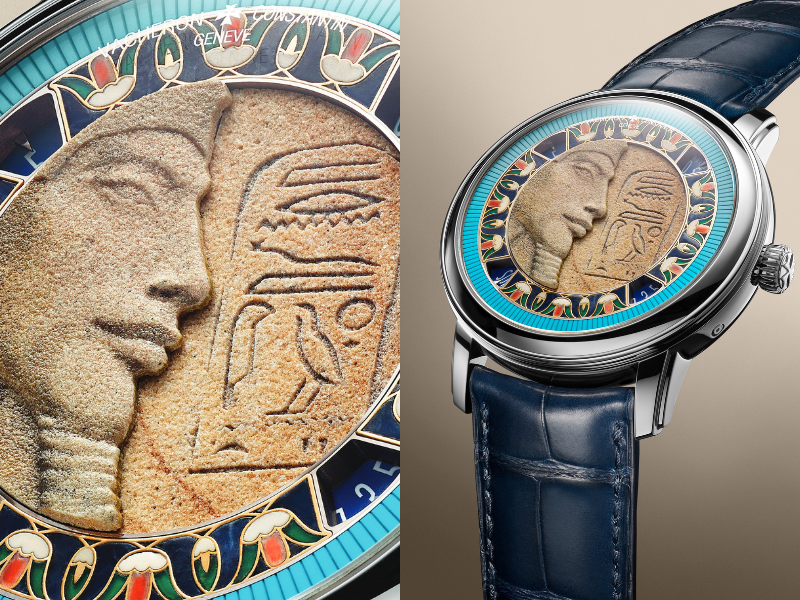
The history behind the Buste d’Akhénaton follows the revolutionary Amarna period, during which the pharaoh replaced traditional pantheons with the monotheistic cult of Aten. Though his religious reforms were ultimately dismantled by his successors, Akhenaten’s reign permanently reshaped Egyptian history through its distinctive aesthetic canons and the centring of the royal family as sole divine intermediaries.
Carved in sandstone, fragments of Akhenaten’s colossal pillar statue depict the sovereign with ceremonial regalia and an elongated, androgynous face. Rendered in the same material from Sinai, the figure on the timepiece is presented from a low-angle profile, lending it an enigmatic expression. The dial also features the pharaoh’s cartouche based on a Karnak wall relief. Two friezes frame the subject: an outer turquoise ring referencing the tubular bead collar of Chancellor Nakhti, ruler of Asiut, and an inner stone champlevé pattern that incorporates delicate inlays of mother-of-pearl, chrysoprase, opaline and sodalite, inspired by a 7th-century BC pectoral.
Though the collection’s historical weight will undoubtedly captivate connoisseurs, Gabet also sees it as an accessible gateway for the uninitiated. “It’s a very sophisticated way to look at ancient artworks. Khorsabad is an important collection of the Louvre, but if you go on the street and ask people, it may not be understood quickly. It’s an interesting change of scale. You go from monumental to something you can have on your body,” he says.
“Olivier is right,” Thomas chimes. “Especially for archaeology. A lot of collectors and artists became interested in Zeus through art and jewellery first. It’s just as in the 1850s when we had discovered Khorsabad. Some of the jewels that were made in London of the first remains in Assyria were what drew people to the British Museum or the Louvre to see the actual remains.”
3.png
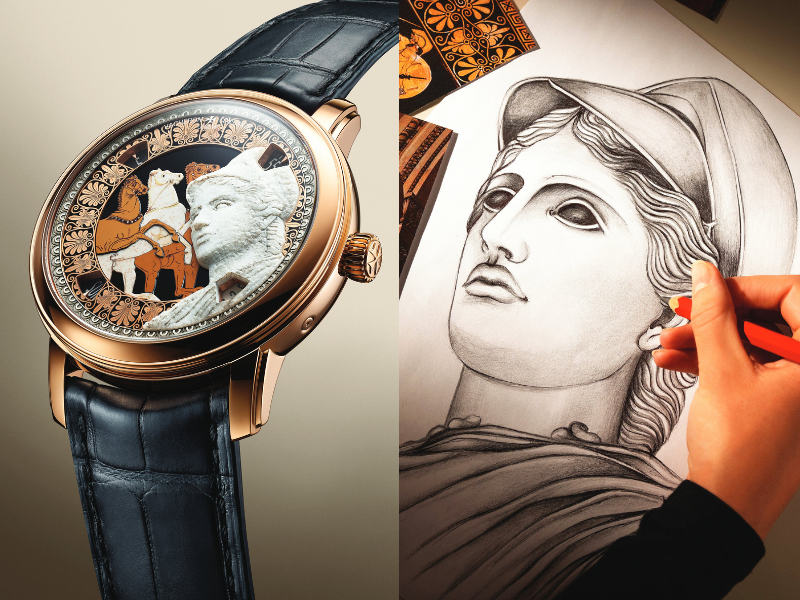
Expanding our understanding of ancient Greece is the daughter of Zeus, goddess of war and wisdom. In 1797, a 3.05m-high marble statue of Athena was discovered among the ruins of a Roman villa near Velletri. Acquired by France during the Directoire after its restoration by Vincenzo Pacetti, the monument was briefly seized by the troops of Ferdinand IV of Naples in 1798. Fascinated by its symbolism, Napoleon negotiated its return through the 1801 Treaty of Florence, leading to its permanent entry into the Louvre’s collection in 1803.
The majesty of the Pallas of Velletri is conveyed through glyptic work executed in marble from Paros — an island in the northern Aegean Sea — renowned for its dazzling whiteness and large crystals. The dial’s stone marquetry is based on a Greek amphora illustrating a battle between giants and gods fighting from chariots drawn by horses. The same steeds appear in creamy white and orange mookaite against an onyx background. The champlevé enamel frieze draws its design from a 460 BC krater by Aegisthus portraying the murder of Tityos, framed by a second ring of engraved, patinated white gold echoing a Dionysian scene.
The god Tiber concludes the remarkable collection. Discovered in Rome in 1512 at a sanctuary for Egyptian gods Isis and Serapis, the 1.76m marble sculpture depicts the bearded river god reclining on a stone bed, clutching a cornucopia overflowing with grain and fruit. It was also allegorical of the city’s origins, which served as a vital artery to the Eternal City.
Sculpted from the same Italian marble, Vacheron Constantin’s rendering of Tiber conveys an impression of tranquil power, but what is most impressive is the micro-mosaic executed in thousands of jasper, chrysocolla and opaline fragments. The floral decoration mirrors a mosaic dating from the late 2nd century AD discovered in Utica, located in Henchir Bou Chateur in Tunisia. Gold-leaf gilding enriches the dial with a luminous textured surface, which is then covered with translucent enamel. A drypoint-engraved mother-of-pearl frieze surrounds the composition, echoing a 1st-century BC Campana plaque that depicts a lively Dionysian dance.
The micro-mosaic technique showcased here marks a significant advancement over the previous collection, reflecting the manufacture’s growing capabilities. “The technical exploration is endless because with innovation, we have new ways of laser-cutting that can go down to a micron level. I’m sure that the inspiration from this fruitful collaboration will give rise to new techniques. We always reinvent ourselves,” says Donguy.
4.png
Beyond the frame
The trio agree in unison that the word “fruitful” perfectly describes the partnership between the institutions. “I think in the world of today, our relation to cultural art is very ambivalent,” Gabet says matter-of-factly. “But if a manufacture like Vacheron Constantin thinks it’s important in relation to global culture, it signals that art is indeed meaningful.
“Museums are now places for massive tourism, but if you look closely at their history, especially the Louvre, it was founded as a place of inspiration for artists. It was opened to provide access to collections. It served to nurture, influence and educate. The Louvre was once considered an industrial museum too, where all the craftspeople and designers came to look at objects and very often get technological inspiration.
“This partnership has helped us activate the collections, make dialogue with other pieces and look at them in a different light.” Donguy nods affirmatively. “When we started the first opus, we were already thinking about the continuity of the collaboration. I’m super enthusiastic about keeping this partnership intense, with other ways to explore time.”
“Most of the objects we preserve have lived many lives, many of which we don’t know,” Thomas adds. “We have kept the measurement of time that divides the seasons, months, hours and minutes because nobody has found a better way to do it. But we also have lesser-known objects that tell the complexities of time and how people dealt with it in the past.
“Maybe this can be another inspiration for our next collaboration?” she asks with a glint in her eyes.
This article first appeared on June 1, 2026 in The Edge Malaysia.