
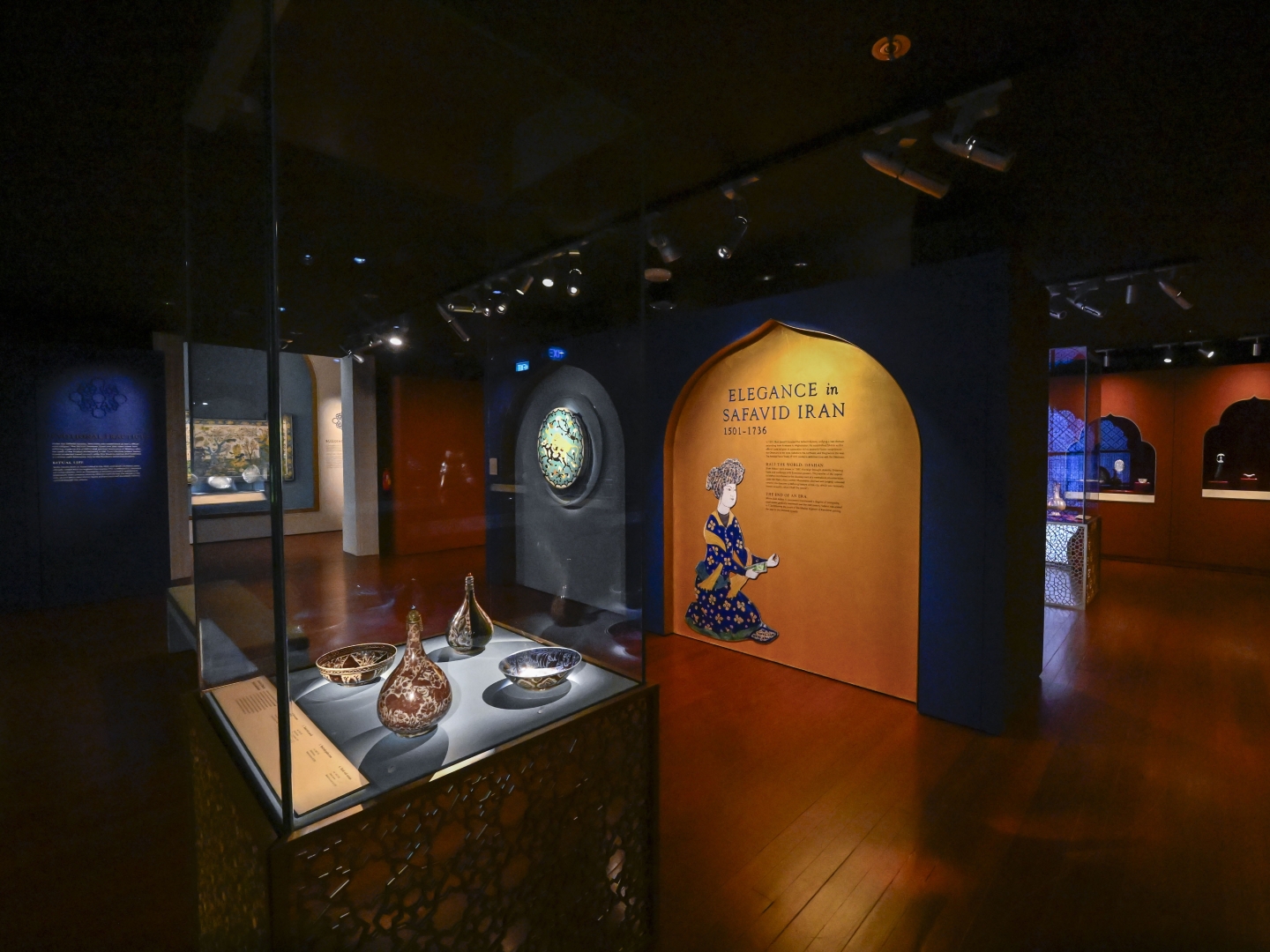
More than 100 artefacts from the Louvre and the Asian Civilisations Museum’s archives are on display (Photo: Asian Civilisations Museum)
The immense power and influence of the Islamic dynasties — Mughals, Safavids and Ottomans, in what is now modern-day India, Iran and Türkiye respectively — are indisputable. While most recognise the “Gunpowder empires” for their political dominance and rapid territorial expansion between the 15th and 18th centuries, historians and aesthetes are constantly intrigued by their contribution to art, culture, literature and architecture. Each artwork produced projected authority, taste and imperial ambition.
One of the world’s most renowned institutions, the Louvre’s Islamic art department has accumulated 14,000 to 18,000 artefacts — spanning 13 centuries and three continents — tracing the civilisation through various art forms. Previously, visitors were able to browse through 3,000 objects at the venue at any given time, including those from the great kingdoms. With the gallery currently closed for maintenance and renovation work, the Louvre is organising a travelling exhibition to display a fraction of its repository in this part of the world.
The team from the Louvre had reached out to Asian Civilisations Museum (ACM) of Singapore for an opportunity to showcase its collection, originally planned to include 100 items focusing on the three specific empires. “We didn’t simply want to take it as it is. We wanted to initiate a dialogue between both museums,” says Clement Onn, ACM and Peranakan Museum director. “We proposed the idea to incorporate our pieces into the exhibition. What they lack is something we have, which is Islamic art from Southeast Asia. If you look at museums around the world that have great Islamic art displays, most of the time, objects from Southeast Asia are very much missing or not mentioned.”
1.jpg
Therefore, Crosscurrents: Masterpieces of Mughal, Safavid, and Ottoman Art from the Musée du Louvre is curated in such a way that it invites people to delve into a dynamic journey to discover the direct or indirect connection between Southeast Asia and the great empires through material culture. Thirty treasured items from ACM have been selected for their historical significance to be presented with those from the Parisian institution.
Noorashikin Zulkifli, principal curator of Islamic and Peranakan at ACM and Peranakan Museum, says: “The exhibition title foregrounds this concept of contact, exchange, encounters and the experiences that we shared.”
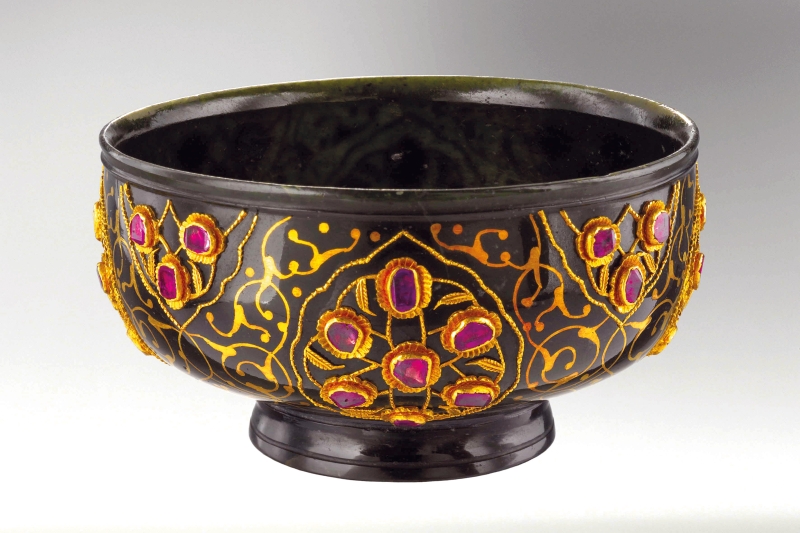
The show opens with a small yet monumental cup that carries the weight of history from around the globe. This dark-green jade sourced from Hotan — a major oasis city in southwestern Xinjiang, China, known as an ancient Silk Road trading post — depicts the hardstone inlay technique popular during the Ottoman period. The base was carved with shallow channels that were then filled with gold wires and set with rubies. This relic was eventually acquired by King Louis XIV and exhibited at Versailles before arriving at the Louvre in 1796.
“Recent analysis from the museum tells us that the gold is actually from a Balkan country and the rubies from Myanmar,” says Noorashikin. “This is the perfect example of what we want to highlight at Crosscurrents, where an object can give you a picture of what trade networks were like during the 16th century. When you look at something and think about where the materials came from and what inspired its creation, you realise that globalisation is not new.”
3.jpg
At the “Splendour of Mughal India” section, visitors are welcomed into the richly layered world of the Mughal court. Infused with Persian, Islamic and Indian influences, goods such as intricate brassware, bejewelled weapons and enamelled storage boxes attest to the exceptional craftsmanship and mastery of that era that can hardly be replicated today.
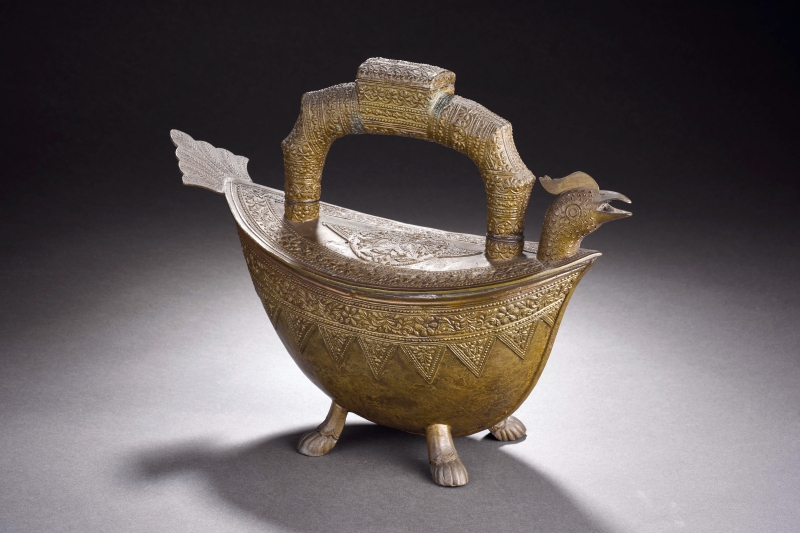
The link between the empire and Southeast Asia is examined through a selection of ewers. Originating from the Middle East, the aftaba (water vessel) was initially created for practical purposes. It was used as a tool for ritual purification and the practice of adab (etiquette) in Persian culture. In India, artisans enhanced the design by adding distinctive decorative details. The spout, handle and base are heavily engraved with animal motifs such as birds and elephants, reflecting the dynasty’s enduring fascination with the natural world.
One item from the ACM collection was made by the Minangkabau community in West Sumatra, Indonesia. Resembling a chicken and complete with elaborate patterns, it demonstrates how artistic ideas travelled across the Indian Ocean and took on new forms in Southeast Asia.
“This is proof that the connection between the Mughal and Southeast Asia was established more through merchant networks than overt diplomatic missions,” Noorashikin notes.
The next part turns the spotlight on the ceramic production and literary culture in Safavid Iran. In the late 16th century, Shah Abbas the Great was so captivated by Ming porcelain that he started growing a collection and bringing in master potters from China to develop the industry. This led to a boom in Persian blue-and-white ceramics, made using a combination of mineral and tin imported from the Malay Peninsula. One dish features a Safavid interpretation of the qilin (a mythical creature from Chinese tradition), showing the strong artistic exchanges between Iran and China during the 17th century.
2.jpg
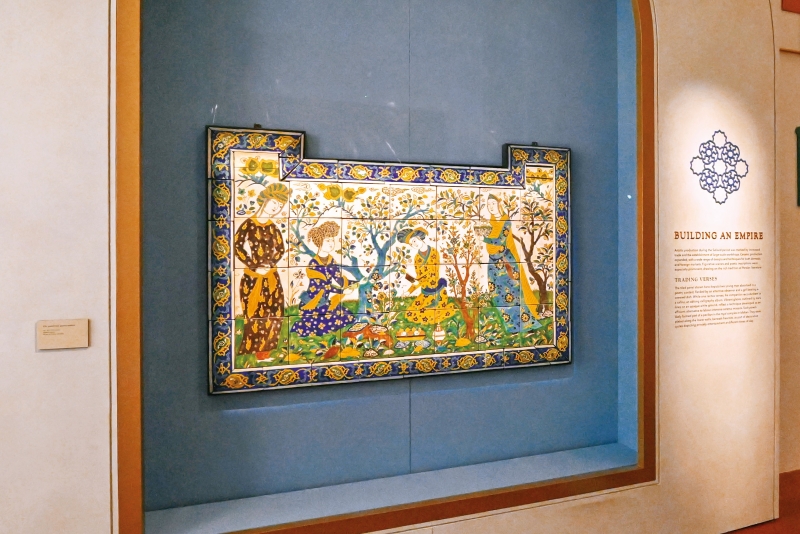
In another corner, a huge tile panel portrays two young men engaged in a poetry contest, while another records the verses in a safina (calligraphy notebook). Once part of a royal pavilion in Isfahan, the concrete slabs would adorn the lower walls beneath frescoes. Beyond the royal court, poetry and literary exchange were central to the society and deeply influenced artistic traditions across the wider Islamic world. The Persian language especially contributed to the development of classical Malay hikayat, a traditional genre that blends native myths, legends and history with fantasy to preserve social values and teach morals.
The showcase concludes in a purple room on the third floor, where the “Luxury of the Ottoman World” is explored through an array of colourful İznik ceramics. In the 15th century, İznik potters produced outstanding stoneware that rivalled the brilliance of Chinese porcelain. Blue-and-white finishes initially dominated their designs before a vibrant colour palette emerged decades later. “With this specific type of ceramics, you can kind of tell the chronology based on the shades introduced over time. From deep blue and green, artisans experimented with deep purple or magenta before finally incorporating coral red and emerald green. This transformation in style really reflects the empire’s artistry and technical innovation,” says Noorashikin.
A mosque sculpture from the ACM collection also testifies to the early relationship between the Ottoman empire and Southeast Asia. While its multi-tiered roof references regional architecture, the crowning dome takes cues from Ottoman aesthetics, which were adopted by West Sumatra in the late 19th century.
Speaking of architecture, coordinating this kind of presentation into two medium-sized galleries poses its own set of challenges, Noorashikin says. “Architecture really is one of the Islamic world’s well-known art forms. So, we try to be intentional with our exhibition design. We identified and distilled the visual identity of each empire into a much simpler form and they can be seen through the arches installed in each space.”
Beyond its role as a platform that encourages conversation about the importance of Southeast Asia in the development of Islamic art, Crosscurrents is a comprehensive — and beautiful — history lesson that reminds us how art transcends borders and exists to unite humanity despite our differences.
'Crosscurrents' is on display at Asian Civilisations Museum until Jan 24, 2027.
This article first appeared on July 13, 2026 in The Edge Malaysia.