

Main character Charlie has retreated into isolation and compulsive binge eating, hoping to reconnect with his estranged teenage daughter (Photo: Tat Chin)
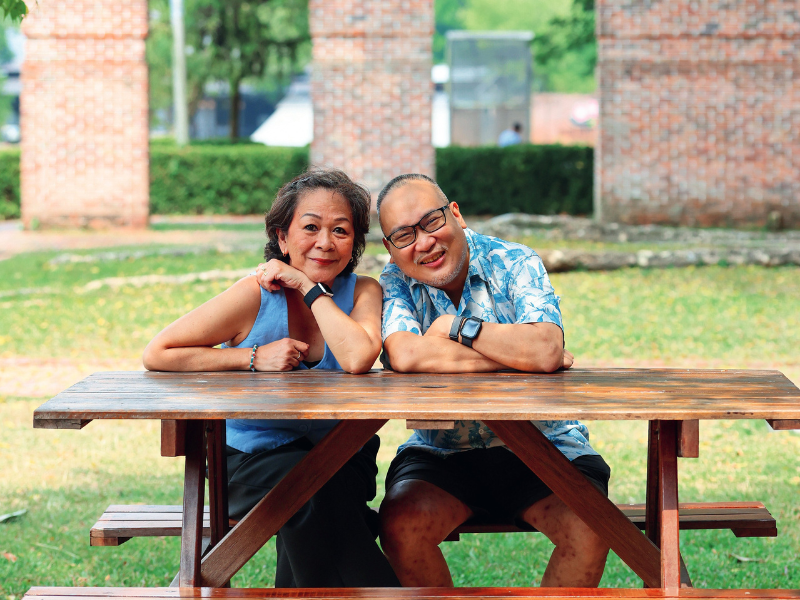
A theatre revival can be undertaken for any number of defensible reasons: to honour a classic, capitalise on a celebrated title or offer a fresh coat of paint to an ageing text. When Christopher Ling decided to mount The Whale at the Kuala Lumpur Performing Arts Centre (klpac), it was not to rack up another trophy in a 26-year career, but because Samuel D Hunter’s award-winning play met him at a point in life when questions of faith and finitude had become impossible to look away from.
“When I chanced upon his work as I turned 50 last year, I thought about mortality for the first time,” Ling says. “You look at Dolly Parton, who just passed away at 80, and you think, ‘Maybe I have 30 more years if I’m lucky’. I’m closer to my death than to my birth.”
That realisation finds a natural echo in Hunter’s acclaimed piece. Premiering off-Broadway in 2012, The Whale is set entirely within a dingy, cluttered apartment and follows Charlie, a reclusive, 600-pound online writing tutor slowly dying of congestive heart failure. Paralysed by years of grief following the death of his partner, he has retreated into isolation and compulsive binge eating, his failing body becoming the most visible manifestation of what he has been unable to process. In his final days, he desperately tries to reconnect with his bitterly estranged teenage daughter, Ellie, hoping that one act of reconciliation might redeem what is left of his time.
The production went on to earn the Lucille Lortel Award for Outstanding Play — cementing Hunter’s reputation as a playwright of intimate, claustrophobic realism — before making a high-profile transition to cinema under Darren Aronofsky in 2022, with Brendan Fraser delivering a widely celebrated, Oscar-winning performance. While the film expanded the visual perspective through close-up camera framing, it retained much of the original theatrical DNA, preserving its single-room confinement, suffocating atmosphere and unsparing focus on redemption as well as human frailty.
Ling, curiously, did not watch Aronofsky’s adaptation until last year. Midway through helming Anak-Anak Malik and seeking a “palate cleanser” from its heavy topics of cultural oppression and isolation, he found instead a reprieve that pulled him in a different direction. Recognising something of Charlie in performer Sudhan Nair, he cast his lead a full year ahead of the rest of the line-up. Even then, the appeal of The Whale had little to do with its subsequent prestige. What held him was the way its characters speak into discomfort — plainly, sometimes cruelly, and with little protection from the consequences.
2.png
“What I really loved was their honesty,” he admits. “It’s the straightforwardness of what they want to say and how they say it.”
That demand for unvarnished truth also turned him inward, sparking a reckoning with his own journey. Anxiety no longer lies in crossing the final threshold but what remains unfinished on this side of it.
“The life-and-death situation, of course, signals the urgency with which you need to get things done, tie up loose ends or whatever it might be. But I’m not looking at it that way yet. What is my legacy if anything were to happen to me? When you have the opportunity to create impact, what do those on the receiving end do with it?”
A multiple Boh Cameronian Arts Awards recipient who was also conferred the Anugerah Seni Negara Bakat Muda in 2009, Ling has spent decades shaping the local landscape. From his early years driving Theatre for Young People (T4YP) to his first stint at klpac from 2008 to 2013, he has seen successive generations of home-grown talents find their footing and carve distinct paths, including Dinesh Kumar Maganathan, who entered T4YP in 2009 and recently directed Duncan Macmillan’s Lungs.
Some remain “eternally grateful”; others take what they can and “simply vamos”. Observing that cycle repeat has also sharpened the filter through which he selects his projects. “I’d have hated to put out anything trivial or fluffy. But I’d like to think that everything I deliver leaves a mark or purpose. If a play doesn’t speak to me, I will not direct it.”
Truth be told
To ensure The Whale lands with the local community, Ling has taken a deliberate approach to the narrative, stripping away its hyper-specific American geography while keeping the plot and psychological architecture intact.
“Hunter’s iteration is very firmly set in Moscow, Idaho,” he explains. “But we decided to water down all the Americanness of it. If you look at this and think, ‘Oh, it’s an American thing’, then you switch off. ‘It has nothing to do with me. I’ll just sit here on the outside and watch’.”
Ling has previously found means of bridging that cultural distance. In his 2015 staging of Tony Kushner’s Angels in America, he pared back references to Republicans and Democrats so audiences would not feel encumbered by foreign politics. More recently, with Desmond Sim’s Hungry, he resisted presenting it outright as a show about autism, wary that spotlighting a single issue might eclipse the familial dynamics at its heart.
The same goes for The Whale — rather than saddling actors with jarring accents or forcing the story into an ill-fitting Malaysian recontextualisation, this version exists in a stateless limbo. Only about 3% to 5% of the licensed material has been edited to achieve this neutrality.
“Whenever I sit in the director’s chair, the most important things are universality and accessibility,” asserts Ling. “The themes are very relatable: loss, suffering, anger, joy and sorrow. The Whale is warm and melancholic, and my job is to ensure everyone has as many gateways into it as possible, whether through music, sound, actors, set or lighting. Everything is orchestrated to draw you into its world.”
That immediacy matters to him. If viewers leave feeling detached from what they have witnessed, the exercise has failed. “I would hope that after you exit the door, you come out discussing the ideas instead of talking about what to have for dinner. Because if not, then I’d have wasted your time; it’ll be just an exhibition piece.”
1.png
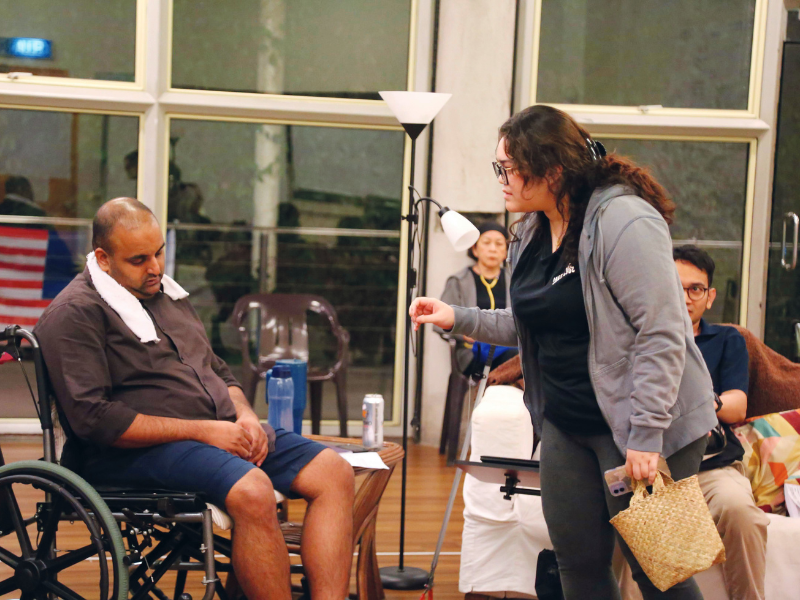
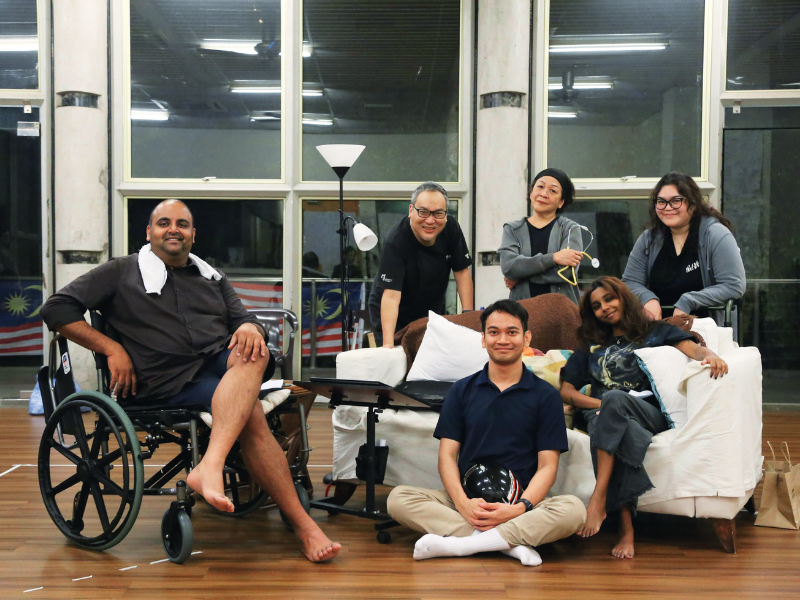
Demand for engagement extends into the casting decisions, where Ling, who watches “as many things as possible” across different languages, eschews traditional open calls and relies on intipati, the intrinsic essence. Seeking those whose temperaments embody the script’s core drivers, he hand-picked the ensemble, each his first selection for their respective role, among them Tania Ashwini (Ellie), Jae Gomes (Mary) and Asraf Zulk (Thomas).
Another instinctive choice was jazz vocalist Junji Delfino, who assumes the part of Charlie’s fiercely protective friend and carer, Liz. When the call came in early 2026, it was both a surprise and a long-awaited opportunity. Accustomed to being pigeonholed into musical theatre, she had been eager to sink her teeth into pure acting.
“I’m never top of mind for straight-up plays,” Delfino says. “It’s always musicals. And I don’t begrudge anyone because that’s what they know me for. But, give me a chance, you know?”
Yet, the deeper she went into The Whale, the more unsettling the resemblance became. “I could not help but find the stark parallels between Liz and Junji. It’s almost like, ‘Where does one end and the other begin?’”
That overlap cuts deepest in Liz’s double-edged relationship with Charlie, in which devotion shades into enabling. “I am a bloody enabler,” Delfino admits candidly. “She loves Charlie so much; he’s the only one she has. As a nurse, she knows he needs to be saved but also feels she’s the only person who understands him… the one who hasn’t turned away.”
Beneath that bond lies a tangled, fraught backstory. Liz’s scathing exchanges with Thomas lay bare a childhood spent in the shadow of a revered church leader. “I know a few pastor’s kids, and I wouldn’t wish that upon anyone,” Delfino remarks. “It’s tough to be constantly under a microscope.”
Carrying that history alongside the grim inevitability of Charlie’s decline requires delicate restraint to prevent any inner unravelling. “Charlie is a chord I don’t want to hear because it’s too real. I need to be careful not to allow that energy to get to me so much that it reduces me to tears — my tear ducts are way too active.”
Delfino anchors that complexity in decades of experience as a singer, approaching spoken dialogue with the same attention to phrasing she would give a musical score.
“To me, singing is always storytelling set to music anyway,” she adds. “It all has to do with the internal heartbeat of the character, from rhythm and intonation to which word you choose to emphasise. I’m going through that preparation now so that by the time I set foot on stage, I am Liz. She and I are one. And hopefully, when the run ends, I’ll be able to say goodbye and not take her home with me.”
That measured cadence has not gone unnoticed by her director, who had first encountered Delfino in Zahim Albakri’s Spilt Gravy on Rice, in which she played Concepcion. Ling now chalks much of what he admires in her discipline up to an intuition for “respecting the buffer”.
“I’ve learnt so much from her. Junji will never react immediately as much as she probably wants to. That has also clarified my responsibility off-stage, where actors are given considerable freedom to develop their portrayals. If Junji were ever to ask, ‘Chris, what’s all this about?’ I should have an answer. I need to at least have a vision of what I want instead of just telling the cast to go figure it out. That’s a quality I take very seriously and hold very dear.”
4.png
Kinds of kindness
Born from Hunter’s lived struggles and formative upbringing, The Whale is not polite about its pain, and Ling has no interest in making it palatable. His strongest point of identification, however, comes from an unanticipated corner. “You’d think I resonate with Charlie, but no. It’s actually Ellie.”
For him, the younger voices provide some of the production’s most revealing counterweights. Ellie brings volatility; the naïve, faith-filled Thomas supplies much-needed levity. “You might think that for a play so sad and melancholic, some parts are actually quite hilarious, especially in Thomas’ disillusionment.”
The tonal elasticity does not make the themes any gentler; if anything, it throws a thornier dilemma into clearer relief: When does candour become cruelty? Hunter’s characters do not so much soften the despair and desolation as hurl it across the room, leaving Ling to negotiate the uneasy space between truthfulness and tact. “Honesty is the best policy, but there’s a right timing for it,” he reflects. “You tread a very fine line between being honest and kind, but you always have to try and be respectful of it.”
Rather than prescribing how viewers should judge these wounded and wounding personas, or cushioning the material with cautious disclaimers, Ling prefers to keep the mirror unclouded. “I can’t force others to see the show the way I see it. If [there are] 160 people for every performance, we’ll have 160 ways of looking at it. We take full responsibility and accountability for what we say, so nothing you’ll see is gratuitous.”
Nowhere is that approach more visible than in Charlie himself. In place of the prosthetic verisimilitude of Fraser’s screen transformation, Ling and puppeteer Malin Faisal developed a costume over three prototypes that foregrounds sheer bulk.
“I wanted the audience to be faced with that,” he says.
The construction becomes more than an approximation of his body; it externalises the “baggage and burden” he carries, both physical and emotional. “We don’t hide it. Let’s confront it head-on.”
Shame, estrangement and familial obligation sit just as deeply beneath the surface, and Ling has been attentive to how those tensions register within an Asian context, prompting rehearsals to probe behavioural codes that feel inherently closer to home: how one sits before a parent, what goes unsaid at family gatherings and the uneasy collision between duty and grievance. “The actors cannot play American versions of themselves. One of them has been permitted a consistent American accent as a small nod to Idaho. But ultimately, I want to talk to you about you.”
Despite the relentless anguish on display, both Ling and Delfino regard the piece as fundamentally hopeful, sustained by an insistence that tenderness remains possible even at the precipice.
“Whatever baggage, whatever shackles, the essence of you inside is where your hope really resides,” Delfino says.
Ling leaves the question more open-ended: “Where do you find hope? In another person? In yourself? There’s a little bit of Charlie, Liz and every one of them in everybody.”
The “whale”, then, need not belong to any one person. It can stand for whatever has grown too large to ignore: guilt, resentment, regret or the weight of words left unsaid.
What Ling hopes is that we recognise some fraction of ourselves within it, even if each of us emerges with a different answer.
'The Whale' runs from Sept 17 to 20 at Pentas 2, klpac. Tickets from RM78. Purchase here.
This article first appeared on Sept 7, 2026 in The Edge Malaysia.