

Gu:um is Han's second venture, inspired by his favourite moments spent cooking with friends and family (All photos: Low Yen Yeing/ The Edge)
Of all the talents a chef may possess, the rarest is turning a private recollection into an experience that can belong briefly to many. Chef Louis Han would know. Preserving his anecdotes more literally than most, he has compiled some of his favourites in a book that serves as the creative basis for the rejuvenated menu at his one Michelin-starred restaurant in Singapore, Nae:um, a name that loosely translates as “a fragrance that evokes memories”. Although we are not privy to the full compendium, here is one story he holds particularly dear:
“In South Korea, I grew up near the mountains, where noodle shops were everywhere. But none compared with the home-made version my mother prepared for me every Sunday. She worked long hours at a law firm and had little time to be in the kitchen during the week, so weekends were something I really looked forward to. That routine ultimately found its way into memilmyeon, now one of the restaurant’s staples. Buckwheat noodles are dressed with baek (white) kimchi — using a recipe I learnt from my grandmother — along with chives and perilla oil, then finished with cured roe sauce and pickled aged cucumber. I’m not allowed to take it off the menu, though. Customers would riot!”
That his mother inspired one of his signature recipes is its own small irony. For years, she was the person least convinced he should make a living behind a stove, preferring that he become a doctor or, failing that, a scientist. Determined to prove his resolve, Han enrolled in culinary school, and completed an eight-month stint as a cook with the United Nations Peacekeeping Force in Lebanon as part of his national service. His career later took him to kitchens in Abu Dhabi and Mosu in Seoul (which then held three Michelin stars), where he worked as sous chef under the acclaimed and notoriously exacting Anh Sung-jae, before settling in Singapore. He has called the country home for the past decade, during which time he married a Singaporean and opened Nae:um on Telok Ayer Street just a week before the city suspended dining in amid the pandemic.
3.png
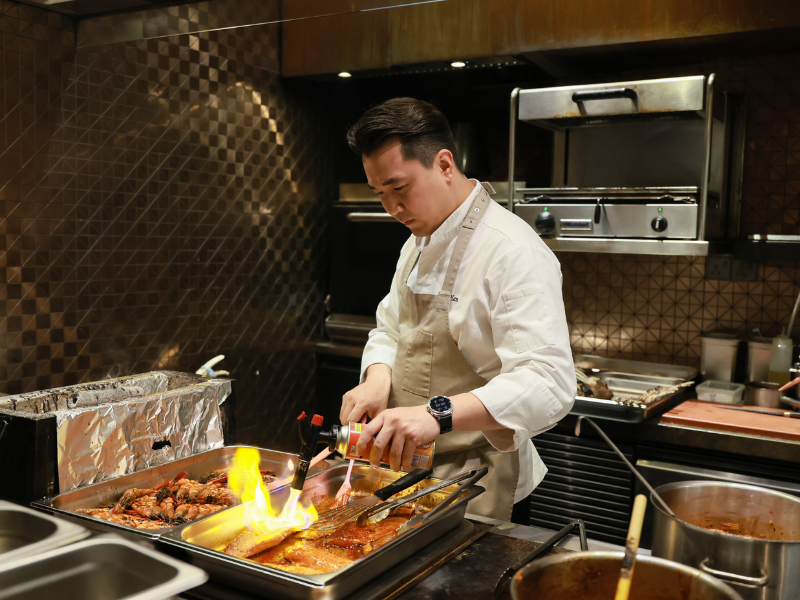
It was an inauspicious beginning, though not one that dulled his appetite for risk. After seeing Nae:um through its precarious first years, Han began considering a second venture. The clue came from Front Yard Barbecue, the restaurant’s fifth episodic menu, whose fire-led offerings were popular enough to suggest a standalone establishment. But the idea also drew on one of his happiest rituals: beachside gatherings in Seoul, where family and friends lingered over meat and vegetables hissing and browning above a glowing bed of embers. Gu:um debuted on Keong Saik Road in 2024 as a 40-seat premium steakhouse, complete with a bar well stocked with Korean spirits and wines.
Han’s latest project did not have to look far for its next audience. Across the Causeway, Malaysians hardly needed persuading of the pleasures of communal cooking or the social theatre of huddling around a table, helped along by years of watching K-dramas in which barbecue shops recur as the unofficial backdrop to reconciliations, romantic advances and workplace griping. In June 2025, The RuMa Hotel and Residences, as part of its Atas Key Tables series, gave local diners their first taste of Gu:um. That brief, sold-out showcase made an indelible impression to warrant a four-month residency at Atas next.
“Our starting point is the Western steakhouse, reworked through a Korean perspective. Rather than relying on dry-ageing, we build flavours through marinades — from traditional galbi and gochujang to fermented fish — which allow the same cut to take on very different expressions. For the residency, we retained Gu:um’s signatures while making the selection more Muslim-friendly by removing pork and avoiding alcohol where possible,” says the inventive chef.
2.png
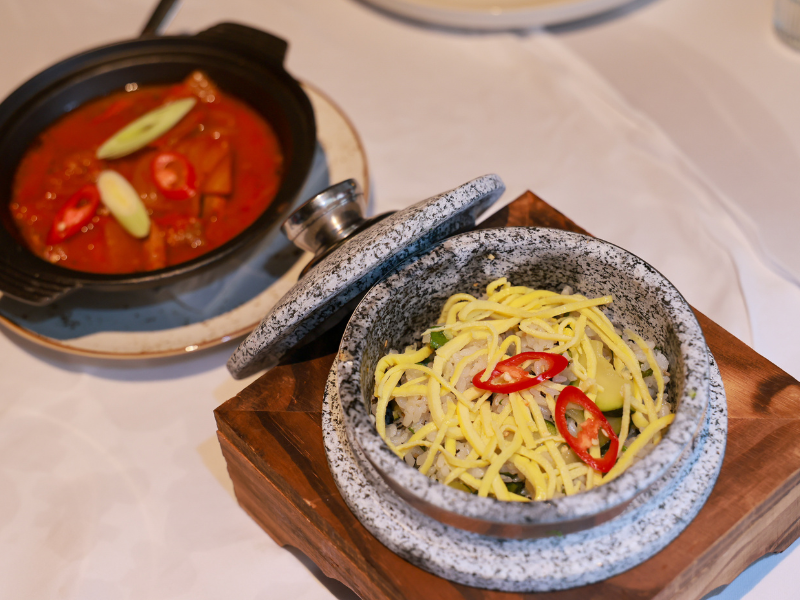
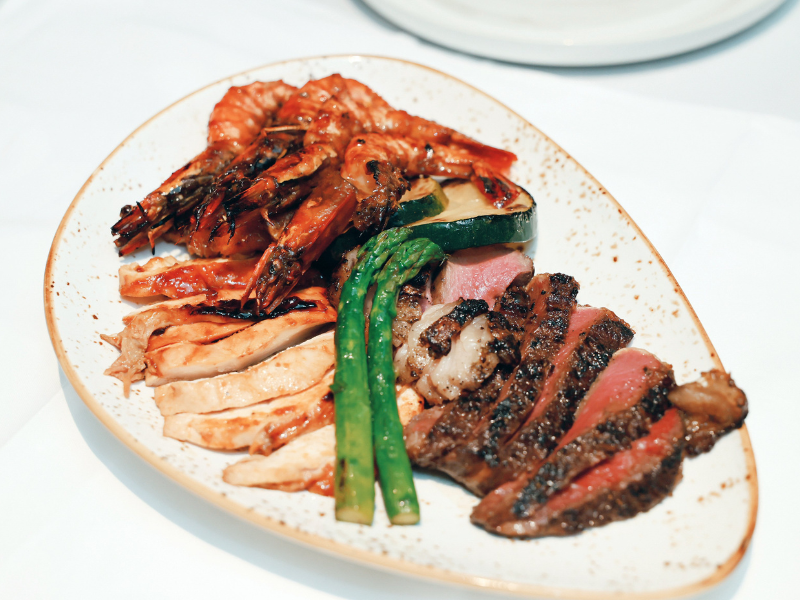
Wit and comfort take turns on the menu, without ever compromising its cultural grounding. Yukhwae jeon stacks beef tartare, egg-yolk jam and pickled onion onto a potato pancake, while mulhwae pairs sashimi and seasonal greens with a bracing shot of doenjang. KFC — Korean Fried Cauliflower — turns a familiar fast-food initialism into a sly vegetarian detour, coating cauliflower and rice cakes in the same glossy yangnyeom glaze usually reserved for chicken. There is also the Surf & Turf Platter, an unapologetic spread of wagyu, lamb, chicken, prawns and grouper, each flame-licked and seasoned to demonstrate how much character a marinade can coax from a protein. For dessert, hotteok returns the procession to a more innocent register: the cinnamon-and-brown-sugar pancake, long associated with childhood and wintertime street snacking, arrives with dried fruit, candied nuts and burnt-honey ice cream.
Trips to Malaysia have deepened Han’s interest in its food beyond mere diplomatic enthusiasm; he has come to recognise a genuine kinship between the two cuisines, particularly in their shared reliance on fermentation and spice, with sambal and kimchi being the clearest points of connection. That familiarity has also grown through eating his way across the nation — he readily names beef rendang, nasi lemak and Penang char koay teow among his favourites — as well as a collaboration in April with home-grown outfit Bar.Kar, whose open-flame approach struck him as unexpectedly close to Gu:um’s.
1.png
An avid traveller, he often looks to a city’s award-winning dining rooms as a first reading of its food scene. In Kuala Lumpur, that naturally led him to Dewakan, whose chef-patron Darren Teoh has since become a good friend. “He experiments, forages and goes into villages to understand the produce. That takes a lot of time and effort, and I respect him for doing something not everyone can.” Han’s admiration crystallised after sampling Teoh’s “butterfly” canapé modelled on Malaysia’s native Rajah Brooke’s birdwing, its keranji fruit-leather wings displaying the delicate ingenuity that made the meal soar.
Plénitude in Paris, Arnaud Donckele’s three Michelin-starred contemporary French flagship, offered a different kind of lesson.
“It was the sort of dinner you did not want to end,” Han recalls. Rather than asking the kitchen to explain a particular technique, he prefers to reverse-engineer it himself. “Sometimes, you cannot understand a method simply by tasting the dish. You need to research, find books and think through how it might have been done. I keep working at it until I can figure it out in my own way. Maybe that is a chef’s ego,” he adds with a laugh.
The world may have broadened Han’s frame of reference and cosmopolitan range but he admits he will always have an affinity for Asia, whose gastronomic confidence is growing more assured and less inclined to measure itself against the West. Overlooked ingredients continue to catch his attention too. One example is the Chinese cauliflower mushroom with a ruffled, egg noodle-like appearance, which combines the crunch of a vegetable and the savouriness of fungi that can be incorporated into a broth or pan-seared like a steak.
It is also perhaps inevitable that any conversation about Asia’s dining influence eventually wanders towards the screen, especially amid the feverish hype surrounding Netflix’s Culinary Class Wars. Han had, in fact, been invited to join its first season but turned it down, wary of surrendering his narrative to the editing process. “I would rather prove myself through the sincerity of my cooking.”
He has already won the culinary class war that mattered most, though: earning the faith of his mother, and making good on the future he had chosen for himself.
The Atas x Gu:um residency runs until Nov 30. Daily, 6pm onwards. Reserve here.
This article first appeared on Aug 10, 2026 in The Edge Malaysia.