

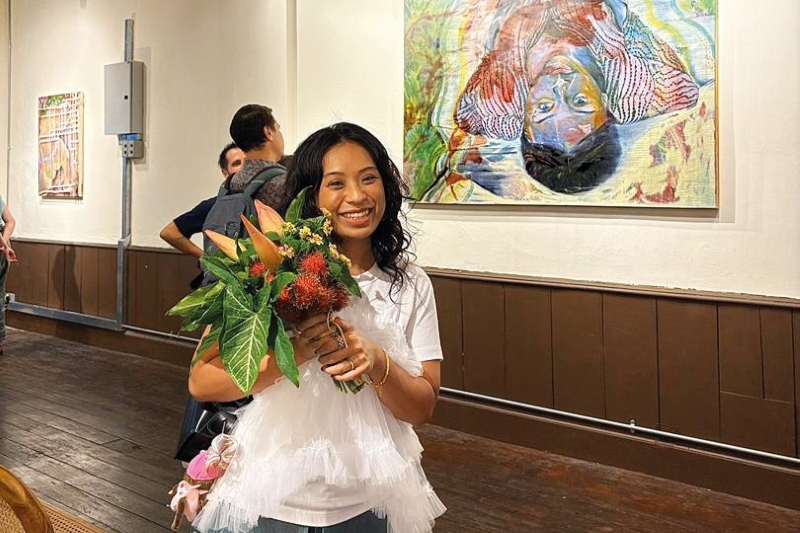
The love of my life (All photos: Aisha Rosli)
This is where painter and painting diverge: Ordinarily, it would be unimaginative — if not downright dull — to rely on the painter’s personality to understand the work. With Aisha Rosli, however, to ignore that connection would be disingenuous and entirely miss the point of her art.
Apart from embracing audacity, her works are fierce and inspired by dream-flights — a paradox, then, when confronted with the artist in person, who can best be described as affable, self-effacing, even a little conventional.
In interviews and descriptions of her work, she speaks of painting out of “mindscapes”, with all its Freudian and feminist allusions. Upon meeting her, that concept acquires a more existential resonance. For much of what she is asked about the meaning or allusions in her paintings, Aisha appears quizzical, even tentative. Such a disposition, however, makes sense when she speaks of process — especially that of transference.
“I create works when I have intense emotion,” Aisha says plainly. “There are days when I have things happen to me that I don’t feel good about and, from that, I create visually. Between the reality of my emotions and the imagined, that’s where ‘mindscapes’ come in. I hold on to emotion as I create, then it changes and I begin to need to fix things visually.”

In Silence Drowns the Screams, a previous exhibition at the Cuturi Gallery in Singapore, a figure — autobiographical or an imagined autobiographical one that Aisha describes as a “character” — is ubiquitous. Painted in Krishna-blue, the personae are multi-faceted in expression and emotion: anguished, detached, even voyeuristic. They lie prone, are suspended or exist in contortions — the body, in response to emotional fluxes, appears to be both fascination and seduction.
“I feel in my own body that it is space. Space is always recurring in my whole work,” Aisha offers. “The work is like a puzzle piece that I need to create aesthetically, precisely how I want it to take shape … to be. From an initial feeling, it becomes a work, and that’s my creative process. There’s a lot of ‘me’ in the work, of course, but with inspiration from other things, like fabrics; to put elements of myself in the painting but to have it very distorted. I don’t want to create a work that conveys meaning — rather, something puzzling, full of questions.”
That element of fabric — the decorative — may be the most captivating aspect of Aisha’s paintings. For all its daring modernism, verging on the surreal, it is also where the tension between traditional and modernist sensibilities converges. In many works, there is the sarong, allusions to batik patterns and a certain quintessential Malay-ness in depiction, particularly in relation to curvature and figures.
“I never thought of that,” she responds, “but, yes, now that it is mentioned …”
For all their stark emotional intensity, the paintings are also shaped by a kind of aesthetic concealment, where deeply felt emotions are themselves a puzzle. Ironically, the painter herself admits to wanting to temper the audience for the painting’s own “reaching”, guiding how its full impact is experienced.
1000296752.jpg
“People will feel quite uncomfortable, the work is quite emotionally out there,” she says.
Having arrived at an artistic plateau with two previous solo exhibitions at the Cuturi Gallery, this graduate of the Nanyang Academy of Fine Arts admits to being in a state of “transition”.
“Transition” is what has led to Aisha’s present exhibition, entitled Lukewarm, in Kuala Lumpur, a collaboration between Cuturi Gallery and KL’s Cult Gallery.
“In previous exhibitions, especially Silence Drowns the Screams, there was quite a lot of angst — intense emotion, unbalanced characters hanging off something or trying to hold on to something. It was a lot about trying to understand this situation of mine, visually, when I draw things. It was a lot about bringing the audience into recognising the vulnerability I was trying to show. With this body of work, there is more acceptance, of trying to understand how things truly are.”
Termenung might be the clearest example of this: a prone individual, listless and forlorn, yet more wearied than anguished. By contrast, Star, a vivacious painting exploring the possibilities of the figure itself, feels more tentative and ruminative. The bodies are less contorted and, at times, even assume a classical sense of placement.
The obvious centring of the woman raises provocative questions about the femininity, and even the feminism, of Aisha’s characters. “I paint female figures because it is what is closest to me, something that is close and familiar. There is no particular reason for painting only females or fewer men,” she has stated in previous interviews.

Yet, there is too strong an element of the rhetorical in Aisha’s characters — almost all female — to deny the presence of the feminine, especially the Malay feminine, as a form of provocation. There is, of course, no overt rhetorical force in the paintings, but the interplay of sensuality and hidden anguish is too compelling to overlook.
Aisha cites Francis Bacon as an influence. In the beauty contained in the ferocious and in the aesthetic splay of her figures, that influence is palpable. Yet, in the intelligence and deftness of her representation, she departs from it, and the notion of the figure and the sexual politics explored by female painters such as Alice Neel and, especially, the South African Marlene Dumas, find a more fitting resonance as allusions in Aisha’s work.
Transition remains a complicated experience. Lukewarm — like “the water I drink, whether hot or cold, if I leave it for a while, will be lukewarm, and then I don’t want it anymore” — might well encapsulate Aisha’s most deeply autobiographical painting so far. Still captivating in its boldness, the exhibition is also rooted in searching. Like the figure in Star — less anguished, perhaps, yet poised as if in extension, against a background of mottled colours — it seems to ask, “What more?”
This may be the principal locus of Aisha Rosli at present: not fixed and anguished, but in full flow, even if prone, with hand extended. After all, what better way to take flight than through weariness?
This article first appeared on Dec 1, 2025 in The Edge Malaysia.