

Toh now leads the Kim Giak Low Choon troupe, including her daughter Ling Goh and son Elvis Goh (All photos: Teochew Puppet and Opera)
Meeting the legendary Kelantan shadow puppeteer Abdullah Ibrahim, better known as Dalang Dollah Baju Merah (Dollah of the Red Shirt), soon after a performance that at once mesmerised and enticed, the question most obvious was why puppetry, why shadows?
The reply was enigmatic and alluring, as the art of puppetry always is: “The puppets are ventriloquists for us, our fate … and shadows? That is how we make our way in the world.”
In one of the most insightful essays on the art of puppetry, the German poet, dramatist, writer and journalist Heinrich von Kleist observed a dancer friend who was often found frequenting the marionettes. The great Von Kleist was taken by why his famed friend would visit the puppet theatre, regarded as a “crude” and “common” form, filled with bawdy theatrics and raucous humour, which ought to have been repellent to the cultivated aesthete.
The friend’s reply, at once poetic and persuasive, centred on the idea of “grace”. “Grace appears most purely in that human form which either has no consciousness or an infinite consciousness. That is, in the puppet or in the god.”
And the brilliant essay, simply entitled “On The Marionette Theatre”, concluding with a further contemplation of grace, ends with the powerful lines, “… that’s the final chapter in the history of the world”.
Before the world wrote, the world … more than spoke … the world sang: poetics was natural speech and the oral, the crucible of all culture. Variation, temperament and mood forged and defined storytelling, allowing for a great diversity of storylines and styles of storytelling.
Varieties of Homer’s Iliad and Odyssey and some 300 versions of the Indian epic the Ramayana existed in oral form, including here in the northeast of Malaysia, before they were ever inscribed in text.
Puppets seemed to be the natural vehicle for human foibles, combining the lyrical with the rowdy, the tragic with the hilarious, the playful with the profound, creating a living, speaking variety of the grand question of “the meaning of it all”.
In Chinese filmmaker Zhang Yimou’s dazzling film To Live, adapted from the evocative novel of the same name by Yu Hua, he traces the fortunes of the Xu family and its travails through the Chinese Civil War to the Chinese Cultural Revolution. At the centre of the film is the shadow play, and the fortunes of the art form through the vicissitudes of history and politics.
It was the ravages of war that brought the Chinese southward, creating a significant Chinese diaspora throughout Southeast Asia.
With the struggle for survival came the yearning for memory, played out in songs in various dialects, the opera and the storytelling in puppet traditions.
with_daughter.jpg

With that great wave came the Lao Sai Yong Hong Teochew opera troupe in the 19th century, whose heir, Toh Ai Hwa, has borne the tradition for five decades. Now leading the famed Kim Giak Low Choon troupe, which features her daughter, the deft and brilliant Ling Goh, and her son, Elvis Goh. The troupe, widely acclaimed for its resplendent and evocative performances, returns to the stage with a special tribute conceptualised by Ling, Maestro of Paper Shadows: An Evening of Living Art Celebrating Toh Ai Hwa’s 62-Year Legacy in the Theatre of Puppets.
“The title is more evocative rather than a real representation of this particular performance,” Ling explains. “Paper shadows invoke the memory of how this puppet form actually started — as paper puppets. For a while now, the puppets have been actually wielded by iron rods: the head is made of clay, the body of wood, the legs are papier-mâché, and are joined by metal plates and cloth.”
There is also much that belies the title itself. While the performance is a tribute to her mother, Ling also seeks to break new ground with the tradition itself. Here, puppets share the stage with opera performers. There are aspects of popular song and drumming.
“We attempt, with this performance, to break new ground and create new creative avenues for ‘tradition’,” she says. “I am very fond of tradition but the traditional setting requires renewal. When we do a staging, there is a very appreciative audience. But in the traditional setting of temples, the audience comprises the gods and ghosts. There is no way we can compete with things like K-pop, of course, but we have to push the limits of creative possibilities with this art form.”
At the centre of the performance, however, and still the principal spirit of the troupe, is Toh. In a brief video documentary about her life, she confesses, “When I was [young], I didn’t fancy Teochew opera. I preferred contemporary Chinese songs, and I liked to play the western drum set. However, I was destined to choose this path, and I had to work diligently to keep the tradition alive. But today, it is appreciated as a high form of art, and people hold it in great esteem.”
Toh, who was awarded the title of Penang Intangible Cultural Heritage Inheritor by the Penang Heritage Trust and received the George Town Knowledge Contribution and Heritage Award from George Town World Heritage Incorporated, was initially not encouraged to take up the art form. The more conservative and elitist were contemptuous of opera performers, and her mother, Yeoh Cheng Im, wanted better things for her young daughter.
But through a series of fortuitous incidents, Toh eventually joined the troupe, mastered the art of musicianship and singing, and eventually brought the tradition to the highly evolved art form it is today.
rehearsal.jpg
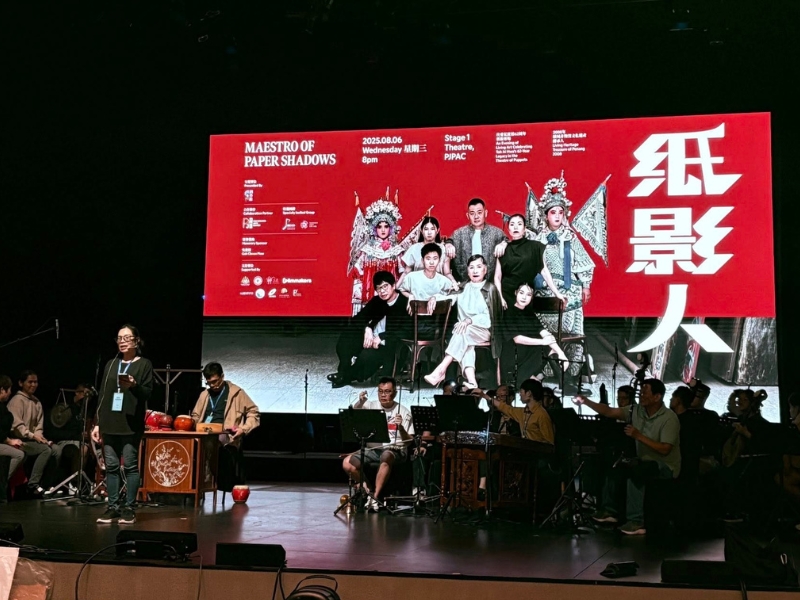
Toh and Ling have introduced to the intrepid and difficult art form experimentation and greater creativeness, embarking on a linguistic variation. The troupe conceived a version of the local Si Tanggang myth, combining Teochew, English and Malay in a staging entitled Ibu. Maestro of Paper Shadows promises further experimentation in form and storytelling.
The most captivating aspect of the troupe is its brilliant harmonic powers, ability to perform flawless acts of dramatic and physical acrobatics — the virtue of both classical opera and puppet theatre. But most of all, it is its ability to summon a complete emotive experience.
In one of the troupe’s great traditional tales, Island Of Farewell, following a series of military mishaps and misadventures, the fate of a dynasty and its citizens is left to the protagonist Chen BiNiang, the wife of famed commander ZhangDa. In an act of great surrender, she challenges the enemy to a duel and sacrifices herself, in the midst of a great crescendo of voice and music.
“The final chapter in the history of the world.” That kind of grace.
'Maestro of Paper Shadows: An Evening of Living Art Celebrating Toh Ai Hwa’s 62-Year Legacy in the Theatre of Puppets' will be staged on Aug 6 at 8pm at Stage 1 Theatre, Pjpac. For tickets, visit onetix.com.my.
This article first appeared on July 28, 2025 in The Edge Malaysia.