
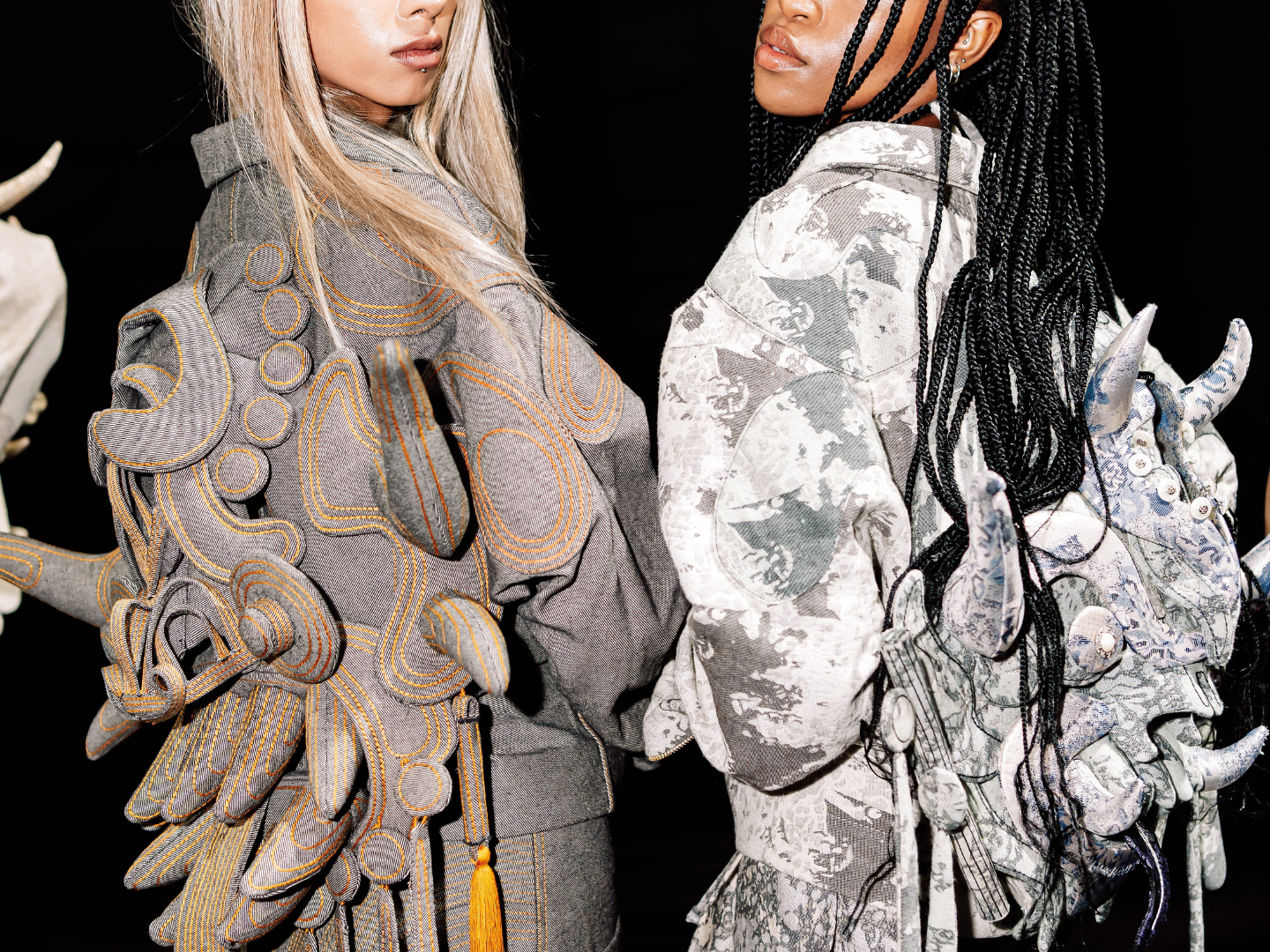
Fearsome monsters adorn the back of these jackets by Huntilanak (Photo: Hariz Amsyar)
In 2025, the year of Malaysia’s Asean chairmanship, there is no better time to celebrate the region’s diverse ethnic communities and cutting-edge style. Get to know five designers from the original Asean quintet, whose cool and meaningful designs remind us of Southeast Asia’s position as a birthplace for visionary creatives.
Huntilanak, Malaysia
Dipping your toe in Southeast Asian culture is nearly impossible to do without a brush with the region’s folklore. Mythical beasts have been etched on our artefacts and in our minds for generations through legends, tales and cinema. Some of these creatures are depicted as bad omens or demonic entities that prey on innocent humans, while others are benevolent spirits that guide and protect mortals.
Just as one might wear a talisman engraved with a motif of these protective beings, Huntilanak’s viral monster jackets are designed to empower wearers, making them feel watched over and inspiring confidence. Handcrafted by designer and ESMOD Kuala Lumpur graduate Ryan Tan, the horned and fanged denim façades seem to melt out of the back of the pieces, roaring at passersby as if to say: “Look but do not touch — or, at least, ask before you do”.
The inspiration for these came unexpectedly while Tan was travelling through Bali, Indonesia, where ornate traditional masks caught his eye. “I was fascinated by how they were not just decorative — they served as a form of protection, whether spiritual or symbolic. I thought it would be really interesting to translate that idea into fashion,” he recalls.
Huntilanak (a portmanteau of Kuntilanak, the vengeful female spirit better known as Pontianak in Malaysia, and the slang endearment term “hunty” meaning “honey”) has always been Tan’s platform to incorporate regional cultural influences in his designs. In the brand’s earlier days in 2021, it was best known for modern daywear constructed from repurposed songket. The creator’s goal was to envision the typically ceremonial fabric outside its normal settings. “Songket is usually reserved for formal or traditional wear. I wanted to modernise it, push it into silhouettes and contexts you wouldn’t normally see and show that our textiles can live beyond special occasions,” he says.
1.png

While modernising traditional styles and materials is often the subject of criticism, particularly when it comes to orientalism and appropriation, Tan believes that innovating is key to keeping our culture breathing in an era when it is being lost to time or tokenised. “To me, the best way to preserve culture is to keep it in motion, not lock it away. I love shaping these fabrics into silhouettes and contexts they have never been in before — distressing songket, mixing tribal weaves with unconventional shapes — so they feel alive. My advice? Learn the history, techniques and symbolism first, then don’t be afraid to twist it.”
In August, he and his team had their first-ever runway show at Kuala Lumpur Fashion Week. Named Britney, the collection was the meeting point of Huntilanak’s key aesthetic elements over the years. Models sauntered down the catwalk wearing milky contact lenses for a possessed yet eerily beautiful glam moment, dressed in boxy cuts, corset-style tops and baggy bottoms. Among the highlights was a songket jacket and pant set boasting the iridescent colours you would find on the surface of soap bubbles, which Tan notes was tedious to blend; the stone grey finale look that comprised a sweeping maxi skirt and monstrous face with protruding teeth and a snaking tongue; and a jacket made in collaboration with local artist Silas (@robotinpyjamas on Instagram), who engineered a textured fabric with real crystals embedded in the threads.
2.png

The presentation was a milestone that most designers can only dream of. Coming off this success, Tan found a new calling in his work — to uplift other homegrown artists who deserve visibility. “Silas, for example, is an incredibly talented artist, but his style isn’t the commonly popular or commercially safe choice here. I felt strongly about helping to elevate his work, not just to give him exposure but to show people that our creative scene is richer and more diverse than they might expect.”
He adds that things like stronger media support, collaboration and grants can help indie designers and students pursue their passions. But he also knows that such aid is slow to come in a market dominated by safer, conservative aesthetics. While going against the grain can be challenging, he urges others with their own distinctive styles to continue dreaming big and sharpening their talents. “I hope to see more cultural risk-taking, reimagining of traditional textiles and designers building their own spaces instead of waiting for approval. The most exciting thing is when someone’s work feels so specific to them, you can’t mistake it for anyone else’s.”
Fassbender & Mellon Collie, Singapore
3.png

You could say that at the heart of all art forms lies a desire to challenge norms and go against the grain — a hunger to dream, yell and speak your mind boldly in an act of rebellion against conformity. These contrasting ideals clash harshly when it comes to fashion, dividing society between those who appreciate the simplicity and “flawlessness” of manufactured styles and the disruptors seeking a more raw, emotive form of expression.
For instance, the signature kaleidoscopic tie-dye of Singaporean indie label Fassbender & Mellon Collie is captivating to some but an eyesore to others. The strong reactions to the layers of swirling colours and prints, usually done on repurposed pieces using ice and various dyes, were the impetus for owner and designer Ethan Lee. This vibrant look blurs the lines between beautiful and ugly, reimagining the natural wear and tear of old clothing as something that can still be alluring.
“The ethos of Fassbender & Mellon Collie, as well as how the brand was built, was heavily influenced by the idea of letting go and allowing things to be. The designs come naturally with the way the clothes are tied along with the ice that I use to disperse the dyes on the fabrics. We’ve always believed in wearing and living in your clothes — every hole, stain and fade on them tells a story,” he says.
5.png

The brand began five years ago on an Instagram page where Lee documented his creative pursuits, from moody photography to experimental dye jobs. It was not long before London-based streetwear label AFFXWRKS (the company born out of a pirate radio show headed by design industry trailblazers Michael Kopelman, Taro Ray, Stephen Mann and Kiko Kostadinov) took notice and commissioned him to rework a small batch of its Advance Pant. The highly successful collaboration opened the founder’s eyes to the demand for his audacious designs and pushed him to establish Fassbender & Mellon Collie as a proper business.
In the beginning, Lee only accepted custom requests. Clients would bring in their own pieces or he would source some second-hand material. In more recent times, however, he has put out small collections of one-off designs and is fashioning a line of small-production original garments. “I work with Dylan, a friend of mine who is a tailor with Three Buttons, to draft patterns. We then get these produced locally with the help of a seamstress,” he says.
As Fassbender & Mellon Collie is a one-man show for the most part and the dyeing process is time-consuming (each article of clothing is individually made and Lee has “yet to find a way to scale up production”), the brand used to sell mainly on social media and its website. Over time, it has come to supply local retailers with a limited number of products — a key step for small businesses looking to improve sales and gain more traction — and is striving to stocking those overseas. He also hopes to participate more frequently in bigger projects like the capsule collection made in partnership with Dover Street Market Singapore, which launched in February.
4.png

While it is the aspiration of many young designers to achieve viral recognition, Lee is pleased with what Fassbender & Mellon Collie has evolved into and is proud of being a part of Singapore’s tiny but mighty subversive fashion community. Building brick by brick at a steady pace enables him to stay true to his original mission — to create freely. “I’m not keen on support from institutions or government bodies. The market here is small and I’d like to think our target audience is quite niche, but we’re happy with the way it is.”
In the country’s bustling metropolitan landscape, where diluting one’s style can feel like an easy way to blend in and avoid unwanted attention, Lee’s trippy looks invite people to get in touch with the world around them, form their own opinions and be unafraid of conveying their thoughts. “I believe fashion, art, music, politics, films, memes and more are intertwined,” he says. “For example, the political state of a country can affect how people express themselves, be it through their art forms or the way they dress. People should know what is happening in the world!”
Gongdid Design, Thailand
8.png

Many success stories begin along the lines of spinning an accidental mistake into something meaningful, but few might be as quirky as why Thai designer Peach Wichcha Soponpattana decided to create pleated garments. “The pronunciation of ‘pleats’ is quite similar to my name, Peach,” she explains, a resemblance that often resulted in others incorrectly saying the folded fabric when calling for her as a child. “My attention was therefore always drawn to them. I found them so captivating. Whenever I saw a woman wearing pleated clothing, it would instantly catch my eye.”
For the founder of Gongdid Design, a clothing brand that is gaining widespread popularity for its airy aesthetic and contemporary approach to everyday womenswear, fashion was a far cry from her background in finance. “I started [the company] 10 years ago while still working at a securities firm. The word ‘gongdid’ comes from kruang pan dai in Thai, a traditional weaving machine used to prepare and wind thread before the weaving process. It signifies patience, craftsmanship and the beauty of making something from the very first thread — values that have been at the heart of Gongdid since day one.”
Her intentions were simple yet profound: “To produce designs that are approachable, comfortable and empowering — pieces that women can live, work and celebrate in.” Peach wished to breathe new life into the textural pattern she fell in love with, detaching it from the local stereotype that it was commonly associated with older, more dated styles, and that only those of slim stature look good in them.
Breaking this cultural mould was admittedly difficult in the beginning. “To be honest, we didn’t have many younger customers when we started. A major challenge has been standing out among so many players in the industry,” says Peach. Her time, persistence and commitment eventually paid off though. “Now, our customer range is quite broad, and I enjoy seeing both younger and older clients — sometimes even mothers and daughters — shopping at Gongdid together and styling the pieces in completely different ways.” While youthful interpretations work with fresh layering styles, the founder assures mature clients that they can feel beautiful and suited to their age wearing the same pieces.
6.png

With no formal training in the design field, Peach looked to her personal preferences and basic pieces that she wanted others to try and enjoy as a jumping off point. Learning from buyer feedback and using the reviews to develop new collections have helped her refine the business’ offerings. “It’s usually based on a concept or feeling I want to convey. Then, I explore silhouettes, movements and fabric qualities. I spend a lot of time testing pleat techniques on different materials to see how they react, to be both eye-catching and easy to wear,” she says.
Apart from the visual appeal of the fabric, accessibility and inclusivity are instrumental to Peach’s design approach. The flexible nature of pleats enables her creations to be truly “free size” without fitting awkwardly or compromising on wearability. “They are timeless yet incredibly dynamic. Pleats symbolise movement, adaptability and freedom. For me, they’re not just a technique, but a language,” she insists. Beyond the usual organza or spandex, new materials such as wool and synthetic leather make fascinating avenues for experimentation, expanding the possibilities of the iconic folds while keeping them relevant.
7.png

Rather than any distinct industry figureheads, Peach finds inspiration for her pieces from her travels and, as she grows and gains more experience, memories and feelings from her own life. Gongdid’s Spring/Summer 2025 collection, comprising two volumes titled Origins & Echoes and Journey, focuses on the brand’s ethos of joyful, modest and innocuous fundamentals that draw on nostalgia — effortless, casual shapes that embody timeless sophistication and contemporary comfort. The label also applies its signature soft pleats to a variety of accessories including bags, hats and scarves, and offers a small men’s range. In addition to its main showroom in Bang Rak, Gongdid appears at several pop-ups in shopping malls Gaysorn Amarin and Siam Paragon.
As Gongdid continues to grow in reputation, Peach says, “I want the brand to have a stronger presence internationally, with more collaborations and concept spaces. But growth isn’t just about scale, it’s about keeping our designs relevant, maintaining high quality and preserving an authentic connection with our customers.”
ZACARIAS 1925, the Philippines
9.png

Rita Nazareno always knew she would return to Manila to continue the legacy of her grandmother. SC Vizcarra, named for her lola Segundina Cornejo Vizcarra, began its story a century ago and, thanks to the hard work and love of its matriarchal stewards, has evolved to offer not only artisanal hand-woven bags but uniquely creative contemporary interpretations of traditional craft through its offshoot — Zacarias 1925 — founded by third-generation successor Nazareno.
“In 1925, my grandmother opened her taller de bordados de mano (hand-embroidery studio) in Manila. SC Vizcarra was a pioneer in exquisite needlework of fine embroidery piña, a native pineapple fibre famous for its strength despite its delicateness. Her atelier transformed piña cloth into elegant trousseaus for the city’s elite until the 1980s,” says Nazareno of the brand’s origins. At the time, her great grandmother’s (Segundina’s mother) employer, a wealthy woman, was so impressed by Segundina’s work that she gifted her PHP250 — a tidy sum back in the day — to start her own embroidery business.
“She was so resilient, talented and clever that she grew her little business and became the first Filipina to have a concession stand in the then US-run Clark Air Base.” Nazareno’s mother continued SC Vizcarra, eventually growing it into 13 stores across the Philippines, Guam and Hawaii, but fell on hard times in the early 1980s due to political upheaval. “My mother saw an opportunity to focus on continuing the tradition of producing finely crafted objects by focusing on hand-woven wicker and chair cane baskets and bags.”
10.png

Prior to taking up the reins of the intergenerational enterprise, Nazareno, an Emmy Award-winning television creative services producer, had been pursuing a career in television in the US, her long-standing passion since childhood and a path she felt compelled to explore on her own terms before returning. “I came back to Manila in 2010 and set up Zacarias 1925 to put a more contemporary thrust on the tradition of hand-woven objects. I learnt so much and lived the life I had envisioned for myself [in the US]. But I knew I’d be back to continue what my mother and grandmother worked so hard for, the company that afforded me the chance to follow my dreams. Continuing this became another dream,” she enthuses.
Her vision for Zacarias 1925 — named for her sculptor grandfather and the year the company began — stemmed from a desire to modernise the craft of basketry while preserving and innovating weaving techniques. “[Each piece] almost always starts with a point of personal interest for me — contemporary art, architecture, cinema, culture, be it a Jacques Tati film, Cy Twombly work or Janelle Monáe song. From there, I sketch it out and then work with our team at the workshop,” says the creative director.
11.png

The brand is known for its quirky, colourful and even outright unusual bags and home accessories using wicker and leather: the blocky Mondrian-esque Tati Sol bag takes inspiration from the 1950s hard edge painting movement, while the Architectonic collection’s Cube bag suggests a playful take on geometric abstraction. Decorative items include woven bowling pins and cactus-shaped lamp stands, and even a stag beetle sculpture to spruce up the floor. “There’s a playfulness to my designs, but also this seriousness in the intricacy of the weaves and forms. I think that’s ultimately how I see life, a pursuit of joy coupled with a pursuit of meaning,” says Nazareno.
Apart from her family business, she also teaches and holds talks at various institutions around the world, imparting the knowledge of good, lasting design to burgeoning talents. “The industry I am in is an immense driver of consumerism that is quite out of hand,” she admits. “I tell my students they need to be making things that won’t be in a landfill six months or a year from now. If you design something with an emotional connection, made with utmost respect for craft, then people will keep and hopefully pass it on.” Nazareno is also co-creative director with Gabby Lichauco at the multidisciplinary studio Nazareno/Lichauco, which works on pieces such as panels, furniture and even a staircase for interior designers and architects.
In anticipation of SC Vizcarra’s upcoming 100th anniversary, Nazareno expresses, “We are celebrating this milestone with a book and an exhibit next year. The family also has some plans in the near future for something that will solidify the legacy founded by my grandmother and transformed by my mum. I am absolutely so excited for it. I personally hope the lessons these strong women have passed on will continue to be shared with and enjoyed by future generations, and I look forward to where my nieces will take SC Vizcarra in the future.”
TOTON, Indonesia
12.png

While knowing and chasing your true passion from the get-go can be admirable, there is undoubtedly something to be said about detouring through the scenic route — at least, that was the path Toton Januar, creative director of his eponymous fashion label Toton, went with. Born in Makassar, Indonesia, he took the long way round to the design world. “I was raised by a seamstress mother, but my father and grandfathers were all in the army,” he says. “Growing up as an only child and son, I had quite a varied idea of what I was going to be when I grew up: an astronaut, fighter pilot, architect, just to name a few.”
Neither military high school or engineering panned out, but Januar reminisces, “The one constant since I was a kid has always been my interest in arts and crafts. Not a day went by without drawing and watching my mother work. Through her, I learnt that everything has to go through a process. She has not only been a tremendous influence on the way I perceive fashion, but also life in general.”
It was not until he moved to the capital city (“I was in a boyband and we were chasing our teenage fantasy,” he divulges) and taking a gig as a model to pay for college that he made first contact with the fashion world. Between performing and modelling, and later becoming a designer’s assistant, he affirms how formative those various perspectives were. “Those experiences helped me shape a full understanding of what fashion is, and that is not merely the clothing we put on our backs. I am grateful to have gone through all these twists and turns before committing to my true passion. Those times were invaluable.”
14.png

In 2012, Januar established his fashion label alongside his partner Haryo Balitar with the intention of presenting Indonesian culture through a contemporary lens. Toton’s ready-to-wear pieces are a modern rethinking of the country’s sartorial traditions and techniques, combining ethnic fabrics and folk costume elements into androgynous silhouettes. The acclaimed brand has been exhibited and appeared in pop-ups across the world, winning the International Woolmark Prize Asia’s womenswear category in 2016.
“Indonesia is in our DNA. We draw inspiration from its rich and diverse heritage, and it informs what we do,” says the designer. “For example, I try to take something very traditional like embroidery, which is usually associated with formal evening wear, and turn it into something that would fit a modern woman’s everyday closet.” With 1,300 ethnic groups spread across 17,000 islands, Indonesia’s sheer volume and variety of traditional garments and creative handicrafts cannot be overstated. He hopes these can be translated into daily life, and that its artisans can continue to preserve and evolve their skills into a more complex form.
The vibrant street life and markets, particularly seeing the eclectic dress of the women there, are especially valuable sources of knowledge for him — studying the logic behind the Indonesian way of dressing and understanding its symbols preserve the essence of a culture, more so than indiscriminately applying batik motifs or specific embroidery, he insists.
Emotions and sentiment are Januar’s starting points with each new creation, something especially pertinent to the Toton 2025 collection titled Puing. “[It] originated from a place of hopelessness and despair. Many troubling events seemed to be escalating in the world, mainly the genocide happening in Gaza, prompting me to enter a contemplative state and re-examine my purpose as a creative individual. The result was a somewhat sombre collection that felt almost ritualistic to me,” he says.
13.png

With trends coming and going, and more companies striving to churn out cheap looks at breakneck speed, fashion can be a fast and merciless field. Building something that lasts is not always easy. “The thought of sustainability, ethical labour and animal-friendly practices has been on our minds for some time,” says Januar, adding that it began with his Modernism themed line-up for the Dewi Fashion Knights segment of Jakarta Fashion Week 2017. With the environmental crisis in mind, the series incorporated unused denim and chambray clothes to be reworked into new pieces.
Toton continues to repurpose materials in its creations, notably the white upcycled lace garments that appear in most of its offerings. “We’re trying to be kinder to the environment with our products, and hopefully, it takes us one step closer to being sustainable. We try to produce only what is necessary, and with thoughtful design and good quality in the hope that they will last to the next generation.” The brand’s 2026 collection is set to launch soon, and the founder says it will be participating in Jakarta Fashion Week in November.
This article first appeared on Sept 15, 2025 in The Edge Malaysia.