
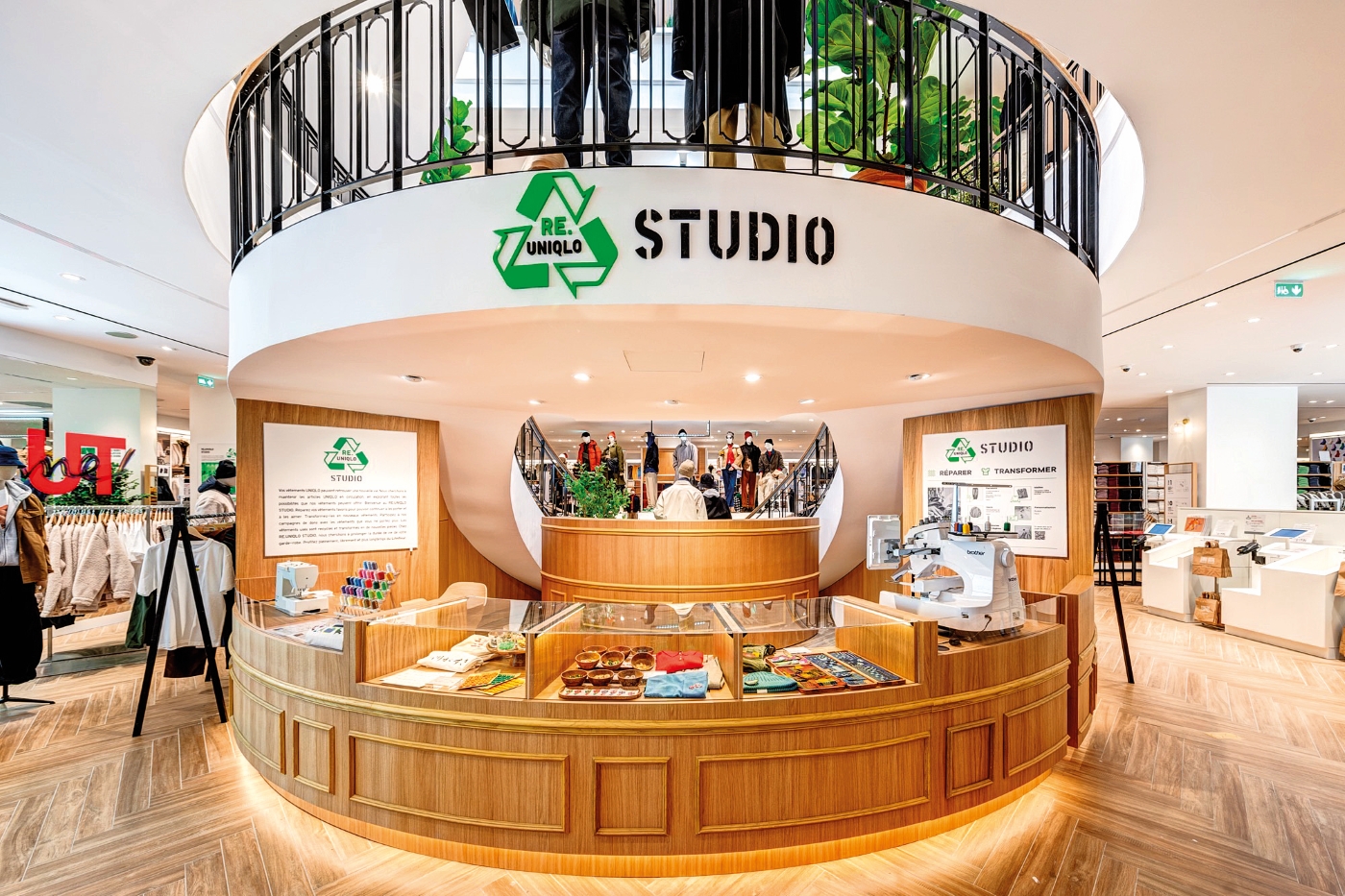
Re.Uniqlo studios have been introduced in 66 stores across 23 markets (All photos: Uniqlo)
Life is often described as cyclical: organisms are born and they consume, reproduce and die, their bodies and energies eventually subsumed by the Earth to create new life. This, however, is not true of non-biological objects. As civilisation and human development race forward at breakneck pace, we find ourselves faced not only with mounting piles of material waste, but a festering nonchalance towards the questionable ethics and hyperconsumptive attitudes left in its wake.
In recent years, activism and awareness have flipped the narrative, especially within the fashion industry. Now more than ever, companies and consumers alike are striving towards more eco-conscious systems and habits, turning garments from something haphazardly produced and disposed of into a powerful medium for change. How can we wear clothes more intentionally, and can it affect the way we live for the better? These questions are what drive Japanese apparel retailer Uniqlo’s enduring LifeWear philosophy, as well as its growing suite of sustainability and outreach initiatives.
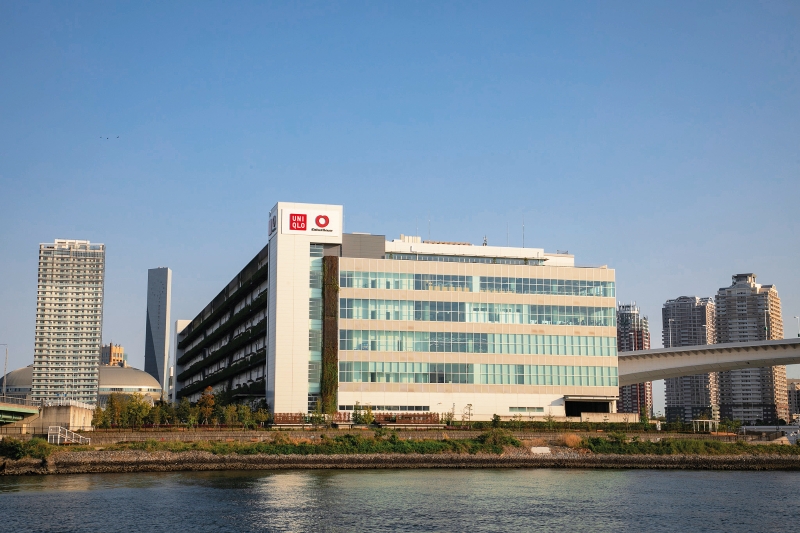
Recently, Options joined a select group of journalists from Southeast Asia at Uniqlo’s global headquarters in Ariake, Tokyo to discover the brand’s latest projects centred around reducing waste, promoting circularity and delivering clothing support to those in need.
Green Ways
copy_of_4a7a3689.jpg
As early as 2006, the company had begun working towards recycling all products and started clothing collection drives exclusively for Uniqlo goods across stores. Donation boxes were implemented nationwide, while other Asian markets began to adopt the feature around 2012.
After over a decade of commitment to community development and social outreach efforts, the retailer’s various projects were rebranded under Re.Uniqlo beginning 2020. Director of sustainability marketing Eiko Sherba explains, “I changed our mission to ‘sustainability communication’, because just doing good things without spreading awareness is not enough. We have decided to strengthen our message through global marketing missions, and we work with our colleagues around the world to spread this in line with our LifeWear ethos.”
With Re.Uniqlo turning five this year, she remarks having recognisable donation boxes in every store has significantly reinforced the visual presence and messages behind the brand’s efforts.
“Unlike some other apparel companies, we don’t offer coupons in exchange for donations. That’s why it is important for us to express what happens to these clothes, where they go and who they end up with through short films and photos, to let our customers know the impact of their contributions,” says Sherba. “It’s a very grassroots approach, but we don’t want it to seem promotional or incentive-driven. Sure, that makes it harder, but we believe it should come from the heart.”
Since 2022, the company has also introduced Re.Uniqlo studios in 66 stores across 23 markets, providing repair and customisation services aimed at cultivating people’s desires to preserve the longevity of their purchases.
Have you got a hole in your favourite T-shirt, or are the seams fraying on your comfiest jeans? For as low as RM8, your cherished articles can be patched up in-store. Traditional Japanese sashiko stitching can mend while adding colour and personality, while a variety of embroidery designs are also available as personalisation options.
Beyond its current systems of reusing or recycling, the retailer is currently test-running its new Pre-Owned Clothes Project. Introduced in 2023 in its Harajuku location, this initiative puts donated Uniqlo items that are still in very good condition up for resale. The articles are carefully selected, meticulously cleaned and checked for any sharp items before being made available at three select outlets around Japan. In contrast to thrift stores where cleanliness might be a concern, the company hopes seeing rewearable Uniqlo clothing in an actual Uniqlo store will provide buyers a sense of security — not to mention the novelty of finding older pieces no longer in production. The local predilection for vintage Americana often sees denims and plaid shirts hiked up in price, but the retailer is able to maintain reasonable tags on its own products as the project continues to refine its model and profit margins.
“It is still in the trial phases in Japan,” says Sherba. “As Uniqlo, we want to maintain the standards of quality we are known for, even though the clothes are second-hand. Keeping up the integrity of the concept is also key, and hopefully we can expand to other countries in future.”
Building blocks
The Re.Uniqlo works form a substantial part of Uniqlo’s overall LifeWear business model, illustrated by a butterfly-shaped diagram which places customers at its core. To its left is the cycle of creation: customer insights guide design, followed by raw materials sourcing, clothing manufacturing and distribution into retail and online sales platforms. To the right is the system of sustaining LifeWear: apparel fulfils its duty of being lived in and worn often until owners decide to part with it through the Re.Uniqlo donation boxes. Contributions are carefully sorted and divided into what can be reused or recycled into new resources, feeding back into the raw materials of the creation cycle and closing the loop.
Respecting all stakeholders at every point of this circular economy is a fundamental priority, shares Koji Yanai, group senior executive officer of Uniqlo parent company Fast Retailing. Material origins are verified as much as possible, and maintaining visibility in the supply chain helps uphold quality, environmental and workers’ rights standards.
The company began its factory monitoring programme in response to the human rights issues commonly faced by the apparel industry in 2004. Since then, this has expanded to encompass as much of the supply chain as possible, with a full production partners list published on Fast Retailing’s website in line with its traceability goals. The discussion is especially relevant in 2025, when many luxury fashion companies in particular have come under fire for a lack of transparency.
“We are making a big effort in this area, because we really consider it a must-do,” stresses Sherba.
Within the Fast Retailing Group, Yanai also details an internal initiative referred to as the Ariake Project, which commenced in 2017.
“[The programme] is intended to help us improve the efficiency of our supply chain management as much as possible,” he says.
The project’s goal is to transform the business into a digital consumer retail company and ensure the consistent creation of LifeWear — namely, by making and delivering products that closely match what customers want, Uniqlo can expand globally and eliminate waste, subsequently reducing its environmental impact.
Dream work
copy_of_4a7a3812.jpg
Sherba shares that consumer behaviour has changed dramatically over the past 20 years of the company pursuing its sustainability work, with many urging for their offerings to be produced in a more environmentally thoughtful way. “That’s why since 2017, we’ve increased the integration of eco-conscious approaches to our clothing production.”
Despite public demand for such goods across industries, buyers are sometimes unwilling or unable to meet the price tags that come from the additional processes and innovations required. The stand-off between purchasability, profitability and positive impact is a tense one, but Yanai believes the key lies in one of Uniqlo’s most treasured strengths — its long-term manufacturing partnerships, some of which have been with the company for 30 to 40 years.
“A lot of the time, we face this issue of balancing cost and revenue, especially when we use recycled materials in our clothing. In some cases, like recycled polyester, we can achieve a good middle ground. But I believe technology will evolve in the near future and enable us to find more sustainable options that are both cost-effective and high quality. We are continuing to research such materials by utilising our relationships with partners like Toray [Industries Inc]. Of course, it’s a very tough situation, but we are optimistic we will find a solution,” he smiles.
Toray, a Japanese industrial materials manufacturer, has been Uniqlo’s strategic technology partner since 2006, and is a vital contributor to the clothing brand’s ongoing achievement of the Fast Retailing Sustainability Targets 2030. The specialist in fibres, electronics, synthetic organochemistry and more is involved in the development and production of several proprietary Uniqlo lines, including HeatTech and AIRism. Among the most pertinent recent developments between the two companies has been the down recycling machine used to produce the Recycled Down jackets collection.
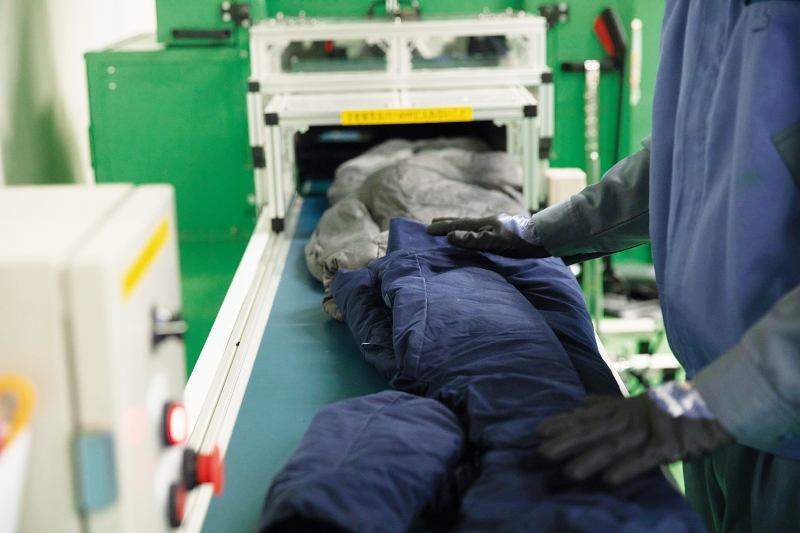
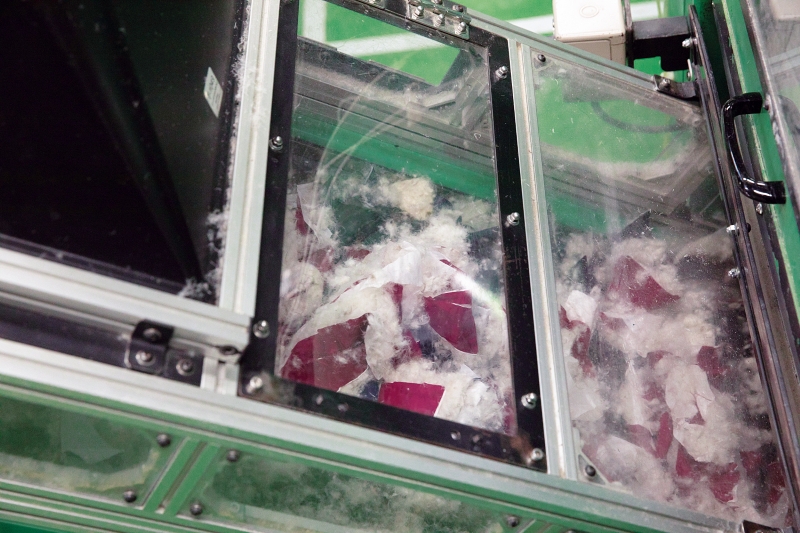
During a visit to Toray’s Advanced Textiles Development Center in Shiga prefecture, Engineering Development Center inventor Naoki Oka, who contributed to the invention of the machine, described how the previous manual method of extracting feathers from donated jackets was comparatively inefficient and hazardous due to the extraordinarily lightweight and messy nature of the substance — even with masks on, inevitable inhalation could result in health complications for workers. In contrast, the down recycling machine — commissioned by Uniqlo in 2018 and completed in 2020 — contains the entire process within a compact room.
Collected articles are packed and efficiently stored in the warehouse in cardboard “sandwiches” of about 90 pieces. Jackets are laid on a conveyor belt and passed through a special blade, slicing clean through the zips and buttons to create strips. A separation chamber utilises controlled airflow to suck the soft material from the nylon, funnelling the down directly into a packaging sack. Oka says around 90% of the down (50g to 60g) per jacket can be successfully extracted, and this is later cleaned and blended with new feathers to produce the Recycled Down products.
Additionally, Toray has played a role in incorporating recycled polyethylene bottles into the production of HeatTech, while recycled cashmere goods samples are also in the works. The Shiga factory’s top-of-the-line Technorama weather simulation laboratory (a portmanteau of techno and panorama) allows researchers to comprehensively test the efficacy and wearability of new products in a variety of conditions including harsh sun and extreme cold — multiple chambers set to different temperatures can emulate the sensation of stepping out of a freezing train car into the summery outdoors, for example.
Asked how such manufacturer relationships allow them to implement systematic changes and work towards greater sustainability milestones, Yanai says, “Historically, when we promised growth to our partners, we always reached those targets, and that has strengthened our manufacturers’ trust in us. Likewise, we have announced our sustainability commitments to external partners, and are now striving to establish our credibility by attaining those goals. Making and achieving targets develops bonds, and that process is a great priority in business — once there is trust, they become willing to work closely for future plans.”
Warming the soul
copy_of_14_a1a5386.jpg
Launched in winter 2024, The Heart of LifeWear is the company’s latest initiative to donate new clothing, primarily HeatTech thermalwear, to refugees, children, disaster victims and others in difficult situations around the world.
“We just celebrated the 40th anniversary of Uniqlo last year. We asked ourselves, how can we use the power of clothing to make life better? The Heart of LifeWear started as a result of that thinking,” says Yanai.
This follows the apparel retailer’s long legacy of providing clothing support to those in crisis, which began with providing jackets to Afghan refugees in 2001. Since 2006, Fast Retailing and Uniqlo have worked with the United Nations High Commissioner for Refugees (UNHCR) to reach displaced individuals and respond to relief needs, with the parent company officially becoming the UNHCR’s first official global partner in Asia five years later.
“Our relationship with the UNHCR actually began with just one phone call,” reveals Sherba. Back when Uniqlo was first exploring the idea of reusing instead of recycling its collections, she says, “I was searching for an NGO through which we could donate clothes, but was turned down by most groups, which were seeking funds instead. I called about 15 different organisations. When I eventually contacted the UNHCR, they accepted our request because their clothing needs were very high but their budget had been cut. We realised we each had the solution to the other’s problems.”
Within its first year, The Heart of LifeWear successfully sent one million items across 28 nations and regions, with about 53% reaching refugee camps in Jordan. For its 2025-2026 stretch, the project hopes to meet and exceed this donation volume, currently targeting to distribute 1,061,000 items globally.
Yanai emphasises the company’s goal to deliver half the amount, about 500,000 articles of HeatTech, to Syrian returnees, adding they are continuing to work with the UNHCR to ensure as many shipments as possible reach those in need before winter hits.
“One of the powers of clothing is to protect lives — to be able to keep one warm in the cold. HeatTech was the obvious item to donate,” he says.
These efforts expand far beyond material contributions as well. “We strongly believe that the development, evolution and flourishing of the local community in all the countries and territories we operate in are crucial to the sustainability of our business,” affirms Yanai.
Uniqlo employs several comprehensive refugee empowerment approaches such as hiring displaced individuals and developing self-reliance projects to help them attain economic stability.
Far-reaching efforts mean acknowledging there are no “one size fits all” solutions: understanding the needs of a country is vital to maximising the impact of its provisions. The company hopes to expand its range of contributions to include other useful articles such as shoes, depending on global needs. For example, in 2024, Uniqlo allotted a volume of AIRism pieces to the southern hemisphere to account for the hotter climate.
“The most important thing is to share products that will be appreciated by those who receive them,” says Yanai, noting further that working on a worldwide scale from year one was a conscious decision they hope to maintain.
As their activities continue to expand, he hopes the project will keep receiving the cooperation of their brand ambassadors and the media to raise awareness and gain support from a wider audience.
This article first appeared on Dec 1, 2025 in The Edge Malaysia.