
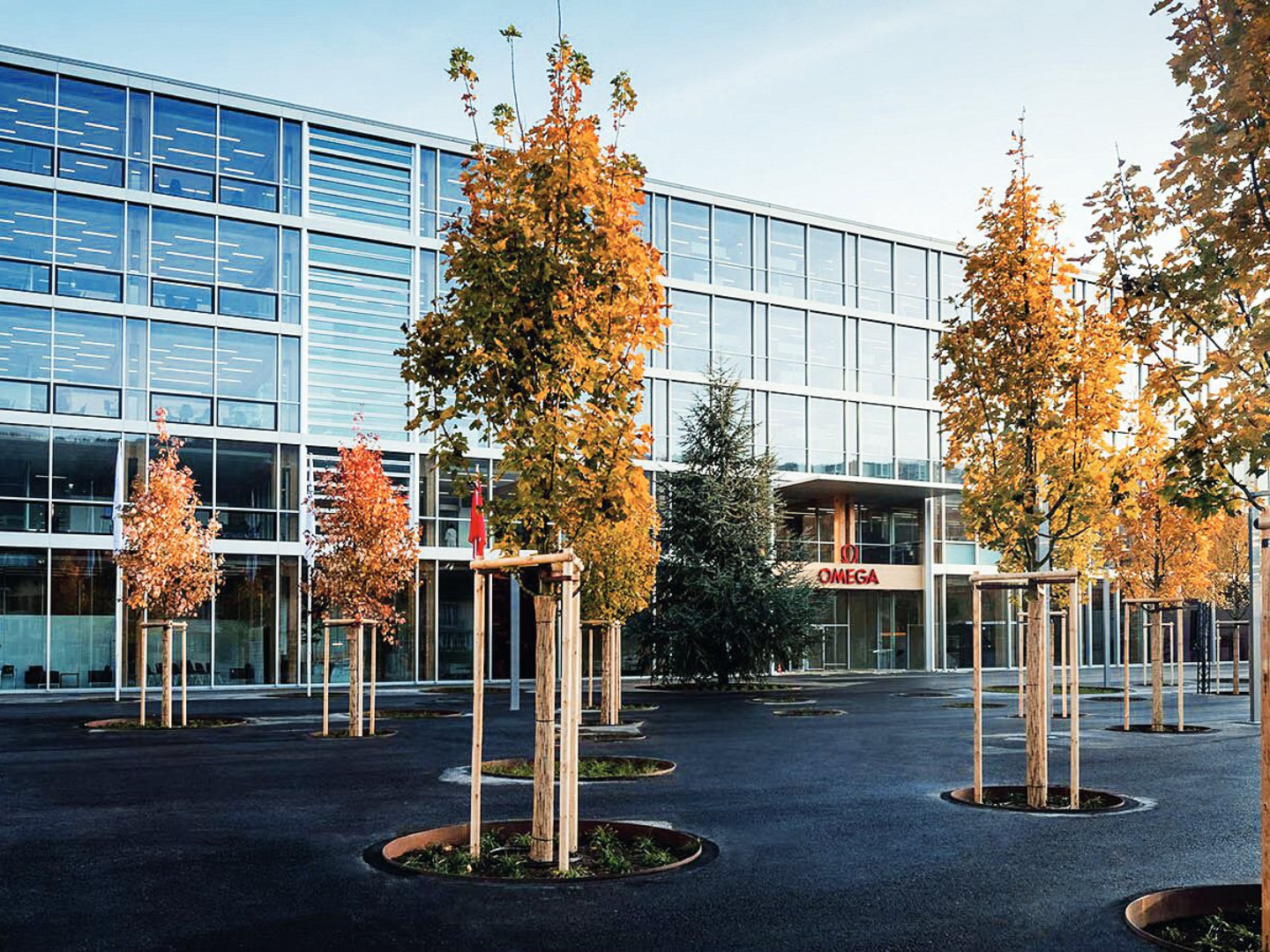
The brand's five-storey facility in Biel/Bienne (All photos: Omega)
Omega’s facility in Biel/Bienne is built around a simple industrial problem: how to move thousands of delicate components through assembly, testing and distribution without losing precision at any stage. Opened in November 2017 after 12 years of planning and development, the five-storey building stands on the site the brand has occupied since 1882.
Its architect, Shigeru Ban, was already familiar with the wider Swatch Group, having designed the Nicolas G. Hayek Center, its Japanese headquarters and multi-brand flagship in Tokyo’s Ginza district. For Omega’s new assembly facility, Ban retained the long, glazed proportions associated with traditional watch factories and filled them with something their builders could scarcely have imagined. A framework of sustainably sourced Swiss spruce gives warmth and scale to an interior governed by exacting controls while a three-storey automated inventory system runs through its core.
The building brings together processes once spread across several locations. T2 (assembly), T3 (bracelet fitting) and T4 (shipping) now sit alongside stock management, logistics, technical inspection and staff training. The advantage is continuity: fewer breaks between stages, closer oversight and a clearer path for every watch as it moves towards completion.
body_pics_1.png
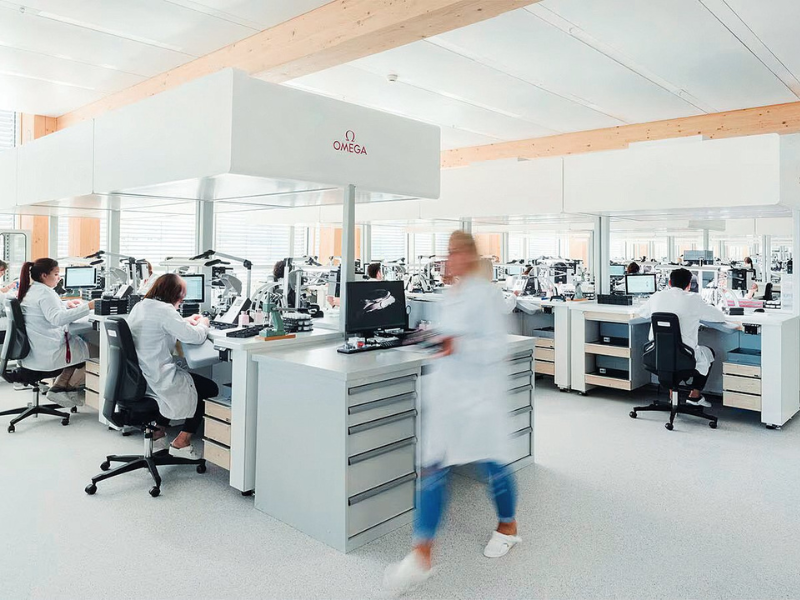
Within the storage chamber are more than 30,000 boxes containing movements, cases, dials, hands and other parts, all catalogued and summoned as required. Two vertical lifts travel at up to 4m per second and can carry out around 1,400 operations an hour, keeping the assembly floors supplied according to the day’s production orders. Oxygen levels are held at 15.2% to prevent fire from taking hold, which means entry is limited to two specially trained employees.
From there, the components make their way to the benches. Digital instructions and barcode scanners keep track of their progress while automated equipment takes care of repetitive tasks such as transporting, positioning, photographing, engraving and packaging. Watchmakers handle the work that calls for judgement and dexterity: fitting hands, casing movements, making adjustments and reading the results of each test.
The third floor houses the testing required for Master Chronometer certification, carried out to standards developed with the Swiss Federal Institute of Metrology, or METAS. Finished pieces are examined for precision, power reserve, water resistance and their ability to withstand magnetic fields of up to 15,000 gauss.
The facility also places Omega in a stronger position to shape what comes next. As mechanical pieces are expected to withstand greater magnetic exposure and deliver tighter accuracy, the burden of proof is shifting — from what a timepiece promises to what it can demonstrate.
This article first appeared in 'Calibre' on July 27, 2026 in The Edge Malaysia.