

Fabrizio Buonamassa Stigliani and Korean artist Lee Urfan (All photos: Bvlgari)
The Bvlgari Octo Finissimo has long stood as an icon of modern watchmaking: a fusion of geometry, precision, and impossibly slim engineering. At this year’s sixth edition of Geneva Watch Days, the legacy continues with a striking new collaboration between Bvlgari and renowned Korean artist Lee Ufan.
Unveiled alongside a retrospective celebrating the Octo Finissimo’s decade of record-breaking innovation in ultra-thin horology, the Octo Finissimo × Lee Ufan edition transforms timekeeping into a contemplative art form. Inspired by Lee’s poetic “rock and mirror” philosophy, the 150-piece titanium timepiece captures the tension between stillness and infinity — a meditation on contrast, reflection and form distilled into a wrist-borne sculpture.
Fabrizio Buonamassa Stigliani, creative director and designer of Bvlgari watches, tells us more about the inspiration behind this collaboration, and how art continues to shape the future of the Octo Finissimo.
The Octo Finissimo has become a kind of “canvas for infinity” through collaborations with architects and artists. What does this year’s partnership with Lee Ufan bring to that ongoing dialogue, both aesthetically and philosophically?
Fabrizio Buonamassa Stigliani: With every collaboration, there is something different, a new challenge. The artist must also be comfortable with this concept. Sometimes this isn't easy, because these are great artists who are used to working on large-scale projects. Switching to a project that is different from what they are used to can be tricky. My role is to support them in this project by determining what is feasible and what is not possible. I accompany the artist in discovering this canvas.
How did your first meeting with Lee Ufan unfold, and what impressions or conversations from that encounter shaped the final watch?
The first time I met Lee Ufan was in his studio. First, we discussed what he would like to see on this watch. We started with an idea that wasn't necessarily feasible. The first few minutes are usually complicated because we don't know each other or know very little about each other. Sometimes with international artists, it's not easy to say no if something isn't feasible.
I ask the artist questions: What is art? What are his tastes? What is his heritage? With these questions, we can begin to discuss our artistic backgrounds and works of art. Little by little, the artist tells me what he has in mind and what he imagines. From that moment on, I started sketching and seeing many options. With Lee Ufan, I made a sketch that he kept. He explained his artistic side to me, and I tried to translate it through the sketch. He really liked it, and we developed the watch. This sketch was close to him and his vision.
bvlgari_2025_octo_finissimo_lee_ufan_x_bvlgari_104132_crea_01.jpg

Did working with Lee Ufan challenge you to rethink any long-held design instincts about the Octo Finissimo’s form or materials?
I find the collaborations on the Octo Finissimo very interesting. With Sejima, we started changing the material. With Laurent Grasso, we changed the color. With Lee Ufan, we managed to work more on the material. For the first prototype, I bought some industrial files and we transformed the material on the bracelet. Lee Ufan really liked it. Each watch is different because all the straps were filed by hand. The dial represents a calm universe, while the case and bracelet evoke a raw material. To accentuate the contrast, Lee Ufan asked for a bezel with a different finish.
With Hiroshi Senju’s aquatic landscapes and Lee Ufan’s mirrored minimalism, this year’s Finissimo lineup spans very different artistic vocabularies. How do you decide which artists and styles feel right for the collection in a given year?
The collaboration with Hirosuhi Senju is special to me because it was my first live collaboration. I really liked his art because with the waterfalls we can see time passing through the cloud of water. We can imagine the sound of the water and the waterfall. With Lee Ufan, we managed to work with the material. It was an interesting thing. The last challenge is always the next one. I've been lucky enough to meet people who are both generous and incredible.
We only see the collaborations that come to fruition, but sometimes there are collaborations that never see the light of day. We receive many requests for collaborations, but with Asian artists, we reach the end of the project 90% of the time. It's not a choice to work with Asian artists, but for me it's more feasible thanks to the cultural difference. Once we start, I'm sure we'll reach the end.
Let’s talk about the Octo Finissimo Tourbillon Marble. The material is notoriously difficult to work with in watchmaking. What were the biggest technical and creative challenges in crafting the deep blue marble dial for this year’s Octo Finissimo Tourbillon?
We work with a supplier who is able to cut very thin pieces of marble. It's a material we really like, and which means a lot in Italy. When we launched the marble watch for Only Watch, we received a lot of requests for a marble watch. So, we decided to launch watches with marble dials. We can't use all colors of marble because they are all different.
bvlgari_2025_octo_finissimo_tb_blue_marble_104257_packshot_02.jpg

At just 4.85 mm thick, this tourbillon pushes limits yet again. Do you see thinness as an ongoing design imperative, or is it more of a byproduct of the creative concept?
Thinness is a consequence; It’s not something we are obliged to do. Obviously, it’s less complicated to make thicker watches, but they are perhaps less in line with our current aesthetic. We enjoy the thinness due to the feeling of a second skin, it’s very pleasant to wear. Thanks to what we have in our manufactures, we are able to showcase our unparalleled expertise. We can combine extreme Swiss watchmaking expertise with a completely different Italian design. We manage to create unexpected combinations and unexpected objects.
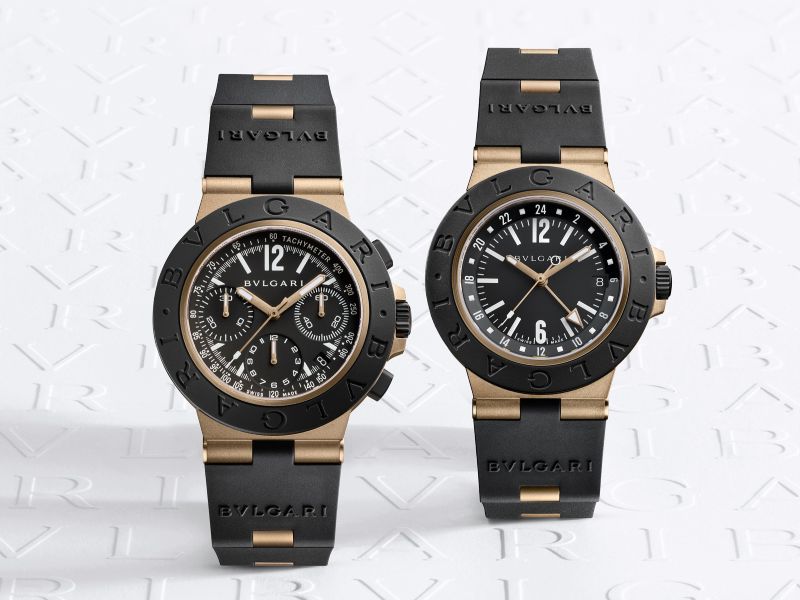
There’s also the Bronzo. This is the first time bronze enters the Bvlgari Aluminium line. What made now the right moment to introduce this historically rich yet “living” material?
This is a very interesting opportunity for Bvlgari Bvlgari Aluminium. The frame has always been made of aluminum with a combination of black and white colors. We decided to change this to offer new products to different customers. The bronze color is quite warm. It's a new color combination. We're playing with materials. We've already used bronze on the classic Bvlgari case, and now on a more sporty, chic watch that's better suited to an active lifestyle.
The Bronzo GMT and Bronzo Chronograph each have distinct personalities. From a designer’s point of view, how did you differentiate their aesthetics and ergonomics?
The watches were created at the same time. The Bvlgari Bronzo was created with the chronograph, and a week later, it was created with a GMT. In our minds, it was just one product family. I like things that are simple and easy to use. Innovation is not just about aesthetics, but also about how an object is used. Ergonomics is taken into account in our product.
bvlgari_2025_bvlgari_bronzo_104241_104242_crea_01.jpg
Looking back at this year’s lineup, which piece feels the most personal to you — and which one do you think will surprise collectors the most?
The Octo Finissimo in collaboration with Lee Ufan is the most personal and surprised collectors. The watches sold out worldwide within 48 hours of launch.
Geneva Watch Days is known for its more intimate, collaborative atmosphere compared to other watch fairs. How does this environment influence the way you present and discuss new designs?
Geneva Watch Days is a more intimate venue with many collectors in attendance. It is more relaxed. Watches and Wonders is a more formal event. It is a completely different venue. As for collaborations, any creative take on the Octo Finissimo will be rather unexpected in the future. I can say that the collaboration with Lee Ufan was also unexpected.