
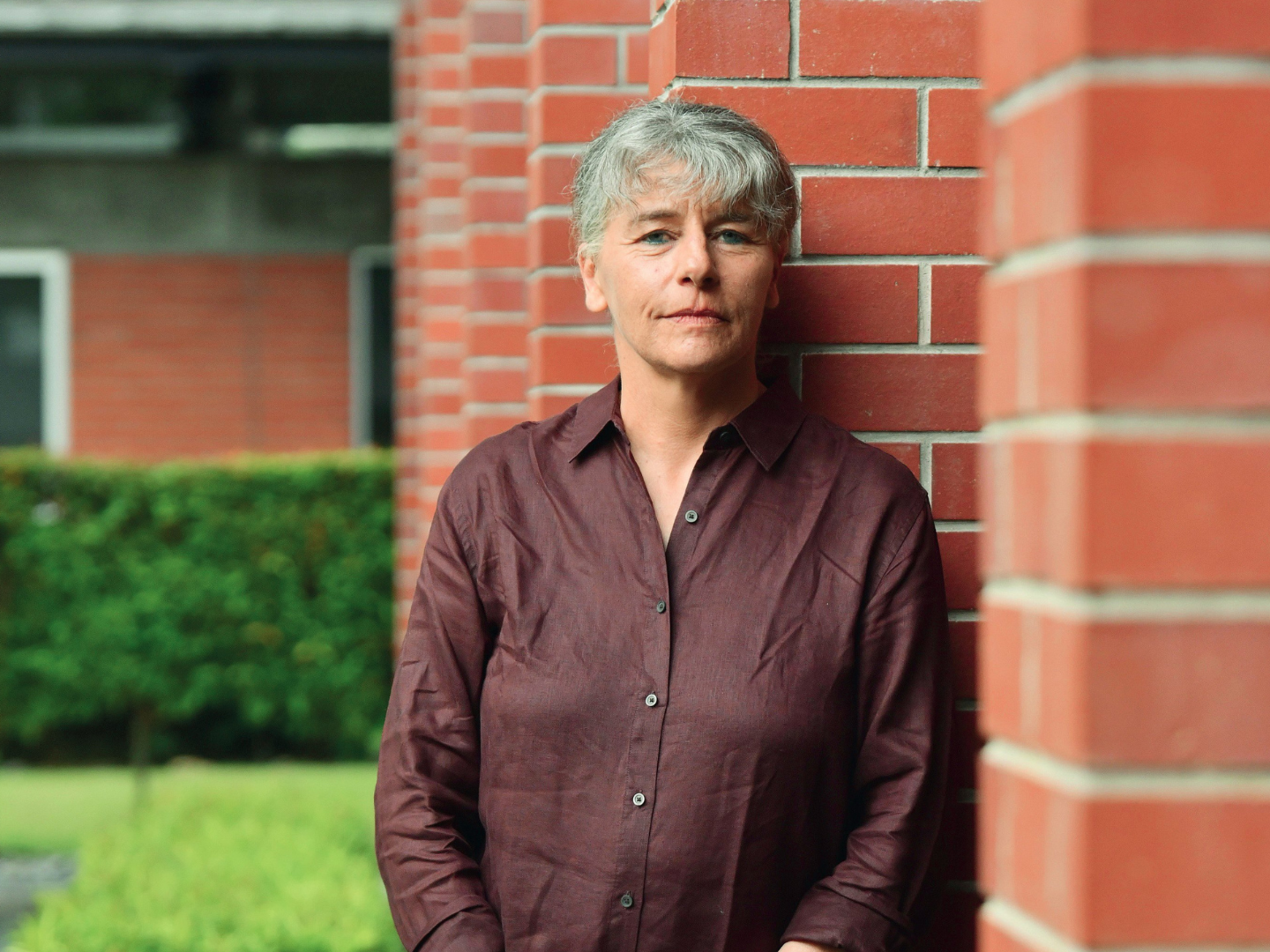
Lovey: "Sometimes, it worries me that AI is in the hands of people who are not accountable to anyone. I think we need to build a counterpart — a kind of independence — where more people have access to coding and an understanding of how these tools work." (Photo: Sam Fong/ The Edge)
Mars has never tempted Catherine Lovey. It is enough, the Swiss author and journalist says, to simply look around without chasing the far edge of the map. On a train once, she spotted a greying man reading Osip Mandelstam’s poems in German — a sight she found startling as his words were still finding readers on an ordinary commute. Further down the carriage, a furious caller ensured everyone within earshot knew work had gone wrong and that “Kevin was an idiot”. Writers, Lovey seems to suggest, need not manufacture strangeness or invent the extraordinary to uncover something worth saying. The universe, if you sit still long enough, gives itself away.
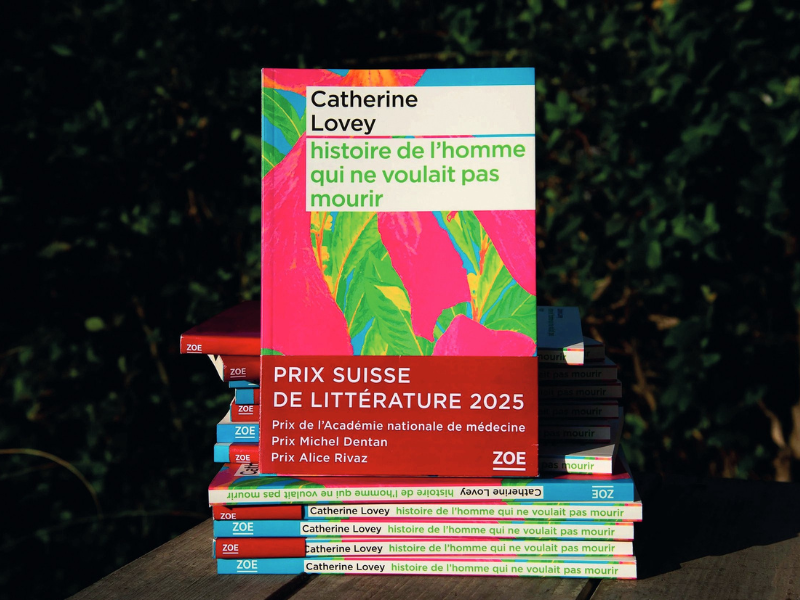
The instinct for the close-at-hand found its fullest expression in her fifth novel, histoire de l’homme qui ne voulait pas mourir (2024), or, in English, Story of the Man Who Didn’t Want to Die. The setup is spare: A narrator quietly observes her neighbour Sándor, a Hungarian émigré consumed by work and travel living across the same landing, with whom she has nothing in common. When he is diagnosed with an incurable illness, a friendship built in adversity unfolds, one that sidesteps their political divides and differing understandings of the world they inhabit. Across 45 short chapters, Lovey traces joy, incomprehension and recognition, revealing all the ways we share in our otherness.
“I don’t usually have a plan. I wait for feelings to emerge or even for the quality of light to settle. Then a face appears, though rarely in sharp focus. With histoire de l’homme qui ne voulait pas mourir, all I had at first was a door, then a woman and a man,” says the author, whose novel went on to win the Swiss Literature Prize last year.
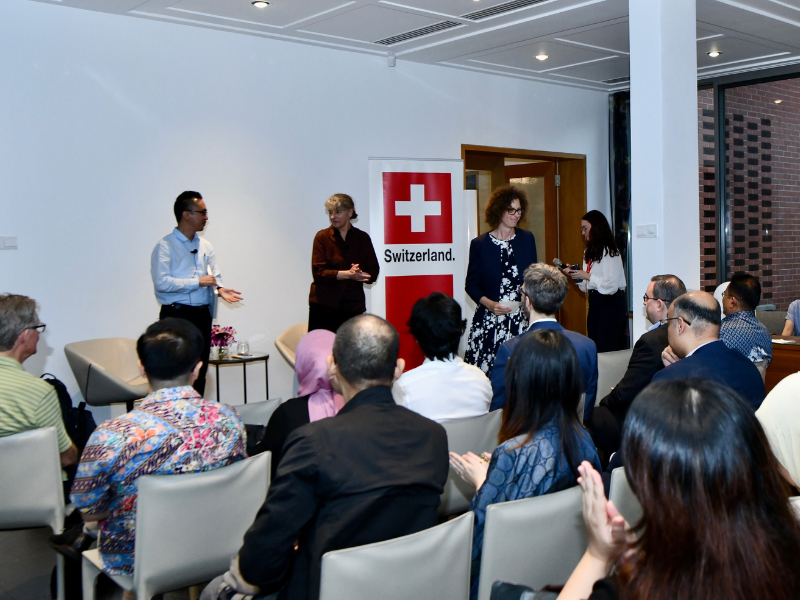
Rather than imposing a structure from the outset, she follows images, tones and encounters as they arise, trusting that meaning will gather along the way. Lovey speaks of wanting to be caught off guard by her own writing because the best moments are often the ones she does not see coming. The same impulse shapes the way she travels. Over the course of just two days in Kuala Lumpur, where she gave a talk at the Swiss Embassy Residence on whether artificial intelligence (AI) could ever write a book, the city made itself known through textures and temperatures she had not thought to anticipate.
Storytelling, in her opinion, is a slow accumulation of impressions that cannot be predicted, only lived. If a writer has not learned to sit with discomfort or delight long enough for it to mean something, there is little to bring to the page that could not be produced faster elsewhere. What unsettles her is how easily this process can be short-circuited, as AI organises and even generates experiences before anything is fully felt.
body_pics_1.png
“First of all, I’m not a specialist in large language models, so my position isn’t to be simply for or against them,” Lovey explains. “I only use ChatGPT and Perplexity for research — never for literature — and what they have made possible in science and medicine is remarkable.
“But I’m starting to feel that we’re being pushed, more and more, to forget we’re human beings. Everything is about speed — ‘summarise this’, ‘do that for me’. Even in media, there’s a tendency to think that anyone internet-savvy can do the job. But journalism, like medicine, is a profession. A doctor who operates on your leg is a trained professional — and reporting requires that same level of skill, judgement and responsibility. It can’t be replaced by second-hand opinions or technology presenting partial or unverified information as fact.”
Lovey is not speculating from a distance. Born in 1967 into a family of mountain farmers in Valais, she studied international relations in Geneva before training in criminology at the École des sciences criminelles in Lausanne — the latter, she admits, to better equip herself for investigating money laundering and corruption cases. Having spent years in the field, first at the Tribune de Genève and then at L’Hebdo, specialising in economics and finance, she understands what it takes to gather evidence carefully, weigh sources and resist the pull of convenient conclusions.
In the 1990s, she was covering the financial world as banks began introducing complex derivatives — instruments, she notes, that many bankers themselves did not fully understand, and whose misuse would eventually contribute to catastrophic market crises. What stayed with her was not the technical detail but the human pattern beneath it: that people are capable of laziness and cruelty. When machinery outpaces judgement, the consequences fall hardest on those with the least power to absorb them.
The erosion of institutional guardrails troubled her too. She recalls being told by teachers that the strength of the American system lay not in any single leader but in the resilience of its constitution and the separation of powers that held it in check. It is this faith in systems — financial, political and technological — that she has grown wary of over time, especially when they are presented as self-correcting or inherently progressive.
body_pics_2.png
“You know, one of the few advantages of getting older, thank God, is being able to clearly discern what is right and wrong because you’ve lived some decades. We are always being promised that something new will solve everything. In the early 2000s, IT experts told us our lives would be for the better, and yet we are still facing environmental dangers as well as pollution on a massive scale. The same happened when the Berlin Wall fell. I was 22, and we were told a new world was beginning. But just look at the tragic situation we’re in right now. I’m not someone who believes these kinds of promises will automatically lead to something wonderful.”
That scepticism extends to the present moment, where she senses a growing fatigue that dulls both outrage and curiosity, exacerbated by automated systems that streamline thought into quick replies and ready-made interpretations. People, she asserts, have grown content with the mediocre, the middle, the good enough. Critical thinking has not been defeated so much as abandoned, replaced by the ease of material that asks nothing of its reader.
Her answer to that predicament, characteristically, is literature. She returns often to the prolific Russian playwright and short story writer Anton Pavlovich Chekhov, whose subtle social critiques she regards as a masterclass in exposing the fault lines of a society through its smallest, most intimate moments.
“Sometimes, it worries me that AI is in the hands of people who are not accountable to anyone. I think we need to build a counterpart — a kind of independence — where more people have access to coding and an understanding of how these tools work. Otherwise, there is a real danger of standardisation or even manipulation. When information is shaped by a few [actors] and repeated at scale, it becomes harder for people to question what they’re seeing. And that is how democracy is destroyed.”
For Lovey, the argument ultimately returns to the individual. “Don’t rely on it for everything. Don’t ask it to write a love letter to your mother or loved ones. Don’t be satisfied with just the ‘simple things’. Take responsibility. Write it yourself, even if it isn’t perfect or risks reproach. Because that is what it means to be human.”
This article first appeared on May 4, 2026 in The Edge Malaysia.