

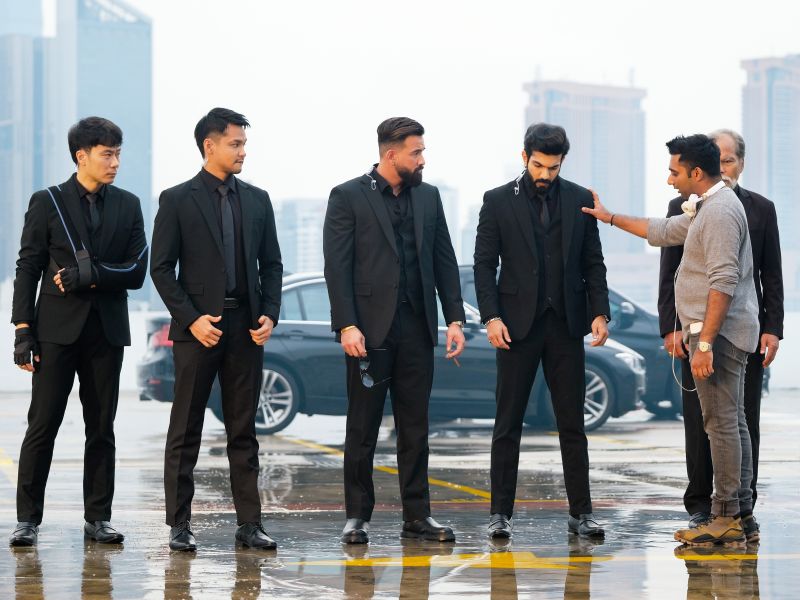
Abhilash co-directed Blood Brothers: Bara Naga with Syafiq Yusof of Polis Evo 3 (Photo: Low Yen Yeing/The Edge)
Sci-fi savvy and unrepentantly perfectionist, James Cameron rarely acknowledges the concept of human limits in himself or anyone else. Over four decades, he has delivered one epic after another — many of which were first dismissed as bloated summer diversions, only to be vindicated when box office triumphs forced critics to recant. The Terminator still trades punches with George Lucas and Steven Spielberg’s tentpole hits after 41 years. Avatar, shot with cutting-edge cameras he and his team devised, became the “titanic” of 3D fantasias. What he leaves behind is not only a catalogue of cinematic feats but the guiding principles that made them possible.
“If you set your goal ridiculously high and it’s a failure, you will fail above everyone else’s success,” the director once said. His oeuvre, forged through months of gruelling shoots, physical peril and technical brinkmanship, was tempered in the white-hot flames of uncompromising ambition. For a young Abhilash Chandra, it was a masterclass in the audacity of chasing the impossible; a spirit that would harden into a cornerstone of his own filmmaking journey.
“This guy really gets it,” he says of the gestalt master world-builder, who set the summer blockbuster template by whisking audiences off to fictional moon Pandora in 2009. “I remember putting on those 3D glasses and watching the blue bubbles rise in the opening scene on a 70mm IMAX projection in the UK. I swear to God, it was so mind-blowing because I was completely zoned into the experience. James Cameron is a genius producer, writer and director. I’d aspire to exist even in his rarefied atmosphere. Avatar was probably one of my greatest turning points. It gave me the extra push to make movies.”
That rush of inspiration stood in stark contrast to Abhilash’s beginnings. He spent his early childhood on Carey Island before moving to towns such as Bukit Belimbing, Sitiawan and Tanjung Karang due to the itinerant demands of his father’s work in the oil palm plantation business. When dad relocated to Indonesia, the family settled in Klang, where his grandparents live, while his mother devoted herself to the household.
must_put_2.jpg

“Films were an escape for those of us living deep in the pedalaman. Going to the cinemas wasn’t really a thing, so we watched the latest releases on makeshift projections. My father, a huge movie fan, introduced me to all kinds of titles, some far too mature or violent. Imagine a nine-year-old watching Lethal Weapon.”
What left him truly spellbound was the first Jurassic Park (“I watched it seven times”), a milestone that stomped across Hollywood’s special-effects landscape as well as sank its teeth into meatier themes such as the clash between science and commerce, environmentalism and greed. Years later, Peter Jackson’s The Lord of the Rings trilogy stirred that same sense of awe, conjuring an entire world with its own history, languages and moral weight. Abhilash wore out its extended-edition DVDs, poring over 13 hours of behind-the-scenes footage and studying every detail — from prosthetics and miniature sets — designed with the kind of care and depth worthy of philologist JRR Tolkien’s fantastical legacy.
“Filmmaking is the only art form where so many crafts come together to realise a single vision,” says Abhilash, his voice quick with excitement. “Hundreds of people — from painters and musicians to costume makers and lighting designers — bring their own expertise. Did you know there are people whose sole job is to paint leaves? They’re called ‘greens’. I was captivated by it all and thought, how could I be part of every aspect? If I became a director, I could.”
He is not far off the mark. Even the great essayist and critic Susan Sontag once described writing as “an ascetic, solitary occupation”, contrary to the seductive appeal of working on set, where “one can get hooked on the simple pleasures of collaborating with people”. While Abhilash’s dream of leaving his mark on the silver screen took root early, it would be years before that grew beyond the living room.
When he told his parents he wanted to study mass communication at university, the idea was swiftly dismissed as impractical. “They asked if I had a game plan after graduation, and I didn’t,” he says. “Becoming a director felt like a faraway concept, especially in an Asian society where you either become a doctor, an engineer or an accountant.” In the end, law seemed the safer bet.
By his second year, however, the cracks were showing. “I had an existential crisis. It was in the middle of a lecture on either contract law or the Sale of Goods Act that I suddenly looked around at my classmates. Everyone was so focused; they knew exactly what they were going to do with their lives. I envied that,” he admits. “This is what I’ve realised about myself: if I have to grind from 9 to 5 and just think about going home, I will lose all sense of purpose. I’m quite extreme that way. If I believe in something, I’ll give it 3,000%. Otherwise, I won’t do it at all.
“I’m a big fan of Ang Lee, and I connected deeply with his career. He came from a very traditional family, and his father — a former university professor with a stern, authoritative presence — often looked down on him. At the heart of it, people like us share the same impulse: we just want to tell stories.”
Reel breakthrough
Enrolling in film school is often derided as an expensive self-indulgence, yet Abhilash saw it as a reliable path to anchor instinct with discipline. New York University’s Tisch School of the Arts, which then had a campus in Singapore (now shuttered), became his crucible, a meeting point where peers from around the world helped shape his raw enthusiasm into sharper form. Among the university’s notable alumni was Onn San (the first Malaysian to earn a master’s degree in musical theatre writing from Tisch), who went on to compose for Ola Bola and won Best Original Score at the 28th Malaysia Film Festival.
“My dad and I argued for three months before he finally let me go to Tisch. I didn’t want to turn 40 and look back, wondering, ‘Where did my life go?’ So even if I failed, at least I’d know I tried. What I wasn’t prepared for was just how humbling the experience would be. I still remember screening my first short — a black-and-white 16mm silent production — to a panel of professors. It felt like American Idol, except every judge was Simon Cowell and there were seven of them. The first thing they said was: ‘Your filmmaking is very naïve’. My classmates were steeped in arthouse cinema by Federico Fellini, Orson Welles and Andrei Tarkovsky. And then there was me, influenced by 1990s Michael Bay.”
tisch.jpg

Asked about the project that baffled his professors, Abhilash chuckles at the memory. “I made a film about three women who discovered they were married to the same man. And — wait for it — these ladies were in burkas. So you have this trio of Desperate Housewives dressed like ‘ninjas’, all conspiring to kill their husband,” he says, laughing at the absurdity. The classroom, however, was not amused. The film ended in silence, punctuated only by a single, weary sigh. Then came the verdict: “One kind lecturer said, ‘Your shots are sharp, you know where to put the camera but you’re not saying anything. It’s empty.’
“It taught me very quickly that you can’t rely on flashy visuals without depth. Audiences go to the cinema to be moved. Without a compelling narrative, there is no audience, and without it, there is no money. Tisch was really a baptism of fire.”
If film school stripped away his illusions, reality proved no gentler. His first taste of working on set came when a line producer for Netflix’s 2014 historical epic Marco Polo — then based at Pinewood Iskandar Malaysia Studios in Johor — gave a talk at his university. Abhilash, “with a muka tembok”, did what few others dared: marched straight up and asked for a job. Despite having only a handful of commercials under his belt, he was placed in the assistant director’s department, where his stamina and organisational skills were tested daily against the sheer logistics of keeping such a vast production on track.
From Johor, he drifted to Singapore, where agency work honed his client-management chops but left him restless for story. One door remained ajar through producer-editor Joel Soh, a former collaborator who had helped shepherd Abhilash’s thesis to the finish line. The two stayed in touch as the Astro scholarship awardee cut trailers and produced for the rising Polis Evo, a buddy cop action juggernaut likened to Die Hard or Bad Boys. That connection was pivotal: Abhilash returned to Malaysia to join the production of Polis Evo 2, his major step into the local industry in 2016. By the third instalment, he was no longer a bystander or just another name on the call sheet; director Syafiq Yusof brought him into the fold to shape the franchise’s voice from the inside.
Vaulting the duo into an even greater prominence earlier this year was Blood Brothers: Bara Naga, a gritty crime saga that, at the time of writing, had grossed an estimated RM78.5 million in Malaysia and extended its reach abroad through theatrical releases in key international markets.
Storyboard to spotlight
Abhilash compares filmmaking to building a house, an undertaking where every hand matters, from the contractor laying the foundation to the roofer sealing it from the elements. Each craft is indispensable in creating something that endures. The challenge, he observes, comes when ambitions and expectations soar higher than the resources that can sustain them.
“Everything is a job, I get it. But when the budget is tight and you’re expected to deliver more, people will complain: ‘Aiyoh, very susah lah. Why make things so difficult?’ Still, I believe we should be meticulous with our processes to ensure the quality. I’m glad that with Syafiq [and Skop Productions], we were able to get the results we wanted for Blood Brothers by partnering with an expert local action team, the Defenderz, to choreograph the stunts. That fight scene between Ghaz and Ariff in the club? It took four days. And the entire third-act battle where the car smashes through? Nearly a month. Everyone was losing their minds. But in the end, it was worth it,” asserts Abhilash, who begins filming the sequel in May 2026.
must_put_3.jpg
The larger point, he stresses, is that Malaysian cinema must endeavour to move past pontianak tropes and slapstick comedies, particularly when our Thai and Indonesian neighbours are already pulling ahead in both technology and storytelling. The jaguh kampung mentality — the small-time mindset of being content as a “village champion” rather than striving to compete on regional or global terms — needs to change. Films like Adrian Teh’s Paskal and Liew Seng Tat’s Lelaki Harapan Dunia are reminders that home-grown stories can resonate far beyond our borders.
Nonetheless, Abhilash is not merely chasing spectacle but emotional maturity, as he confesses to recognising fragments of his own life in the characters of Blood Brothers. The crime action thriller pits Ariff, a fiercely loyal bodyguard wrongly framed, against Ghaz, his closest friend and fellow elite protector. Their confrontation transforms the notion of brotherhood into a test of loyalty and redemption.
“I’ve always been drawn to themes of camaraderie, brotherhood or the conflict that strain relationships. When your loved ones disappoint you, can you still stand by them? Some of my plots are also derived from real-life scenarios, whether from my school days or within my family. Even when the inspiration feels personal, what I worry about most when I make films is the fear of not knowing. You might think something is good, only to face a rude awakening when the movie comes out and everyone says, 'What the hell were you thinking!’
“Anyway, I believe if you are sincere in your craft, someone will connect with it. Yes, there will be a lot of dark days and uncertainties. You just have to remind yourself why you started this in the first place.”
dscf7944.jpg

Malaysians can be harsh critics but none mattered more than the toughest reviewer in the family row at the premiere of Abhilash’s debut feature. After all the bickering and years of film school, had it finally paid off?
“He was happy and secretly proud lah. But you know, dads will always be dads. He just told me to stay grounded,” Abhilash recalls with a smile, a reminder that even as he strives for bigger moments, some of the most meaningful ones are still written at home.
Blood Brothers: Bara Naga is now showing on Netflix.
This article first appeared on Sept 8, 2025 in The Edge Malaysia.