

Malaysian-born, British writer and film producer Arvind Ethan David (Photo: Valerie Cavaness)
An eccentric, witty gentleman with a vast skill set, keen observational prowess and penchant for vice, accompanied by a less-than-confident sidekick who chronicles their many fascinating escapades — we are referring, of course, not to detective Sherlock Holmes and Dr John Watson, but high-society thief A J Raffles and Bunny Manders, the main characters of Ernest William Hornung’s popular short stories.
First appearing in the 1898 tale “In the Chains of Crime” (also published as “The Ides of March”), the adventures of a charming cricketer-cracksman and his bumbling companion were immensely popular well into the mid-20th century.
To the contemporary reader though, the names will hardly ring a bell. “I had become a bit obsessed with Raffles and Bunny. They were amazing characters who just disappeared, and I wanted to bring them back in some way. That was the starting point,” says Arvind Ethan David, an award-winning Malaysian-born producer, director, playwright, graphic novelist, writer and current principal of production company Prodigal TV.
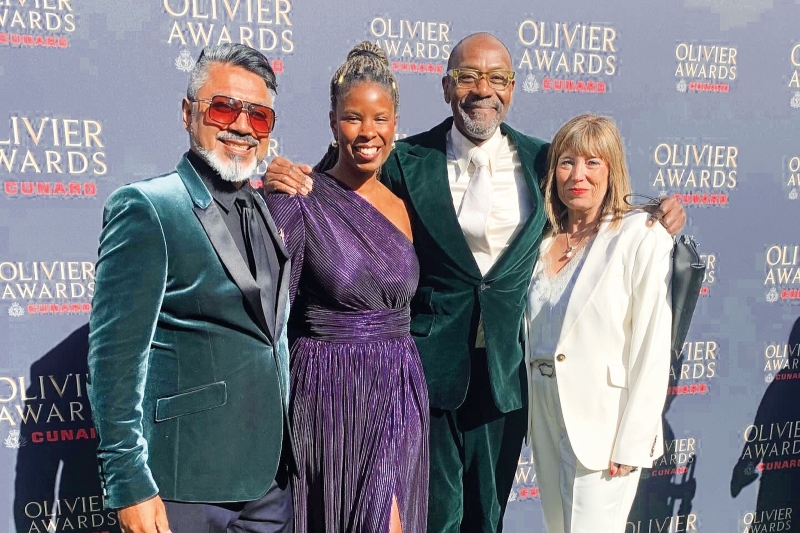
A self-professed “magpie”, the ex-lawyer has dabbled in practically every creative medium (“Opera and ballet are probably all that’s left”) and genre across page, stage and screen. He was most recently nominated for an Olivier Award for his musical adaptation of Sir Lenny Henry’s The Boy with Wings — one of two Malaysian nominees for the Best Family Show category, alongside Jude Christian.
1.png
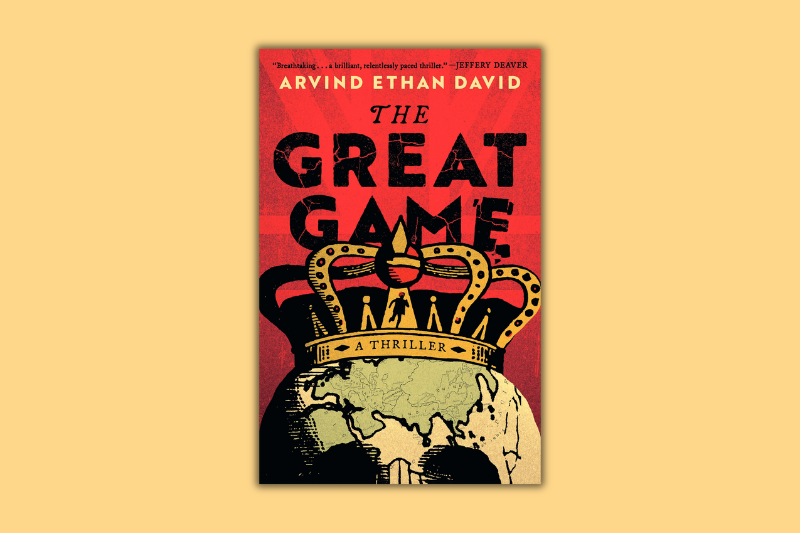
With the upcoming release of his debut novel, The Great Game, “author” will be the next bright feather to furnish David’s colourful cap of credits. Set in 1905 London at the height of the empire’s power, the tale follows the escapades of Raffles and Bunny — the latter no longer a naïve number two, but Lieutenant Balvinder dev Singh, a Sikh law student and former soldier far from home — as they attempt to solve a series of gruesome murders while skirting suspicion themselves.
“This is my first published novel. I wrote one when I was 27 or something and amassed a collection of very articulate rejection letters from people who said, ‘We would love to see your second novel’. And now, 20 years later, they get to!” he laughs.
Drafting phase
Born to a lawyer father and sociolinguist mother, David first moved to the UK at age two. Early years were spent in London, after which the family returned to Malaysia and he attended school in Petaling Jaya, followed by Singapore.
Student plays and newspaper columns were his first experiments with writing, a creative respite when the seemingly severe subject of a career afforded little room for such freedoms. His parents, both literary individuals themselves, encouraged the craftbut the pragmatic Asian paradigm ultimately demanded a membrane between real, suit-and-tie business and personal art — flexible but not permeable. So, law school it was for David, at the University of Oxford’s Lincoln College, where gorgeous libraries, formal dinners, rigorous academic gauntlets and a truly unanticipated twist of fate awaited.
In the summer of 1995, together with high school friend James Goss, David adapted Douglas Adams’ detective novel series Dirk Gently’s Holistic Detective Agency for the stage at Oxford’s Old Fire Station Theatre. Despite the claim made on the event poster, he admits, “It wasn’t particularly authorised, we just did it. But then it occurred to us that we should have let them know we were doing it.” Adams’ agents graciously gave the show their blessing and the legendary author himself appeared on the penultimate evening to see the play.
“[Meeting him was] the turning point of my life in every sense — creatively, professionally, even just as a human being. It was the moment I stopped vaguely hoping to be a writer and started to be one,” he affirms. The adage “never meet your heroes” proved patently false. Entering Adams’ orbit, interning at his company, sitting in his office to watch him work and meeting his partners Robbie Stamp and Ian Stewart, who would become David’s mentors, introduced him to a world of parties, discussions and pioneering initiatives most industry hopefuls could only dream of accessing.
“Of course, there was a bit of an illusion — not everyone gets to be Douglas Adams — but when you’re that young starting out and he’s your role model, everything seems possible. It all started then and it’s all I’ve ever done since: either writing stuff or helping others make stuff.”
2.jpg

Has David ever wondered how life would have played out if that instrumental encounter had never occurred? “Not until this second. I’ve literally never wondered that,” he says after a contemplative pause. “To be that close — emotionally and physically — to a one-in-a-generation genius was such a privilege that imagining who I would have been otherwise is, frankly, terrifying. I mean, one has to assume something else would have happened, you know?”
Indeed, likening David’s venture into the industry to a pinball flung about by the paddles of serendipity would be more than reductive, especially when the opposite is far more true. It took Lord David Puttnam only a short lunch to tell a then undecided David, “Look, half an hour with you and I can tell you are a creative. Go do that.” Billy Joel came to a similar conclusion after a conversation was struck up at adjacent urinals. The storyteller’s soul, as David believes, is something innate, immediately recognisable to kindred spirits, always awaiting the right moment to take root and sprout.
“I’ve always known since I was very little that the thing I am best at and which makes me happy is telling stories. I was never trying to be a lawyer. It was just en route to getting my visa sponsored. I wanted to be a playwright and director. Pretty much the day I got my right of permanent abode, I quit.”
Showbiz whiz
Supported by the investment of a former client, David founded Slingshot Productions in 2006, producing and financing several feature films over a six-year period. Later, he helped run the international operations of Ideate Media, a joint venture between Khazanah Nasional Bhd and Astro Overseas Ltd, with offices in Los Angeles and Kuala Lumpur. Local projects included the Taiwanese-Malaysian Netflix series The Ghost Bride, thriller drama Mandatori and The Garden of Evening Mists.
“I was producing for about 15 years, and earlier as a theatre director, I had worked with Tom Stoppard, David Baddiel, Simon Rich, Diablo Cody, Stephany Folsom, so I’ve been lucky to have them as friends and colleagues,” says David. He became foremostly known for his involvement in the Alanis Morissette musical Jagged Little Pill, Baddiel’s 2010 British comedy The Infidel and Anansi Boys on Amazon.
On top of his original writings, adaptations form a significant proportion of his oeuvre — graphic novels based on Raymond Chandler’s hard-boiled thriller Trouble Is My Business, plus a litany of Adams’ trippy, absurdist works reimagined. “I’ve probably adapted [his works] more than anybody else alive,” he remarks. “I’ve done Dirk Gently’s Holistic Detective Agency as a TV show, play and comic books, The Hitchhiker’s Guide to the Galaxy as a live show, and we’re now in the middle of a few other things.”
3.jpg
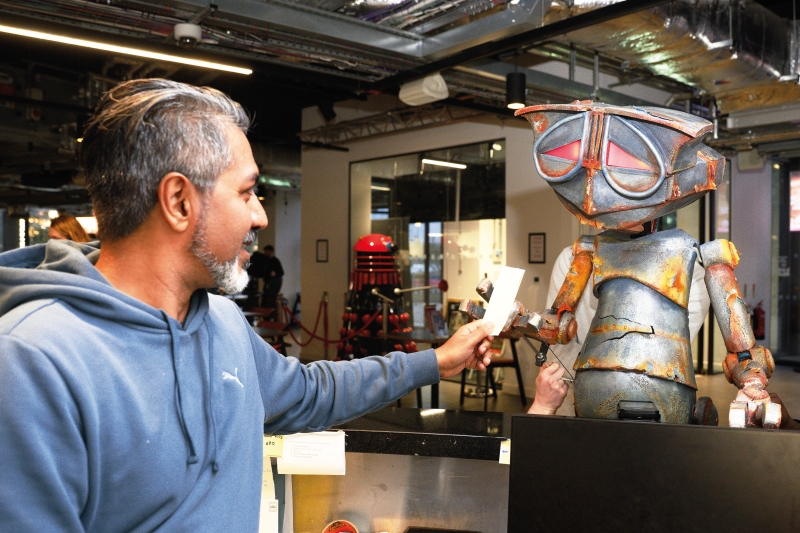
The leap from producing to writing full-time took well over a decade, but when the opportunity arose, it was supplemented with years of exposure, a support system of talented peers and the eagerness of the kid who had always known it was what he was meant to do.
“To sit next to those people, watch them type and offer notes along the way has been an enormous privilege, but some part of me always wanted to be the one typing,” says David. Hearing “people who are the best in the world” recognise his ability and urge him to seize the pen gave him the confidence to make the next step. “I’ve never feared the blank page nor been intimidated by the process of writing because I’d been so envious of it for so long. I could see the life, the process.”
Shifting between mediums has taught him to recognise and distil the most vital parts of any story — not just its basic needs, but what new life it could lead. “As a writer, you’ve got to bring yourself to every job. It’s all you have. That said, you have to balance yourself with the craft and task. The rules are different, depending on who and what, and you have to work with the grain of your source material. But then you have to ask: What makes this work in its prime medium and what does it need in its new medium? That’s where a mixture of craft and personality comes in.”
All but elementary
David’s long-held fascination with the Edwardian mystery thriller and Hornung’s dynamic duo aside, a more recent episode also sparked his plans for The Great Game. “I was at Comic Con some years ago doing a panel when somebody asked, ‘What’s your cosplay of choice?’ and the cast were each going down naming superheroes. And I was panicking as they came up to me because all my answers were white guys. I’m not a white guy, and I should have an answer that’s not a white guy. It made me wonder, ‘Who are the brown superheroes? Why am I not in the Conan Doyle stuff?’”
The South Asian population arrived in Britain as early as the 17th century (if not earlier), establishing a significant social, political and cultural presence that was further consolidated in the 1800s as the nation attracted sailors and aristocrats alike from the subcontinent. Yet, as David notes, “They don’t turn up in Sherlock’s stories, or when they do, they’re the bad guys, like in The Sign of The Four. I wanted to write a story that plays with that notion.”
The Great Game began as a one-pager, produced at the request of David’s agent, to pad out a collection of short stories based on David’s series of Audible originals titled Earworms. “One of them was the opening murder of [the book]. But I honestly didn’t know who had murdered whom or why — I just knew I could write that first sequence!”
The pitch reached Kjersti Egerdahl, editorial director at Amazon Publishing, who was immediately interested in the prospect. Rather than short stories, David says, “What they wanted was for me to write a novel based on one of the two pages they saw. That’s what a great editor does. [Egerdahl] saw the potential in Balvinder before I did.”
Although the plan had been to recreate the innocent Bunny of Hornung’s serials, David quickly realised there was an opportunity for his Balvinder to be a different kind of voice: one that could be a vehicle for his own ruminations on colonialism and Orientalism from a uniquely 20th-century perspective. “I can’t write the original Bunny, who is just tricked by Raffles constantly. But what I can write is someone who begins to bite back at Raffles. Then, there’s a structural balance at play — an insider who’s been given access to every strata of British society, but at the same time isn’t allowed in. That I know how to write. That is an experience I’ve had,” he explains.
4.jpg
Interrogating generic convention is an exercise equal in trust and deceit — guiding readers through a space they think they recognise only to uncover the truth by jostling those assumptions. The Great Game is not stingy about moments that face this reality dead-on. Scenes one would not think twice about suddenly become problematised when a seat at the table or voice in a conversation are simply not a given for our non-white protagonist. At the risk of spoiling the finale, even our sense of right and wrong becomes shockingly and necessarily reoriented by the novel’s end.
“There’s a big meta-question in this book: Can the Edwardian thriller form by having a colonial subject in its presence? Can it be upheld if not everyone playing the game is on the side of the empire? What are the tacit assumptions formed in this genre about good and evil?” David asserts.
With a sizeable volume of projects under his belt, he is no stranger to process: draft, redraft, edit, rewrite, rehearse, repeat. Yet, he confesses, “[This book is] the only thing I’ve ever written that, when I finished it, I was sad. Normally, particularly in TV and theatre, there is no end. There’s no space for sadness because there’s no finality. But this time, when I wrote the last words on the last page, I was saying goodbye to living in Balvinder’s head — at least for a while. And I cried a little, I said, ‘Goodbye Bal, I’ll miss you’.”
The door will not be closed forever though, David hints. “I think Bal is going to do things. He has a future. This book was, in its own way, pretty ambitious, and with the help of some very good editors and readers, I think I got there. Already I can see what I can do in the next one, that can be a bit more ambitious. Who knows whether I will get there!”
'The Great Game' was launched on July 14. Order the book here.
This article first appeared on July 13, 2026 in The Edge Malaysia.