

Bernhard was awarded the title of master watchmaker in 1984 (All photos: Lederer Timepieces)
Bernhard Lederer does not need prompting to recount how he became a master watchmaker — he senses the table’s curiosity and welcomes it with evident delight.
At an intimate lunch hosted by Sincere Fine Watches in Kuala Lumpur, the German horologist can hardly contain his eagerness as he dives into the intricate details of his cutting-edge movements and his eponymous brand, Lederer Timepieces, between pausing to take bites of his meal. He even attempts to transform his bowls and saucers into a makeshift tourbillon diagram for the audience’s edification — but the props fail him and he soon reverts to hand gestures.
Like his watches, Bernhard is driven by escapements, the mechanism within a movement that allows the device to keep time by regulating the release of energy, giving every timepiece its essential ticking sound. Though the self-described “bad school student” initially harboured dreams of engineering planes, reading a book on watches at 17 instantly changed the course of his ambitions.
“In this story, the author was explaining how his dad owned several pocket watches. He would wind one up and, without letting the son see which it was, put it to his ear and ask him to identify the one in his hand,” reminisces Bernhard. The writer’s superfluous poetry in describing each escapement’s sound compelled the young Bernhard to go about flea markets winding up pocket watches just to listen and investigate whether there was truly a difference. “And when you do this for a few months, you catch a virus, and you can never get rid of it,” the now-expert grins, equating this crucial mechanism to the timepiece’s beating heart.
awarderer.jpg

Lederer is most well known for having claimed the GPHG Innovation Prize in 2021 with the release of the Central Impulse Chronometer (CIC), and 2024 Chronometry Prize with its Triple Certified Observatory Chronometer — the first wristwatch ever to be awarded chronometer certifications from Glashütte, Geneva and Besançon, as well as COSC. The brand was also recently inducted into the Fondation de la Haute Horlogerie. But to truly appreciate the exceptional engineering within each ticker, Bernhard insists on going 300 years into the past, to the theory that inspired him and millions of watchmakers the world over: Abraham-Louis Breguet’s natural escapement.
During Breguet’s time, chronometer escapements were accurate but fragile. The legendary horologer theorised it would be possible to marry the perfect timekeeping of a detent with the solidity of a lever by mirroring them against each other, such that each would give impulse to the balance alternatingly.
“When I studied this idea for the first time, I was blown away. I got goosebumps. I thought, ‘What a crazy, superb idea!’ Nowhere was written the fact that this concept never actually worked,” says Bernhard. Breguet’s construction required eight times the energy output to accelerate the mass of the additional escape wheels and gears — the common 32-hour power reserve would have been reduced to a meagre four. Even contemporary executions with better materials could not overcome the fundamental physics issue of energy consumption, he notes.
“It took 200 years until [British watchmaker] George Daniels studied Breguet’s work and proposed a very simple alternative: Why try to turn four wheels on one movement, when you can have two movements with one escape wheel each?” His correction became known as the independent dual wheel escapement, employing twice as many barrels, gear trains, escape wheels and remontoires. Daniels’ Space Traveller 1 and 2 pocket watches from the 1980s were his only timepieces to be powered by this movement, and he declared it was so difficult to make that it could never fit a wristwatch.
“This was the statement that later triggered me to say, ‘Let’s see if that’s really true’,” explains Bernhard. “I need this challenge, to make something for the sake of making. I’m not as fascinated by working, but if there is a provocation, then I get up.”
cic_39.jpg

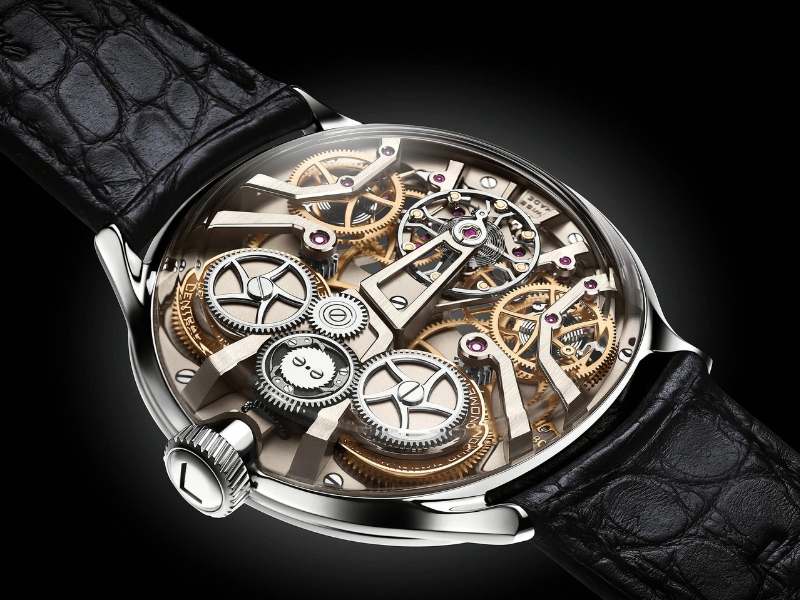
His quest to transform Daniels’ invention into a wrist-wearable version spanned over 10 years, culminating in the award-winning patented dual detent escapement found in the CIC, capable of delivering direct, alternating, backlash-free impulses. One is instantly struck, if not purely by the near perfection of its precision performance, then by the calibre’s distinct visual identity, the splendour of its two independent gear trains and hypnotically pulsing remontoires, accentuated by the deeply satisfying ticking rhythm. This piece, originally crafted in 44mm, now also comes in a more elegant 39mm model, with dials in Silver, Racing Green, Deep Blue and Black Rhodium.
This escapement was not simply an exercise in miniaturisation, but required a complete change of the movement’s geometries, particularly with guaranteeing the correct position of the lever pallets and adjusting the orientation of the triangular stones to levels of exactitude that were unattainable in Daniels’ day. Bernhard also had to account for the dramatic increase in speed and the harsher transfer of energy that came with increasing the frequency from two to three hertz.
Every aspect of this sophisticated piece’s design has been thoughtfully formulated to shed light on the star of the show — its caseback, framed with a domed sapphire, reveals the majestic choreography of the calibre to its full extent, such that the case itself does not encroach upon the metallic scenery. In front, two subdials hold a twin seconds display, with each hand running counter to the other as a constant reference to the double movements. The extraordinary creation is the first instalment of Lederer’s Master of Escapements series to be released over the coming years.
4.jpg
Bernhard is also keen to share his insights on the landscape of contemporary calibres, especially those of larger players that have chosen to venture into the amazing world of unique escapements. Interesting developments such as Girard-Perregaux’s Neo Constant Escapement, Ulysse Nardin’s Freak and most recently Rolex’s Dynapulse are exciting portents that big brands are looking to offer collectors something truly special.
Having apprenticed at the private Wuppertal Clock and Watch Museum, Bernhard was exposed early to a wide range of escapements from across horological history. Compared to the monotony of those on the current market, he laments: “There is no choice, no beauty like all those fantastic developments in the past. My idea behind this [Master of Escapements] collection is to re-engineer technically or historically outstanding escapements to be worn daily on the wrist, to make them visible and therefore able to be appreciated by enthusiasts.”
Bernhard’s work is as much a matter of attaining fantastic feats of innovation by stretching the capabilities of modern tools and knowledge as it is a love letter to the entire historic, mechanical and even aesthetic legacy of escapements within the horological canon. They embody a singular dedication to what came before and what can yet be achieved — and with the independent brand’s 40th anniversary next year, the master himself happily promises there is plenty to look forward to. The newly unveiled CIC 39mm Longitude, for example, is a successor to the Triple Certified Observatory Chronometer, now infused with the intrepid spirit of sailors and maritime navigation. This ocean-worthy marvel, limited to 24 pieces, is available in both sleek white and cobalt blue dials adorned with a small seconds subdial between 6 and 9 o’clock.
This article first appeared on July 28, 2025 in The Edge Malaysia.