
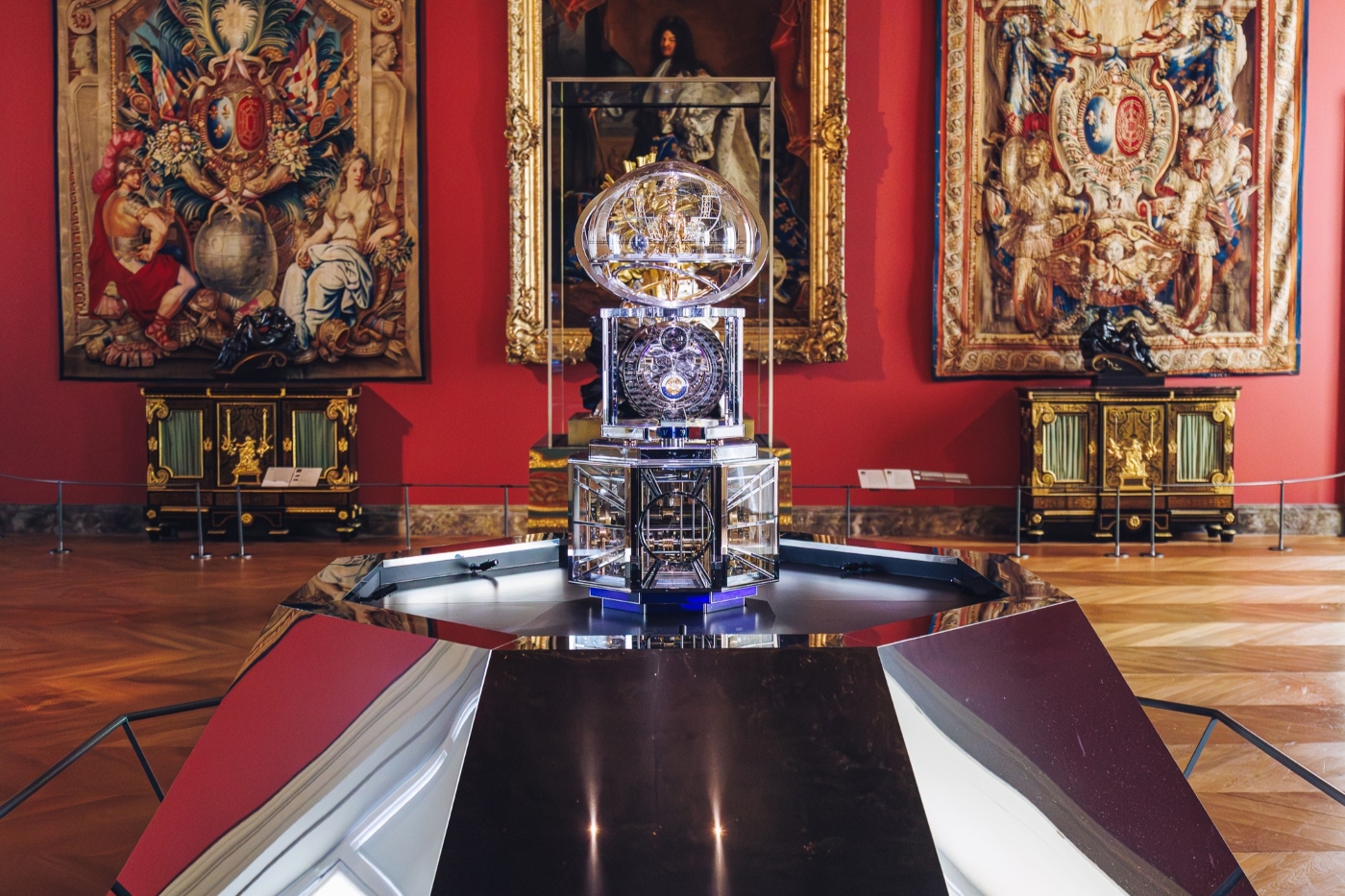
La Quête du Temps displayed as the centrepiece of the Louvre’s Mécaniques d’Art exhibition (Photo: Stephane Sby Balmy)
The early morning rays refracted through the glass panels of the Louvre’s Pyramid, casting a grid of diamonds that stretched over its underground lobby. On a typical day, this area would be flooded with aesthetes and tourists, the majority of whom would make a beeline to hold the gaze of the Mona Lisa or admire the splendour of Venus de Milo. However, on Sept 16, the eve of Vacheron Constantin’s 270th anniversary, the atriums stood empty. A reverent silence hung in the hall towards the Sully Wing, broken only by the echoing footsteps of our small band of journalists.
Standing proudly in the centre of Room 602 was La Quête du Temps, a mechanical masterpiece that commemorates the maison’s significant milestone. Created to honour the legacy of astronomers, scientists and watchmakers who first unlocked the secrets of timekeeping, the monumental structure embodies humanity’s understanding of the cosmos through high artistry. It integrates an astronomical clock with an automaton over three tiers, debuting a new functioning horological complication between the mechanisms.
The project — spearheaded by master automata designer and builder François Junod, CEO and creative director of clockmaking house L’Epée 1839 Arnaud Nicolas, Vacheron Constantin’s senior designer of Les Cabinotiers Alexia Steunou and special development project manager Luc de Siebenthal — united almost 100 master watchmakers, artisans, designers, engineers and astronomers in a shared pursuit to build a horological wonder the world has never seen. The object’s moniker aptly depicts their steadfast spirit over the seven years of its creation. Translated, the name means “the quest of time”.
vc270thd2_0070_c_stephane_sby_balmy_1.jpg

Perched on top of the clock is a gilded figure dubbed the Astronomer. At rest, it takes on a solemn countenance with its arms by its side, while its face and palms incline towards the sky. It appears as if it is standing in surrender, assuming a posture likened to a yielding to something greater than itself. A prior conversation with Steunou revealed that the androgynous form was inspired by the beings in Arthur C Clarke’s science fiction novel The City and the Stars. And Junod, the king of automatons who sculpted the Astronomer and wired its mechanisms, admitted it was his most difficult undertaking to date.
When activated, the Astronomer performs three sequences over a 1½-minute choreography. A tingling melody, produced by French musician Woodkid using the metallophone and Wah-Wah tube, indicated the show was about to start. Upon waking from slumber, the Astronomer looked at its surroundings and made a sweeping gesture towards the day and night symbols at its feet, followed by the retrograde moon before returning to its original position.
In the second act, the right arm prompted viewers to gaze at the celestial vault painted on the dome and paused briefly on Polaris, the North Star. Then, the left arm pointed ahead to Vega, the second-brightest star in the Northern Hemisphere. The final sequence saw both arms raised to indicate the hour and minutes on suspended 3D-printed titanium scales. Here, the numerals are arranged randomly rather than sequentially, so a different motion is offered even if only a short time has elapsed between activations.
The Astronomer can be set 24 hours in advance and is capable of performing a total of 144 gestures. To achieve the latter, a mechanism comprising 158 cams was developed and linked to the clock via a mechanical memory. This is one of eight patent applications filed for the automaton, which includes the articulation system for its head and the Wah-Wah musical tone. Seven other patent applications were filed for the watchmaking innovations.
_nz90013.jpg
The 3D retrograde moon and dome are notable features as well. Precise to 110 years, the moon phase houses a barrel within the sphere to keep it running smoothly during its 29.5-day cycle. The dome is cut below the centre and hand-painted with the constellations that appeared above Geneva on Vacheron Constantin’s founding day on Sept 17, 1755, identified with the help of the Geneva Observatory. Only one producer — an American introduced to Nicolas through Nasa — was willing to take up the challenge to manufacture it.
La Quête du Temps is exhaustively decorated from top to bottom. Incorporated into the massive astronomical clock at the centre, a large tourbillon animates at 12 o’clock while a 24-hour display embellished with a sun and moon appliqué occupies the 6 o’clock. Hand-engraved in haut relief, the latter is set on a disc that is expertly hand-guillochéd with a sunray pattern. The maison’s signature retrograde display is, of course, featured throughout. More engraving work appears on the reverse side of the clock, where the celestial vault of the Northern Hemisphere is ringed by the 12 zodiac signs.
Similarly striking are the plaques of old-mine lapis lazuli on the two-level plinth. The planets in our solar system and stars are embedded in the vivid blue through exquisite stone marquetry. Supporting it all is a base in rock crystal, which endows the timepiece with a visual lightness despite its 250kg weight, and transparency to highlight the automaton’s complex viscera.
Pulling our noses back from the finer details and taking in the entire creation, one cannot help but find La Quête du Temps fitting right at home in Room 602. Until Nov 12, it stands as the centrepiece of the Louvre’s Mécaniques d’Art exhibition, where 10 other works from the museum’s collection, dating from Antiquity to the Age of Enlightenment, are being showcased.
One of the key highlights was the grand Pendule La Création du Monde set behind La Quête du Temps. The astronomical clock presented to Louis XV in 1754 was restored with the support of the Swiss maison in 2016.
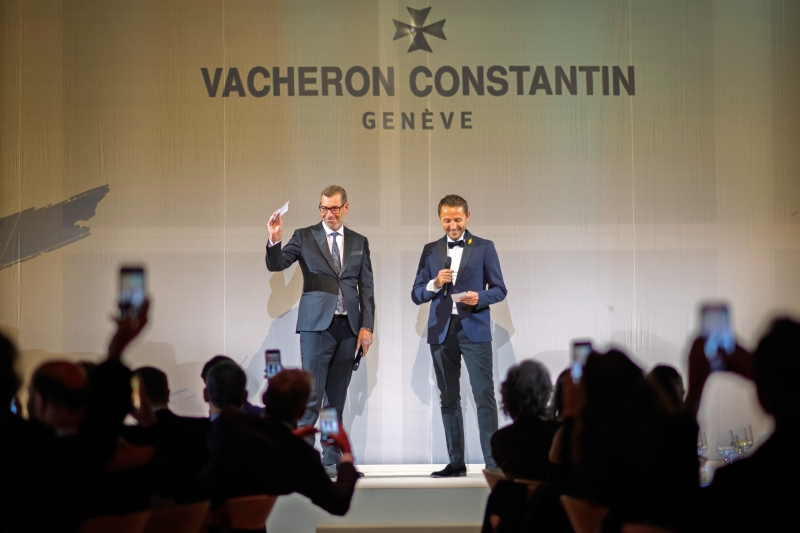
“We worked with Vacheron Constantin to choose from among the thousands of objects we keep in the Louvre,” said the director of the museum’s decorative arts department Olivier Gabet at a panel later that day. Moderated by historian Nicholas Foulkes, the talk also featured Christophe Galfard, an astrophysicist who was a protégé of Stephen Hawking, and the maison’s style and heritage director Christian Selmoni.
presentation.jpg

“Some objects are related to time in terms of technology and aesthetics. If you look closely at the exhibition, there is always a connection. It was very important to not only choose from the collection in my own department but also those of my colleagues, such as the Egyptian department,” Gabet continued.
For example, two fragments of water clocks — one in basalt dating back to the period of Alexander the Great and one in grandiorite dating back to the Ptolemaic period — discovered in Tell el-Yahudiyeh are also included in the exhibit.
Vacheron Constantin’s artistic and cultural partnership with the Louvre began in 2019 as part of the maison’s commitment to the preservation and transmission of heritage. Asked about the role of museums in keeping knowledge alive, Gabet said: “Museums can be for education, but certainly not for instruction. We’re all facing an issue of a fragmented world, but a museum is a place for everyone. We’re here to help people understand where we are in the world and our history.”
Held at Le Meurice’s Salon Pompadour, a truly iconic Parisian venue where generations have celebrated — including Pablo Picasso, who held his wedding to Olga Khokhlova there in 1918 — the panel discussion explored the concept of time across art, history and astronomy, in addition to horology.
“We’re in a time in which everything has to be new, where by tomorrow, it won’t be anymore, and a week later it’s obsolete,” said Selmoni. “So I think [La Quête du Temps] is a kind of parallax in the sense that it’s bringing back the notion that you have to give time to time. In other words, it’s worth considering how important the work of the hands is. I call it the intelligence of the hands. We want to give credit back to hard work. In order to realise something exceptional, you need to work and wait. It’s shedding light on an idea that is very much in contrast with the acceleration of time we experience today.”
_nz98919.jpg
But what is the meaning of time from a scientific perspective? Galfard offered an analogy for easier understanding: “Picture in your mind a star with planets around it. Then picture hundreds and billions of stars becoming a galaxy within one little disc. Add other discs everywhere until you see a whole universe in your mind. Now, get rid of everything until it’s completely empty.
“There are many possibilities of what you’re seeing right now in your head. You might have something like an empty box, with limits that are either close or far away. Here’s the question: Where do you put time in that universe? I’m pretty sure, if you’re like me, you would put time outside that box. In other words, if you had a clock, you would compare the time on the clock to the time outside the universe. It is a time that is universal that would work everywhere. This vision is what Newton gave us.
“But at the beginning of the 20th century, a man came about and said this clock can be brought back inside and we can put it at different points in our universe. And the funny thing is that it won’t tick at the same rate even though they’re all identical. It will depend on what is nearby. For example, if you have a planet, it will tick differently than if there was no planet. Time, the way we understand it today, is not universal. The guy who gave us this idea is Albert Einstein.
“What I just told you is the basics of the most beautiful theory we have today to understand our universe. What is absolutely crazy about it is that since time is not the same everywhere and since planets and stars can move, time will move with them as well, which means time can change. And the moment something can be changed, it means it can have a history. So time indeed has a history and it hasn’t ticked the same way forever.”
vacheron_constantin_la_quete_du_temps_louvre_2025_by_short_cut_-_sai_-_stephane_ait_ouarab_2025.jpg

Later in the evening, a private celebration was held at the Louvre. Dressed to the nines, Vacheron Constantin’s guests were ushered into Cours Marly to dine among the marble sculptures of graceful divinities that once adorned royal gardens and squares. From the spirited Horses of Marly to Apollo’s pursuit of Daphné, tales of ancient mythology came alive in the moonlight streaming through the expansive glass roofs. That night, horology served as the meeting point for history, art and culture.
We left Paris for Geneva the next day for another evening of revelry at Vacheron Constantin’s manufacture. In the birthplace of watchmaking, one is left to ponder the constellations hanging in the heavens. During the Geneva Observatory’s research for La Quête du Temps, the astronomers found that 270 years ago at 10am, Venus, Mars, Jupiter and Saturn were visible above the city, with a rare conjunction between the sun and Jupiter.
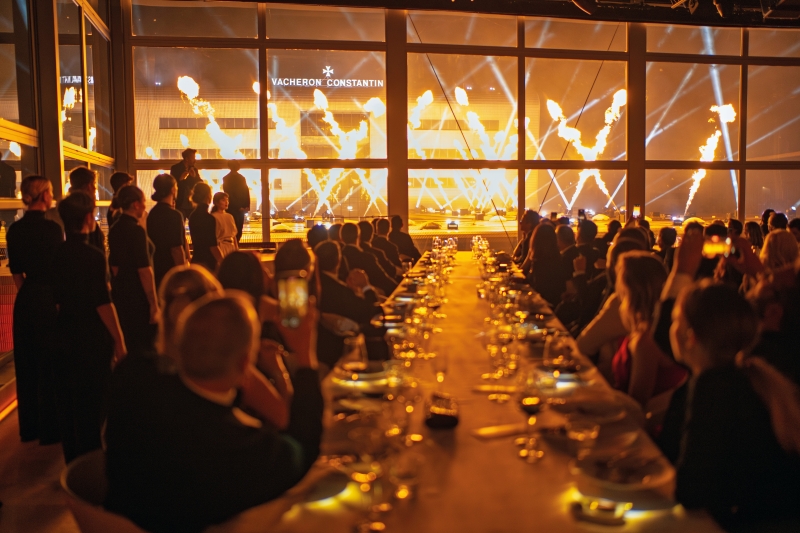
The maison transformed its headquarters and crafted an experiential tour like no other. Guests were led through its watchmaking and decorating floors, where specialists and experts would demonstrate their craft alongside a musician or dancer, bringing to mind once again the convergence of horology and art. A special pavilion was erected to host the gathering and it was here that the maison’s Métiers d’Art Tribute to The Quest of Time was showcased.
watch.jpg
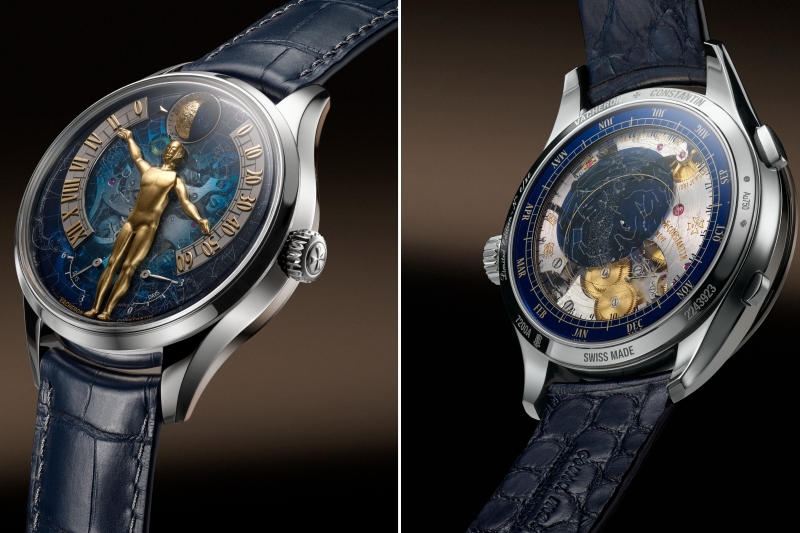
Inspired by the clock, the double-sided wristwatch features four patent applications and the new manually wound manufacture movement, Calibre 3670. Limited to 20 pieces, it boasts its own Astronomer, whose arms glide along two retrograde displays. There are two modes: “active” and “standby”. In the former, the arms function like hands on a standard watch dial, while in the latter, the Astronomer stands still as time runs invisibly in the background. They raise to indicate the time when the pusher at 10 o’clock is manually activated.
This figure, too, is set against a background portraying the starry map on the day of the maison’s founding. A spherical 3D precision moon display shows the exact age of the lunar planet in relation to its phase. The reverse dial depicts a sky chart that tracks the constellations in real time and displays the sidereal day.
From beginning to end, Vacheron Constantin has demonstrated yet again that nothing is done short of extraordinary and great effort. The pride and emotion in which new projects are executed and celebrated reflect its motto, once extracted from a letter between the founders and now reaffirmed by current CEO Laurent Perves: “Is it always possible to do better? Is it always possible to be amazed? Undeniably.”
This article first appeared on Oct 6, 2025 in The Edge Malaysia.