
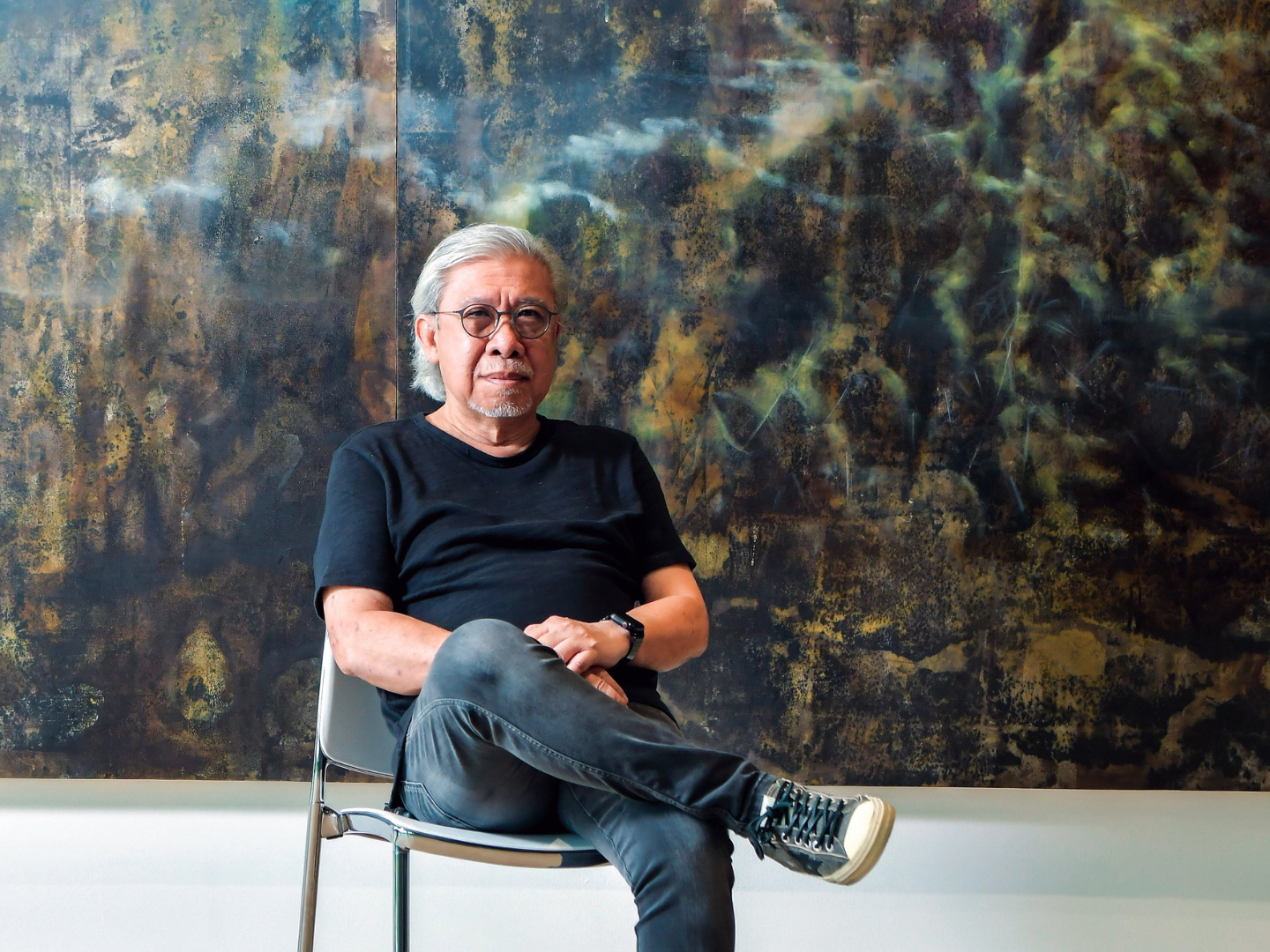
Wong first ventured in to collecting art to fill the walls of his plastic surgery clinic but discovered that art and aesthetics would prove a lifetime 'obsession' (Photo: Zahid Izzani/ The Edge)
Since the 1990s, a significant shift in contemporary art has occurred in Malaysia and Southeast Asia. In tandem with that, the Steve Wong Art Collection has emerged as one of the most comprehensive collections, representing the cultural and economic transformation of the country and region, while showing how such an archive can be viewed as a historical record.
Few beyond a select circle of serious connoisseurs — including institutions such as the Metropolitan Museum of Art in New York and the National Gallery of Australia — would have recognised the name Subhash Kapoor. Owner of the boutique gallery with the quaint, if somewhat banal, name Art of the Past on Madison Avenue, the apparently affable Kapoor gained recent notoriety as the “idol thief”, after being implicated in the looting and smuggling of vast antiquities from India — a criminal enterprise that runs into the billions of dollars today. What differentiates the Kapoor saga from other instances of looters and smugglers, who mutilated Buddha statue arms and heads at antiquarian sites, is the story of a growing obsession with the knowledge of art and archaeology, coupled with a fervent love of the classical object.
Starting out as a mere speculator and thief, Kapoor found himself increasingly drawn to the nature of the stolen objects themselves — their history and craftsmanship. Reading voluminously and collecting countless books, the idol thief, by the time of his capture, had also become a serious student and commentator on antiquities and their artistic value.
While artists are often prone to procrastination and bouts of idleness, the serious art collector is marked by avidity and the inveterate. Much like the writer and mad book collector Jorge Luis Borges, there is often little distinction between “collecting” and what might be called “aesthetic hoarding”. As Borges once said: “Whenever I walk into a bookstore, I see a book I simply must buy, only to realise I already have several copies of the same ones at home. Still, I buy it anyway.”
Radical shift
Apart from the economic tilt towards Asia in the 1990s, the structural experiments of earlier, more turbulent decades in Malaysia seemed to be yielding tangible outcomes, particularly through increased prosperity, wider economic distribution, and most importantly, greater social mobility.
In the world of art and culture — once almost the sole domain of institutions serving as institutional collectors — an obvious democratisation of collecting began to take shape, accompanied by the emergence of a viable art market. So confident was the “emerging industry” that then-prime minister Tun Dr Mahathir Mohamad, in outlining his Vision 2020 agenda, even envisioned Kuala Lumpur as a principal cultural centre for Asia — a mark of the nation’s seemingly unflappable success and the sophistication that would come with it.
By then, the notion of positioning a nation as a cultural centre had already taken root further south, in the Lion City, where former prime minister Lee Kuan Yew sought to shape the country as a centre of art, culture and recreation, playing an important role in the economic diversification of contemporary Singapore.
Proliferation of the arts
1.png
In Malaysia, art collecting had once been largely the privilege of state institutions such as the National Art Gallery; academic bodies including the Universiti Malaya under the leadership of then vice-chancellor Ungku Abdul Aziz Ungku Abdul Hamid; or institutions such as Bank Negara Malaysia; and Permodalan Nasional Berhad.
The 1990s also witnessed a relentless proliferation of the arts, with the rise of newly formed theatre groups like the Instant Café Theatre. The continued invigoration of established organisations such as Five Arts Centre saw productions being staged with such frequency that a repertory culture seemed to be taking shape. Newspapers began dedicating whole pages to reviews and publicity, while financial support and sponsorships for the scene grew steadily. This expansion was most evident in the establishment of numerous private galleries.
The increase of private gallery, individual collectors, and its corollary, the art market, ushered in a new generation of artists that marked a departure — in theme, approach and attitude — from the formative generation of Malaysian artists. Ahmad Zakii Anwar, Jalaini Abu Hassan (Jai), Chang Fee Ming, artists of the Mata Hati collective, principal female artists such as Umibaizurah Mahir Ismail and later, the likes of Ivan Lam, Anurendra Jegadeva and Nadiah Bamadhaj gained prominence during this period. Galleries such as Valentine Willie Fine Art, Taksu and Wei-Ling helped cultivate a serious commercial culture around art collecting.
A mainstay of the many exhibitions of the time — fuelled and full of energy — was Dr Steve Wong. A prominent plastic surgeon who ventured into art collecting initially to fill the walls of his clinic, he soon discovered that art, and by extension, aesthetic, would prove a lifetime “obsession”.
In conversation, Wong begins at the end: “If I had to live my life all over again, I would probably be an architect, designer or something of that nature rather than a plastic surgeon. I think I entered the field as a second choice, though I often joke with friends and tell them that plastic surgery has also to do — a little bit — with the arts. I tell people I am in fact a sculptor, except I cannot sign my work and it does not last long.”
The admirer of “beautiful things” never harboured any ambitions to become a painter himself. “When I was young, I was very much into fashion and rock music. It was the Swinging Sixties, after all. I was in the UK for many years and had access to all the museums too. Even then, I never thought of being a painter, although I did, in fact, create one large painting in my life.
“Back in London, there was a huge blank wall where I lived. As a student, I didn’t have much money and remember going to Bayswater to buy some cheap paintings. But, confronted daily by this big space, I thought: ‘Hell, if Jackson Pollock can do it, then I can do it too. I bought three canvases, splashed paint across them, and they became my feature wall for several years. To this day, that remains the only artwork I have ever made.”
Growing with artists
2.png
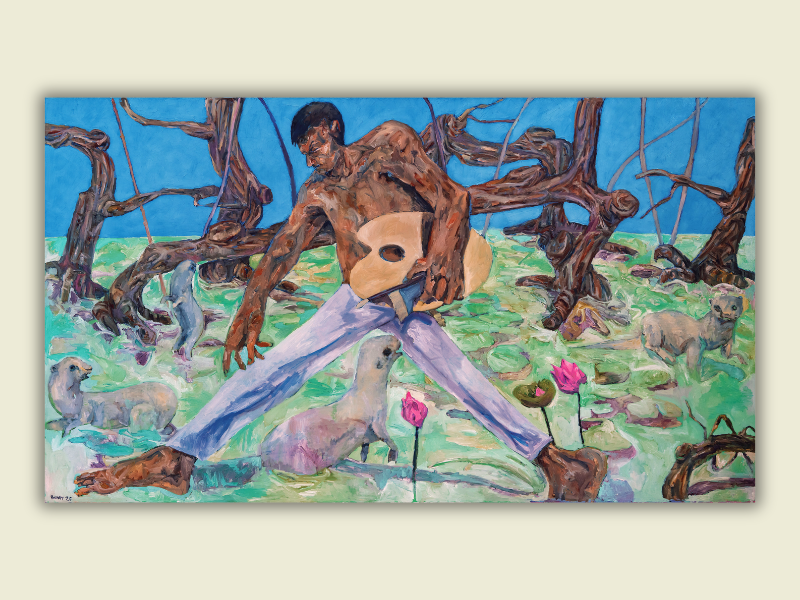
One of the hallmarks of Wong’s approach to collecting has been a faithful commitment to artists who have grown in importance and stature. Works such as the first Smokers Series of Zakii, early pieces by Jai, and more recently, the subversive paintings of the late Samsudin Wahab and Fadhilah Karim, reflect his dedication to watching an artist’s development over time.
“I have collected Malaysian art from the mid-1990s until today. I can say I have most of the good artists in my collection, including some who later gave up on art altogether. I enjoy discovering younger talents and following their progress. That, you could say, is my style of collecting. Some, like Zakii, I have followed for more than 20 years, [and] the same goes for Jai, until a point comes when their work becomes too expensive or no longer resonate with me. There are quite a number of artists from whom I have collected at least 20 to 30 pieces,” he adds.
“In a way, it is like having a baby. You follow an artist and watch them grow. Many of the contemporary artists of the 1990s have ‘grown up’ in the way that we ourselves have grown older also.”
Wong’s collection remains highly eclectic. Asked whether he possesses perhaps an eccentric aesthetic sensibility, he responds: “I do not have a fixed preference. It could be minimalist, abstract, figurative, political, anything goes that catches my eye… I think it could be innate. I would like to think I have an eye for art, which is why I have often said in previous interviews that I do not quite listen to the advice of consultants. I make up my mind on what I like. It’s very hard to say what my taste is — it is very broad; anything that appeals to me visually. My affinity is mainly for paintings. I love sculpture and installations as well but storage limitation have meant that I focus mainly on paintings.
“Instinct, intuition — whatever you choose to call it — but I think first, you must have an eye for it. Then again, what I like, a lot of people don’t. Most would probably never buy what I have in the house.”
A centrepiece within Wong’s private gallery is a resplendent woven tapestry unfurling from the ceiling by Balinese artist Citra Sasmita, signalling his growing interest in the landscape of Southeast Asian art. It furthers reflecting the eclectic nature of the collection or the simple principle of “liking what I see”.
New exhibition
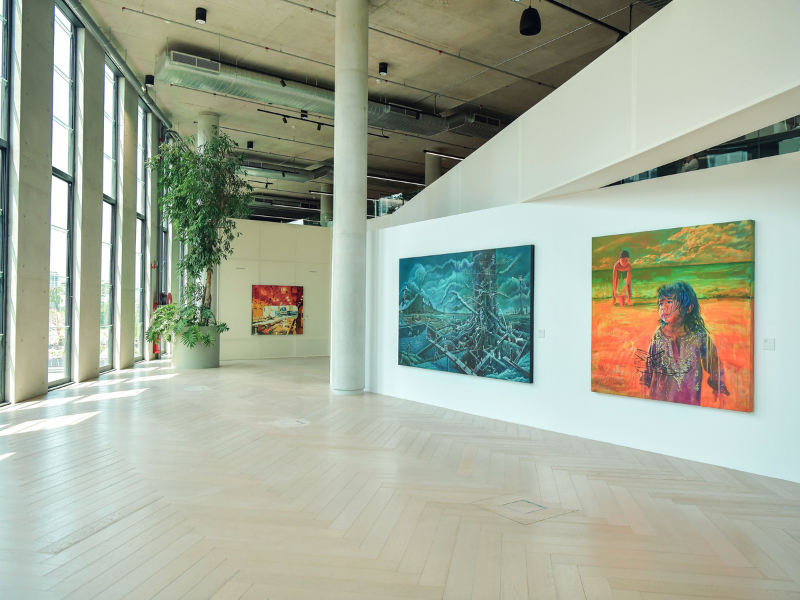
Presently, works from the Steve Wong Art Collection are on display at the GDP Campus in Damansara Heights, KL, through an exhibition called Memory’s Landscape. It follows another equally acclaimed presentation held at the same venue in 2024, Not Just in Black and White.
Space and showing have become increasingly central to Wong’s purpose. “Art should be shown. It should not be kept away,” he insists. “But I am a hoarder — I have over 1,000 pieces. I have two private spaces, and much of the work remains unseen. I’ve been trying to organise exhibitions elsewhere but the right venues are limited. GDP is an amazing space and one that suits me. When I stage an exhibition, I would like to have ‘oomph’, so I need big walls and rooms that are spread out and not clustered together. At the moment, there are very few options that can accommodate that. If such a location existed, I would be more than happy to display there. I also like big works. And for those, you truly need scale.”
With a collection of such breadth, one wonders what remains of a “daily conversation” with the works themselves?
“I don’t have a daily conversation with the art because I don’t see everything all the time. When I visit the galleries, it is not necessarily to look at the works but water the plants. Much of it remains in storage and only resurfaces until it’s shown. Collecting is an obsession, and although you try to restrain yourself…”
Suggestions of institutional collaboration with the Steve Wong Art Collection are met with a sharp response: “That’s a question you need to ask the institutions,” remarks Wong.
Over the past three decades, Malaysian art has diversified and undergone a profound transformation, much of its trajectory recorded only in scatterings and without a real hand truly keeping a finger on the pulse of its evolution. When that history is eventually assembled, examined and properly documented, Wong’s collection will likely stand as one of its most important points of reference.
What, then, becomes of a collection of this scale? Wong concedes, “Yes, that’s my headache — and my family’s as well. At the moment, I don’t want to think about it. People suggest I build a museum for it or give it away. But really, it’s not as simple as that.”
Again and again, the dilemma reverts to institutional roles and the “cultural sophistication” a former prime minister once invoked in his grand vision. It is where the vibrant private meets the depressed public to grapple with the foundational questions that come with all collecting — even of the “hoarding” kind. What is it all for, really?
'Memory’s Landscape' is at the GDP Campus, KL, until Aug 2. Open on Fridays, Saturdays and Sundays, from 10am to 6pm. For more information, contact (603) 2095 9500.
This article first appeared on June 1, 2026 in The Edge Malaysia.