
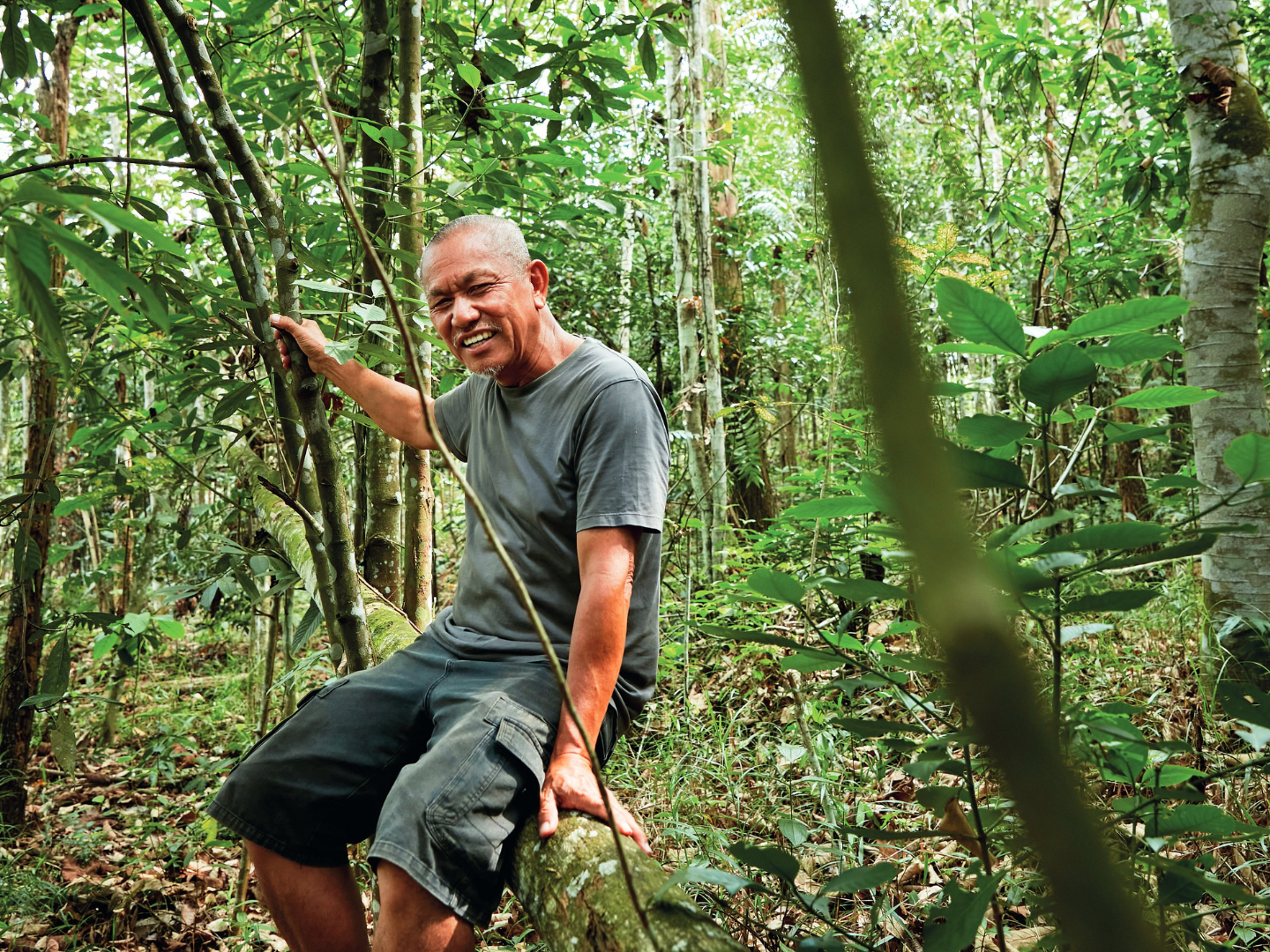
Alongside a team, Lok has slowly transformed his land into a verdant forest rich with endangered plants and wildlife (Photo: SooPhye)
David Lok remembers his childhood in Seremban like it was just yesterday. Growing up in a township next to a forest and sprawling rubber estates meant endless adventures awaited just outside his door. While children today look forward to sleeping in and endless screen time during the school holidays, he would wake at the crack of dawn, his arms covered in goosebumps from the chill of morning dew. He would put on his trusty cardigan and, together with his ragtag group of friends, run headlong into the woods.
“We climbed waterfalls and swam in rivers. We would play the entire day and only come back in the evening. We were just in nature all the time,” he reminisces with a smile.
Food was plentiful beneath the canopy, with branches and bushes laden with wild berries. One of Lok’s earliest memories is leaning against a large trunk, devouring freshly plucked fruit. With his toes dug into the warm earth, he watched as trails of sticky juice ran down his fingers. For a six-year-old, it felt like the closest thing to heaven. Now 66 and semi-retired, he still believes that to be true.
“I’m fortunate to have lived at a time when you could go to the river and find food in less than five minutes. We’d stand by the bank and fill our bamboo basket with freshwater shrimp. No fire? No problem. Five claps between our palms and voilà — shrimp sashimi. We’d also bring a small plastic packet of soy sauce and fish for ikan keli. A quick barbecue and lunch was done. The forest provided everything,” he says.
Putting down roots
Purchasing and reforesting 50 acres of land was not part of the retirement plan, but life certainly had its whims and fancies. Located in Bandar Baru Sungai Buaya, northwest of Rawang, Selangor, the parcel was privately acquired in 2023 with partner Moo Fook Yow.
A bumpy 4x4 ride leads to the grounds, cutting through the scarred and barren terrain of a neighbouring 700-acre project being developed into a massive furniture hub. “Isn’t it ironic?” Lok remarks. “I’m doing conservation while they’re cutting down trees. But maybe that’s life — it’s all about opposites.”
The first sign of our destination is a sweet, citrusy scent drifting from a grove of some 3,000 calamansi trees tightly ornamented with plump fruit in all manner of green and orange. The orchard tells only part of the land’s story. Deep in the woods, weathered stumps offer glimpses of a once-lucrative oil palm plantation, while a scattering of ancient giants hints at its origins as a virgin jungle predating human intervention. After years of neglect, a secondary forest eventually swallowed the landscape.
The fast-growing acacia was one of the pioneering species that colonised it. These potent, natural nitrogen-fixers not only self-fertilise but also enrich the surrounding soil. “Essentially, they fix the land, making it fertile again, then they die,” Lok explains, adding that their life span is around two to three decades. “In fact, almost 90% of them have died. I call it the acacia graveyard.”
2.png
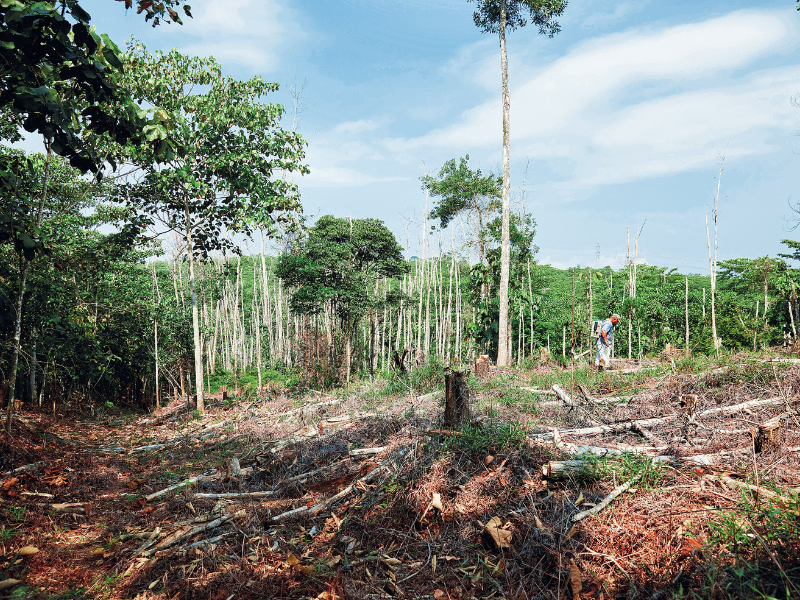
So why on earth would anyone volunteer — sorry, spend almost half a million ringgit — to inherit a forest choked with tripwire vines, rotting logs and thorny thickets? Surely, a bonsai garden would seem a far more reasonable pursuit for one’s golden years. Lok lets out a belly laugh before gathering his thoughts.
“The forest acts like the skin of Mother Earth. When we cut down trees, we’re actually skinning her, leaving her wounds bare. For me, the healing process is paramount. With climate change rampant, everyone is talking about it, but all I wanted to do was to try and heal her,” he explains.
“Many of us think reforestation should be done by the government, but that’s a misconception. So this is my attempt at starting a small-scale project to create awareness of how we can privately help the Earth recover. ”
In other words, Lok is taking matters into his own hands, although he has a few blueprints to follow, citing palm oil industry veteran Henry Sackville Barlow’s Genting Tea Estate and architect Hijjas Kasturi’s Rimbun Dahan as examples.
Call of the wild
Despite some initial teething problems with the Selangor State Forestry Department — the previous owner held a permit exclusively for sandalwood — Lok eventually found success in securing approval to cultivate native forest species. Free Tree Society, an environmental non-profit organisation, stepped in with 400 saplings to kick-start his journey. He wasted no time putting them in the ground, the first being a merbau, a symbolic gesture in tribute to our national tree. As he familiarised himself with the hills and bends, gradually learning the lay of the land, he began purchasing and planting even more.
“Along the way, I found out we have over 30 critically endangered species. Since I was already planting, I might as well try to alleviate the issue and grow those too. I now have 22 of them. It’s very important that we create a live gene bank for the future generation. I want this forest to be like an arboretum,” he says, stressing our dire need for more carbon sinks and wildlife sanctuaries to combat environmental collapse.
To ensure he sows the right seeds, Lok collaborates closely with the Forest Research Institute Malaysia (FRIM), but his research does not stop there. He often consults the Orang Asli, valuing their traditional wisdom and directly supporting their livelihoods by purchasing native saplings from their nurseries. Before long, he hired a small team from the indigenous community to cover more ground. By last year, their collective efforts had pushed that initial number to an impressive 6,500 trees. Today, the tally is close to 10,000.
1.png
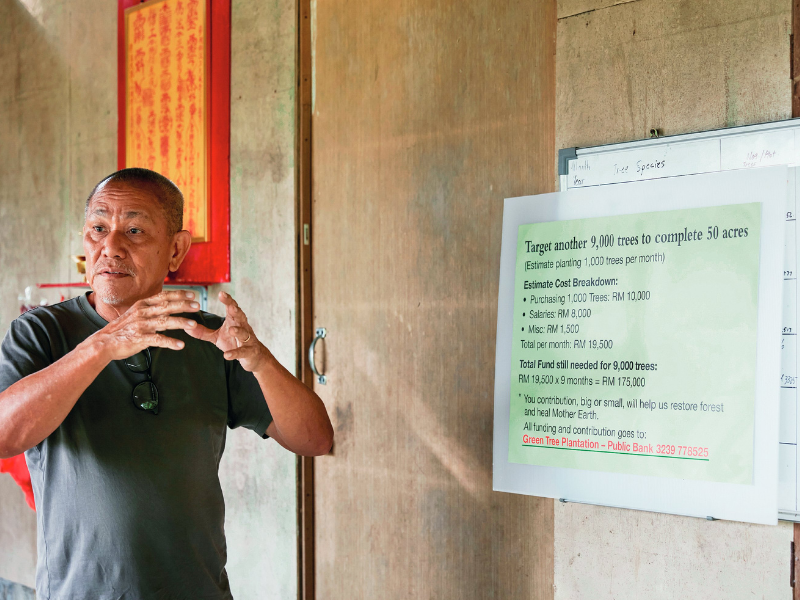
Slowly but surely, Lok’s land transformed, with its creepers cropped and shoots springing towards the sky. Many are bearing fruit, attracting curious animals to the grounds. “You know what? We saw a mother and baby tapir the other day. They were just roaming around and came up to say hi,” he beams. Having said that, there were also less amiable visitors.
“There are earthworms in the soil and we use fertiliser salts. Guess what? The wild boars love it. I would plant 10 saplings and they’d dig up eight. It went on for a while until I decided to put some logs around the plant to see if it would deter the boars — and it worked!” he exclaims, proving that trial and error is often the best teacher. Other times, he just had to roll with the punches.
When the neighbouring developer cleared the adjacent land for construction, they smothered a river that drained the valley on Lok’s property. Left with nowhere to go, the water backed up over time, swelling into a massive lake nearly four storeys deep that drowned and killed roughly 1,000 trees. Refusing to give up, he channelled his optimism into action and began carving out a new riverbed to guide the excess water towards deeper parts of the land. With a rivulet now running through the soil, his team can much more easily hydrate the young shoots that need a little extra TLC.
Lok can now effortlessly identify every sapling on sight, pointing out their distinct characteristics as he treks through his self-declared playground. It is an oasis rich in natural phytoncides — the airborne wellness compounds that dedicated forest bathers gladly travel far and wide to find.
“I was ecstatic to have rescued 250 chengal trees,” he says, gesturing towards a plant with a red tag, an indicator of its endangered status. “There are not many left in Malaysia. We also have resak or vatica yeechongii, discovered by the late professor Chan Yee Chong, who worked at FRIM. Merawan kanching is probably the rarest. It’s believed that we only have around 400 of these left in our country. There are 105 here and we want to continue populating them.”
Lok half-jokingly says this is also a strategic move to safeguard the forest’s future. “These 50 acres will contain Malaysia’s most critically endangered species. So when my 30-year lease is up, those trees will act as a deterrent to anyone looking to clear the land.”
Emotional ties
3.png
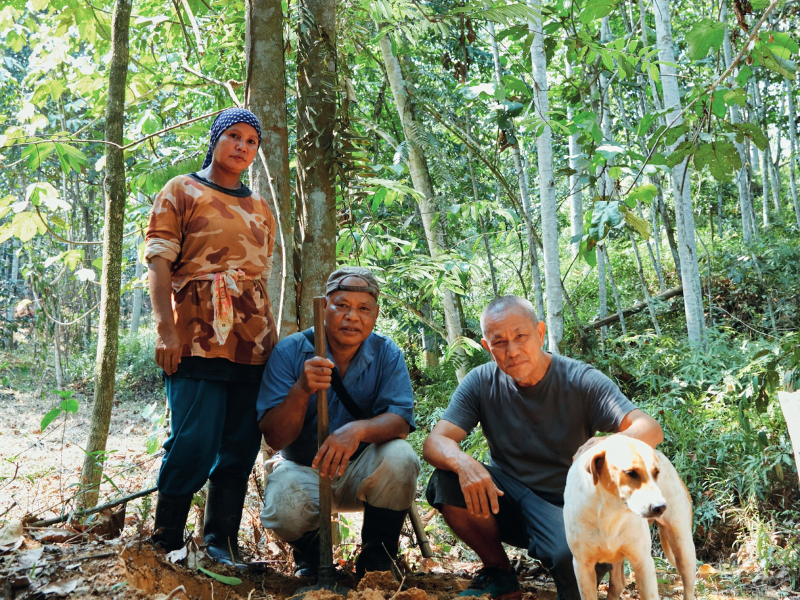
Two hounds, Spotty and Chocolate, trail closely at Lok’s heels, occasionally darting off to investigate a fresh scent. Meanwhile, an older dog, comically named Ah Sou, prefers a less active post, staying behind to “guard” the cabin by the calamansi grove. The steady crunch of leaves stops as Lok leaps onto a fallen trunk. Balancing with his arms outstretched, he places one foot carefully in front of the other before dropping into a seat with his legs dangling in the air. “I’m having fun. Every day, I’m running around, visiting the nurseries, buying saplings, talking to people and creating awareness. It’s like a full-time job,” says the sprightly sexagenarian.
Lok regularly plays host to corporate teams and students, inviting them to get their hands dirty with tree planting while teaching them the principles of forest stewardship. A frequent speaker at universities and environmental summits, he is also actively seeking collaborators to compile his field data into a practical blueprint for future conservationists. Yet, it is his photography workshops that bring him the most joy — a time when he can weave together his love of nature and the craft he had practised professionally for more than four decades.
Although a capable team now runs Studio DL, his company in Petaling Jaya, Lok occasionally returns to the field for loyal and VIP clients who will settle for no other lensman. He describes himself as an emotional photographer, having honed his skills while studying in the UK and the US, where he fully immersed his mind in the expansive worlds of art and philosophy. He recalls a class he took on colour photography and his lecturer rejecting all his work for months with nary a comment other than a cold, “No colour”.
“I was the top student in my last class, but here I was struggling so much. One day, I was hanging out at the South End and I heard the Boston City Council was planning to demolish Chinatown. I decided I had to document it. So I brought my box camera and outdated film and took some pictures. I submitted it without much thought and my lecturer finally said ‘You have colour today’,” the amused Lok shares.
“I learnt that it was never about colour. It was about emotion, how I felt and the thoughts I needed to project into my shots. After that, all my work was about capturing emotion. I became sensitive to things like body language and space.”
For anyone who was a lovesick teen in the early 2000s, the poster of Yasmin Ahmad’s Sepet is likely etched into memory. “I was one of the first few to watch the movie because she wanted me to shoot the poster,” he says, adding that he also played Jimmy, one of the thugs in the film.
“That scene of Orked and Jason sitting at the edge of the lake was so beautiful. It encapsulated the feeling of the entire film. We had a simple set-up behind my studio. The actors came early in the morning at 7:30am and we were done by 8am. We got the shot very quickly because they had so much chemistry,” he recounts. He continued working with the late director, capturing some of her most poignant Petronas ads.
Down to earth
4.png
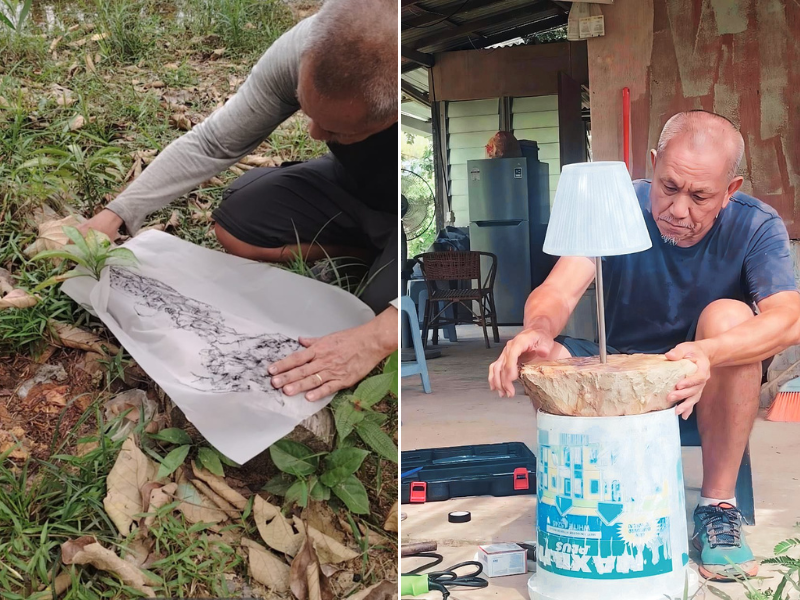
In the beginning, Lok planned to finance new saplings by selling prints of the green landscape. Yet, for a long time, the perfect shot remained elusive, leaving him deeply unsatisfied with his work. “I kept wondering why. I could feel the emotions, but just couldn’t capture them. Then, one day, I was walking in the forest and the word ‘osmosis’ came to mind. I took it as a message that the forest wanted to participate, that it wanted to do the communicating itself. So I took tracing paper and traced the bark, the ground, everything.
“It was raining one time and there was a lot of mud. So I collected some and prepared a tub of clean water with photographic paper underneath. Then, I poured the mud into the water and flashed it to capture the texture and patterns. What I saw left me speechless.”
Twenty years ago, Lok landed a project documenting historic Malay woodcarving artefacts for a book. What he thought would be a week-long affair turned into six years. “I was like a man possessed. I travelled in and out of Kelantan, Terengganu, Kedah, Pattani and Songkhla. Malay woodcarving opened up an enormous world of ecology, nature, philosophy and religion. It was like discovering a treasure trove.”
He revered the late Nik Rashiddin Nik Hussein, whose carving of Burung Gagak Sura, a symbolic ceremonial bird, appears on the cover of Spirit of Wood, authored by Farish A Noor and Eddin Khoo. “I learnt so much from him; how the great artisans of the past could tap into a flow state when carving, acting as conduits of nature.”
Lok was stunned when that image of mud churning in water perfectly mimicked the form of the mystical bird he had photographed so many years before. This special print, alongside works made through rain, leaves, light and other natural elements, will be showcased at Forest Speaks, an exhibition to be held from June 26 to July 5 at his studio.
This will be the first fundraising initiative under Green Tree Plantation, the conservation organisation Lok started with Moo back in 2023 to drive this community-led approach to forest restoration. Alongside the artworks, a selection of furniture repurposed from naturally fallen acacia wood will also be available for purchase. If you must know, he actually built these pieces himself, having learnt a thing or two from his blacksmith father and worked in construction prior to photography. All the proceeds will support the planting and nurturing of another 8,500 trees.
“You know, when I started doing this, my friends called me crazy, saying all my money and efforts would be wasted after the lease was up. But I said it’s okay. Thirty years is a long time. I want to create awareness now. Maybe in 20 years, someone will think this is important and will want to do the same. But for now, I will plant first. I want to show people that we can do this. Many of them have called me a fool, but so yan yao so fook, you know?” he says. In Cantonese, it means fortune favours the fool.
Investing in a project whose fruits he may never witness in his lifetime requires a great leap of faith indeed. But Lok just laughs it off. “I’ve decided to live until 120 so I can see my trees.”
'Forest Speaks' will run from June 26 to July 5, 9:30am to 6:30pm at Studio DL, 7, Jalan PJU 3/50, Sunway Damansara, Petaling Jaya.
This article first appeared on June 22, 2026 in The Edge Malaysia.